
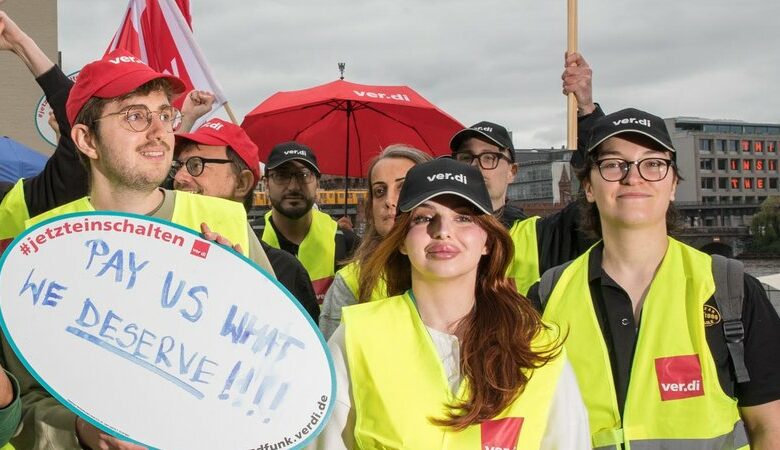
TikTok workers in Berlin Strike for Social Collective Agreement
Berlin – Employees of TikTok in Berlin have initiated a strike demanding a social collective agreement, highlighting concerns over job security, platform quality, and the broader social impact of artificial intelligence. The strike, organized by the ver.di union, began several days ago and is scheduled too continue with a rally planned before the labor court on September 25th at 9:30 a.m. at Magdeburger Platz 1, 10785 Berlin.
ver.di is calling for a social collective agreement that includes severance payments equivalent to three years’ salary and an extension of notice periods to twelve months. The union argues that TikTokS potential relocation of work to cheaper service providers threatens not only jobs but also the platform’s quality and safety. Lucas Kentel, deputy head of ver.di Berlin-Brandenburg’s Medien department, stated the core issue is holding tech giants accountable for the social consequences of AI implementation.
A town hall meeting was held as part of the strike, bringing together employees, experts, and politicians to discuss the social consequences of digitization and potential political solutions. Participants emphasized the need for platforms like TikTok to take obligation for their impact. Christoph-Schmitz-Dethlefsen of ver.di’s federal executive board stressed the social and legal obligations of TikTok, advocating for platform regulation to ensure adherence to legal frameworks regarding personal rights, youth protection, hate speech prevention, and essential rights. He noted AI could assist in content moderation but requires continued human oversight.
The discussion featured Cansel Kiziltepe (SPD), Berlin’s Work senator; Sonja Lemke (Left Party), a digital politician and member of the Bundestag; carmela Salim Wagner from the Wheat tree Institute; Moritz Altenried from HU Berlin; and a tiktok analyst named Lena, who shared insights into her work.
Kiziltepe praised the work of the TikTok works council and encouraged tech workers across the industry to organize. While acknowledging the importance of the Digital Services Act (DSA) and the upcoming KI Act, she stated they are insufficient to regulate global rights and called for increased pressure at the European level. She also revealed she has formally requested TikTok’s managing director, Thomas Wlazik, to return to negotiations with ver.di. Lemke echoed concerns about implementation challenges within the DSA, noting that further details need to be defined.
Moritz Altenried argued that automation doesn’t eliminate work but redistributes it, characterizing this shift as a “class struggle from above.” He emphasized the need for both social and political pressure to achieve improvements in labor law, democratic processes, and regulatory frameworks.
Lena, a striking TikTok employee, urged other tech workers to consider organizing, stating, ”Think about how you want to organize yourselves. That gives a lot of strength.”
