
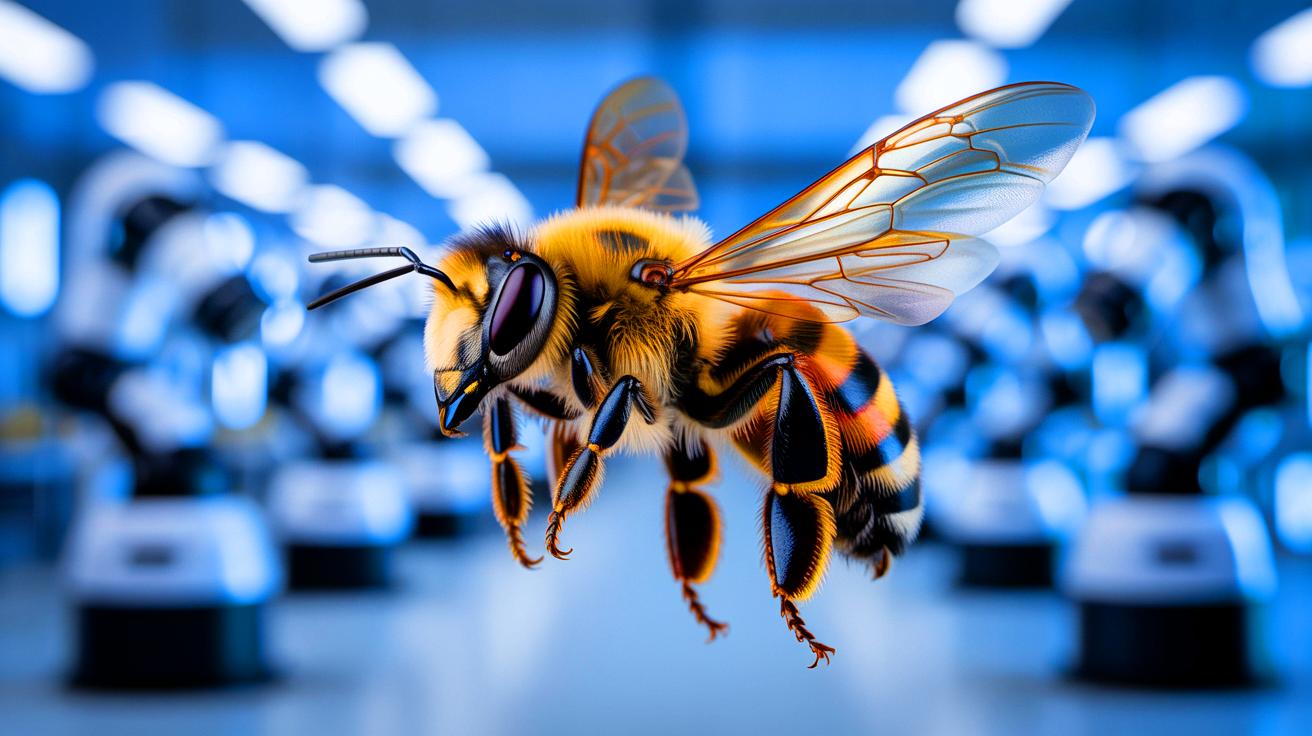
Bee Brains Buzz with Secrets for Smarter Robots
Tiny insects inspire AI breakthroughs in efficiency and agility.
Insights gleaned from the study of bee behavior are fueling innovation in artificial intelligence and robotics. Scientists are discovering that these creatures, despite their minuscule brains, possess sophisticated cognitive abilities that can be replicated in machines.
Decoding Bee Flight Patterns
Bees use intricate flight patterns to sharpen their visual perception. This dynamic interaction enables them to recognize complex visual cues with accuracy, distinguishing between different flowers and even human faces. Researchers at the University of Sheffield have modeled these behaviors, gaining insights applicable to AI development.
Professor James Marshall from the University of Sheffield emphasizes the potential of small, efficient systems for advanced tasks. Emulating natural processes could lead to robots that adapt to their environments more effectively.
Rethinking Neural Computation
Studies at the University of London challenge the notion that brain size dictates intelligence. Analysis of bee brains reveals that even microbrains can perform complex visual discrimination tasks. This discovery highlights neural efficiency as a key factor in intelligence.
According to Professor Lars Chittka, intelligence stems from optimized neural computations, not merely brain size. This idea is inspiring AI development focused on efficient processing strategies. New research indicates that optimized algorithms inspired by bee brains could improve AI processing speeds by up to 30% (Science Advances, 2024).
Robotic Pollinators Take Flight
MIT researchers are developing robotic insects that mimic bee agility for agricultural applications. These tiny pollinators, capable of complex aerial maneuvers, can assist in artificial pollination, especially in controlled environments.
By replicating natural flight patterns, these robotic insects perform precise pollination, increasing agricultural yields while reducing environmental impact. This synergy between biology and technology provides sustainable solutions for food production.
The Future is Buzzing
The study of bee cognition is shaping the future of AI and robotics. By understanding the efficient information processing of these insects, researchers can develop technologies that emulate natural strategies, leading to smarter and more adaptable machines.
