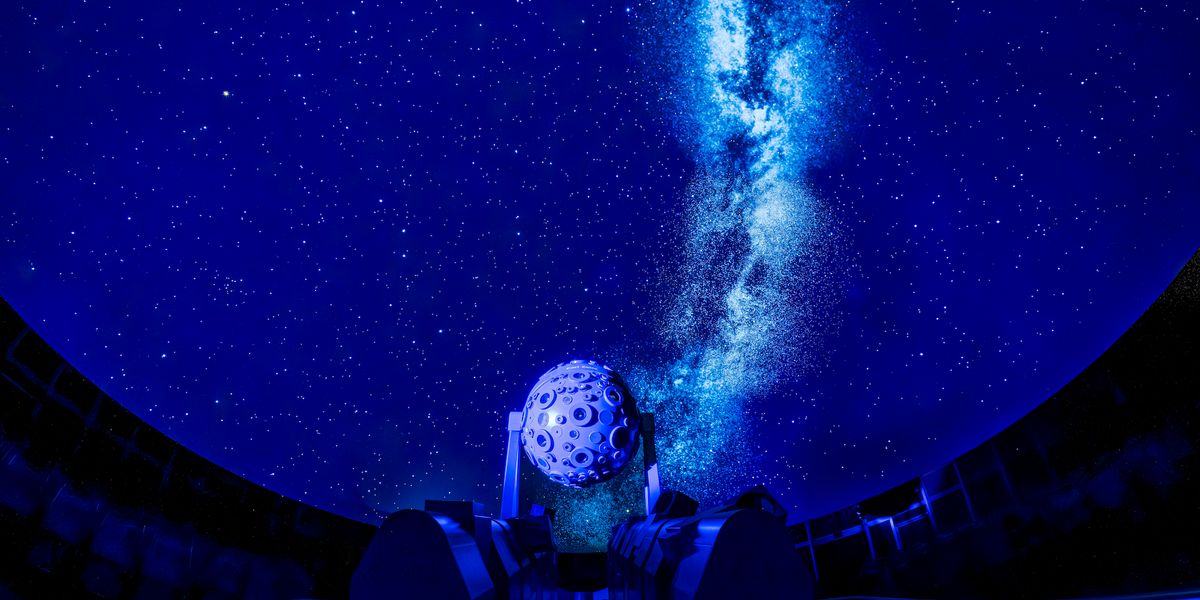
The World’s Oldest Operating Projection Planetarium Reopened Its Dome on 15 July 2026
The world’s oldest operating projection planetarium reopened its dome on 15 July 2026, after a €7.5 million overhaul that replaced a 1980s projection screen with one engineered to vanish from view.
Zeiss-Planetarium Jena now runs eight 4K projectors onto a 23-metre surface that had to clear a protected, bomb-damaged shell by millimetres.
The Tech TL;DR:
- Jena’s new Micro Pro dome screen cuts perforation size to 0.8 mm, keeping holes from swallowing pixels in an 8K-to-10K projection chain.
- The install avoided direct-view LED because the building’s protected geodesic dome could not carry the weight or accept attachments.
- An unexploded incendiary bomb from March 1945 left the dome geometry warped, forcing the new screen structure to be fitted around the original steelwork.
The venue, which opened on 18 July 1926 as the world’s first projection planetarium, shut for just over six months of work and welcomed more than 170,000 visitors in 2024 alone, blooloop reported. Its brief was blunt: audiences raised on 4K home displays and soundbars will not sit under a surface that shows its seams.
“People at home have become accustomed to 4K displays and sophisticated home audio,” Stefan Harnisch, director of Zeiss-Planetarium Jena, told blooloop. “I cannot show them something in a public planetarium that looks inferior to what they have in their living rooms.”
A screen that had to disappear
The old screen was a grid of perforated aluminium panels installed in the mid-1980s, laid in overlapping horizontal rows. Four decades of wear left dents and dirt, and its joints and fasteners had grown more visible as projection resolution climbed — the effect the industry calls the “igloo effect.” It shows up worst on uniform colours, where there are no highlights to hide the seams.
“The most difficult image to show clearly on a perforated screen is one that is a solid colour,” Ronald Potgieter, project and quality control manager at screen manufacturer Endurescreens, told blooloop. “With a solid colour, there are no contrasting highlights and shadows to hide defects.”
The fix is arithmetic. Traditional perforated planetarium screens use 1.5 mm holes spaced 3.2 mm apart, opening roughly 23% of the surface — plenty of room for sound to escape from the speakers behind it, but enough missing aluminium to eat light and shadow pixels. At 8K aggregate resolution, pixel pitch shrinks below the hole spacing, so the perforations start competing with the image.
| Screen spec | Conventional perforated | Jena’s Micro Pro |
|---|---|---|
| Hole diameter | 1.5 mm | 0.8 mm |
| Hole spacing | 3.2 mm | 1.6 mm |
| Open area | ~23% | 16% |
The smaller perforation pitch means the holes sit below the pixel size of the new projection chain — eight Zeiss Velvet 4K projectors delivering 8K to 10K across the dome with a stated native contrast ratio of 5,000,000:1, according to blooloop. “The perforation diameter is smaller than the projected pixel pitch of an 8K system,” Potgieter said. “The holes no longer compete with the pixels.”
Why LED lost the tender
Direct-view LED domes are the industry’s current object of desire: brighter, sharper, higher contrast. Endurescreens’ director of global sales, Lei Yin, framed the trade-off operators actually face — cost, power draw, cooling, pixel maintenance, and above all weight.
“Their first thought is often to look at LED because it is undeniably bright and sharp,” Yin told blooloop. “But the real questions operators have to ask are very practical: can they actually afford it, and can their building physically carry the weight?”
Jena’s building answered that question for them. Bauersfeld’s geodesic dome — predating Buckminster Fuller’s popularisation of the form — spans 25 metres in slender steel rods under a sprayed concrete shell just six centimetres thick. It is a protected historic civil-engineering landmark.
No drilling, no welding, no attachments. Endurescreens built an independent framework on dedicated structural feet around the auditorium perimeter, carrying the 23-metre screen’s load without touching the shell. Some rival bidders proposed shrinking the dome to make room; Jena refused.
Projection also keeps the acoustics intact. Sound passes through the perforations to a concealed HOLOPLOT X1 and X2 Matrix Array behind the screen — a system WSDG, the acoustic consultancy appointed by the Ernst-Abbe-Stiftung in June 2025, validated for use with the Micro Pro surface, Live Design reported.
WSDG measured the empty auditorium in October 2025 before the interior was stripped, then modelled the concave dome’s tendency to focus sound energy at focal points. A sound-absorptive overlay behind the screen controls reverberation while keeping the surface a uniform white field.
“In concave spaces, reflections can be directed towards focal points and sound energy can become concentrated in particular areas,” WSDG acoustic consultant Tobias Behrens told Live Design. “Our task was to control those geometric effects while retaining a reverberation time appropriate for planetarium shows, film screenings, educational programs and live events.”
The bomb under the dome
Removing the old aluminium panels in January 2026 exposed the complication no tender had anticipated.
“We had to make precise adjustments just to ensure it all cleared,” Harnisch said.
For integrators and venue engineers, the lesson is that heritage AV work is a surveying problem before it is a display problem: laser-scanning the existing geometry, modelling tolerances, and specifying the screen and projector chain as one coupled system. Harnisch put the coupling plainly.
“It is like a marriage,” he told blooloop. “The projectors and the projection screen depend on one another. The projection screen provides the playground for the projectors. If you have an inferior playground, even the finest projector in the world cannot play properly.”
It is the kind of geometry-and-tolerance problem where specialist AV integration consultancies and structural surveyors earn their fees — the same discipline that governs any retrofit of projection, spatial audio and concealed loudspeaker arrays into a building that cannot be touched.
The contrast ratio Endurescreens claims — perceptual image quality edging toward LED while keeping projection’s structural and acoustic advantages — remains the vendor’s own benchmark, not an independent measurement. What the next decade of dome retrofits adopts, screen or LED, will be decided by buildings like this one: old, protected, and unwilling to carry more weight.
“We introduced fulldome technology in 2006, and several other planetariums around the world popped up with the same technology because they saw it here,” Harnisch told blooloop. “Now I hope that we hold the torch way up high, so the industry sees the technology we are using in terms of our projection system, our screen, and our spatial audio.”