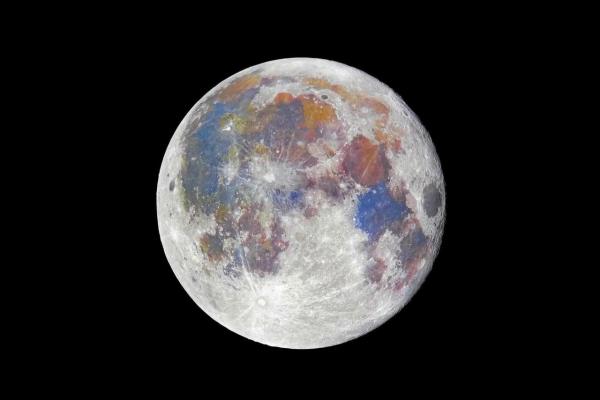
The True Colors of the Moon: Unveiling Its Hidden Vibrant Surface
The crew of NASA’s Artemis II mission has surpassed the previous record for the farthest distance humans have traveled from Earth, a milestone achieved during their current 10-day lunar flyby. As the spacecraft reached this historic distance, the crew captured high-resolution imagery revealing a colorful lunar surface, challenging the traditional perception of the Moon as a monochromatic grey body.
Mineral Composition and Lunar Imagery
The images captured during the mission highlight various colors across the lunar landscape, which astronomical imaging and mission data attribute to the presence of specific minerals. The coloration is linked to the distribution of titanium and iron on the Moon’s surface, providing new visual data on the satellite’s composition from a crewed perspective.
Mission Parameters and Technical Execution
Launched on April 1, 2026, the Artemis II mission utilized the Space Launch System (SLS) rocket to propel the Orion spacecraft on a free-return trajectory around the Moon. The mission serves as the first crewed flight of these deep space capabilities, testing systems required for future lunar landings and eventual missions to Mars.

The crew consists of Commander Reid Wiseman, Pilot Victor Glover, Mission Specialist Christina Koch, and Mission Specialist Jeremy Hansen. The mission includes several critical maneuvers, including a perigee raise burn and a trans-lunar injection, to ensure the spacecraft maintains its course for the lunar encounter.
Operational Milestones
During the flight, the crew conducted a series of tests, including suit demonstrations and correction burns, to verify the functionality of the Orion spacecraft’s life support and navigation systems. Mission Control, communicating via the Capsule Communicator (CAPCOM), noted the significance of the distance record, referencing the previous benchmark set by the Apollo 13 crew.
The Orion spacecraft, which includes the crew module CM-002 and the ESM-2 service module, is designed to sustain the four astronauts throughout the 10-day journey before initiating reentry at speeds of approximately 25,000 mph.
The mission is now proceeding toward the return phase, with a scheduled splashdown target in the Pacific Ocean off the coast of San Diego.