
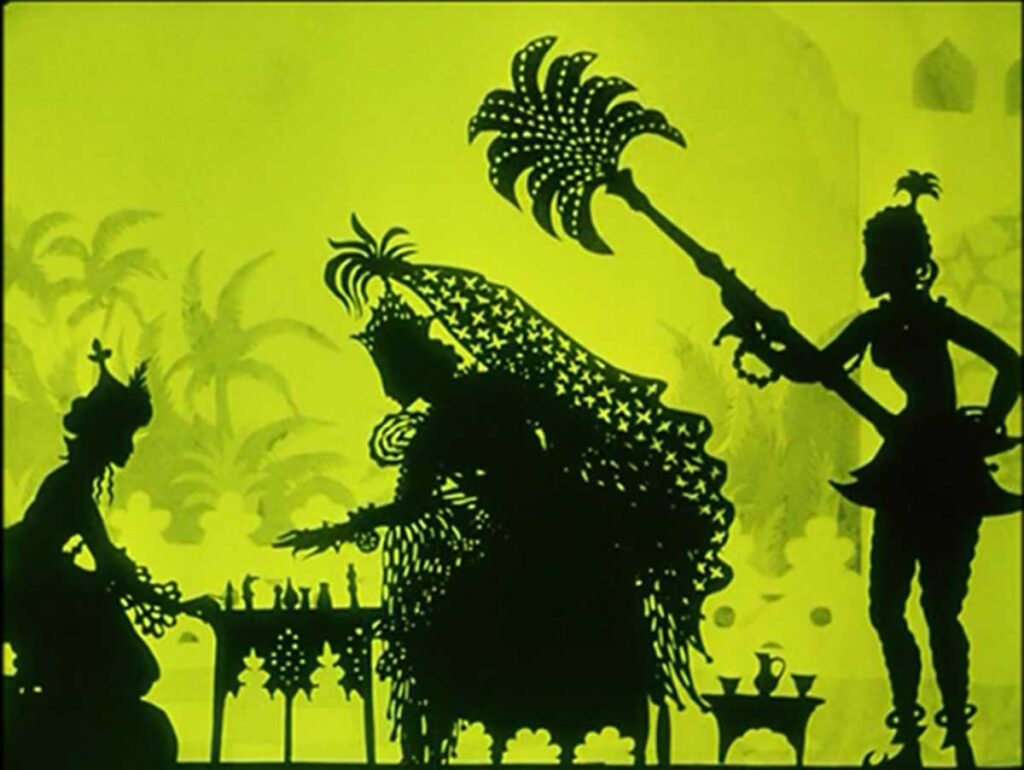
Nearly a century after its debut, the German animated fairytale film The Adventures of Prince Achmed is being recognized as the oldest surviving animated feature film, predating Walt Disney’s Snow White and the Seven Dwarfs by over a decade. The film, created in 1926 by Lotte Reiniger, utilizes a silhouette animation technique, manipulating cardboard cutouts and thin sheets of lead under a camera.
Reiniger’s innovative approach, inspired by Javanese wayang kulit shadow puppet theater and ancient Chinese paper-cutting, involved painstakingly crafting each frame of the 65-minute film. The story draws from tales within One Thousand and One Nights, including “Aladdin,” “Ahmed and Paribanou,” and “The Ebony Horse,” weaving a narrative of a prince’s fantastical journey. The original release featured color tinting, enhancing the visual experience.
While Disney’s Snow White required significant resources and a large team, Prince Achmed was largely the work of one person. Reiniger, who began experimenting with silhouette cutouts as a child, pioneered techniques that would influence generations of animators. She also employed an early form of a multiplane camera, a crucial device in pre-digital animation.
The film’s recent entry into the public domain, as of March 3rd, 2026, is sparking renewed interest in Reiniger’s work. Enthusiasts have been sharing the film online, and screenings, such as one scheduled for London’s Cinema Museum, are bringing attention to her pioneering role in animation history. The screening will be followed by a discussion led by academics from Fantasy-Animation.org.
Reiniger’s career extended beyond Prince Achmed, and included adaptations of classic fairytales like Cinderella and Hansel and Gretel. She later fled Nazi persecution, relocating to London where she created animated advertisements for the British Post Office. Despite her significant contributions, Reiniger’s name has often been overshadowed by the prominence of American animation studios and figures like Disney.
The rediscovery of The Adventures of Prince Achmed highlights the often-overlooked contributions of women to the early history of animation. The film offers a unique aesthetic, distinct from the cel animation that would later dominate the industry, and provides a glimpse into a different approach to storytelling through the medium.
