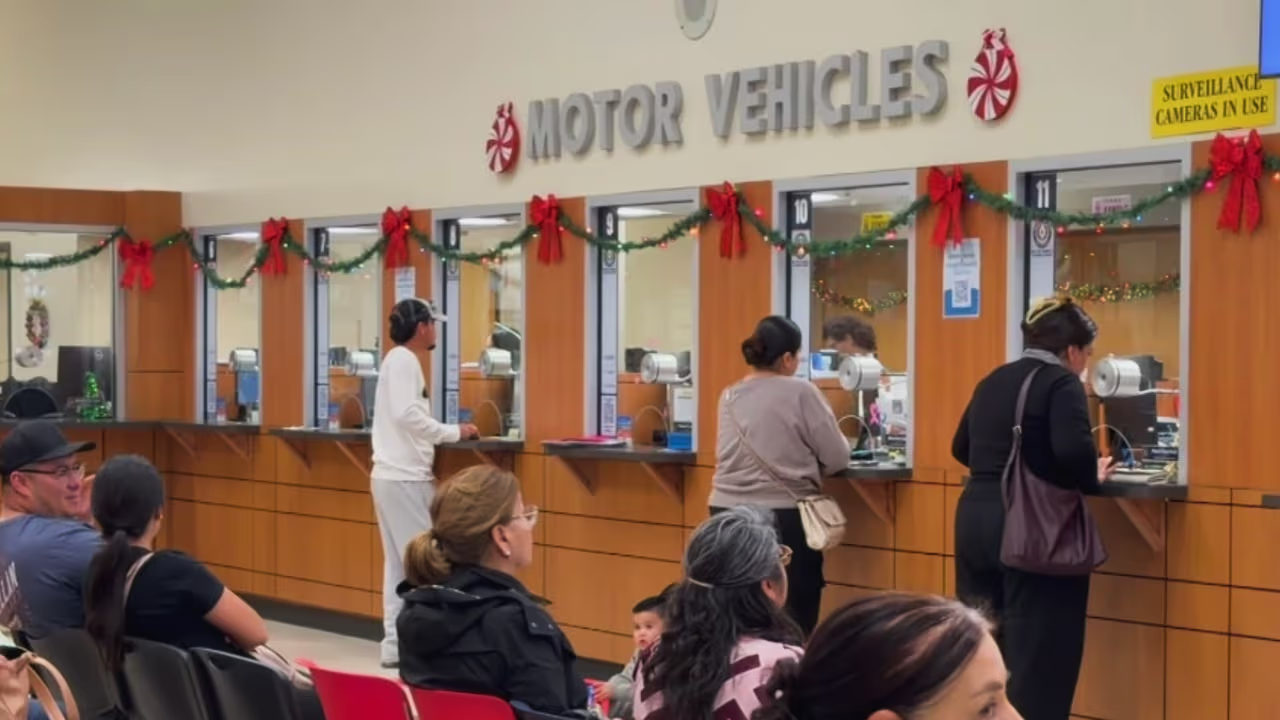
Texas DMV to Require Proof of Legal Status for Vehicle Registration Renewals Starting 2027
Starting Jan. 1, 2027, Texas will require proof of legal presence to renew a vehicle registration, barring undocumented immigrants from the process, according to Lanacion.
The rule has applied to initial registrations since March 5, 2026, La Nación reported. Renewals currently follow the pre-November 2025 standards, but the stricter requirements take effect in January.
Drivers must present one of five document combinations: a REAL ID-compliant license or ID without “limited term” or “temporary” markings; a license or ID from a state that requires proof of legal presence; any state license or ID paired with a U.S. birth certificate, naturalization certificate or citizenship certificate; a valid U.S. passport or a valid foreign passport with an I‑94 form (not reflecting parole only), permanent resident card or immigrant visa; or a Texas handgun license issued by the Department of Public Safety, La Nación reported, citing TxDMV guidance.
| Option | Documents required |
|---|---|
| 1 | REAL ID license/ID without “limited term” or “temporary” markings |
| 5 | Texas handgun license issued by DPS |
The rule does not change identification requirements for obtaining a vehicle title, according to the rule adoption text published by the Texas Secretary of State. TxDMV states that individuals not legally eligible to reside in Texas cannot register vehicles as residents.
“Now what is happening is they are using this state agency to try to enforce immigration law,” state Sen. Juan “Chuy” Hinojosa said, Univision reported. Hinojosa has asked the TxDMV board to reconsider the measure at its Dec. 10 meeting.
“A lot of confusion, a lot of chaos at the DMV office, a lot of fear and more risk,” an unidentified immigrant told Univision.
Many undocumented owners are now registering vehicles in the names of their U.S. citizen children.
County tax assessor-collectors, who process registrations across Texas’s 254 counties, and Democratic lawmakers oppose the change. Advocacy group RAICES warned the measure will create confusion at DMV offices, La Nación reported.
The controversy coincides with expanding immigration enforcement technology. A mobile application used by immigration agents can instantly access phone numbers, addresses, vehicle registrations, immigration records, Medicaid data, criminal histories and biometric information, Univision reported.