Tesla Patent Reveals Hidden Active Wing for Next-Gen Roadster
Tesla Patent Reveals Next-Gen Roadster Active Rear Wing With 700 kg Downforce
A newly published United States Patent and Trademark Office filing reveals that Tesla is developing a sophisticated two-piece active rear wing for its next-generation Roadster, capable of generating up to 700 kg of downforce at top speeds above 100 mph. Published on September 24, 2026, patent application US 2026/0285418 A1 outlines an aerodynamic assembly featuring an integrated leading-edge slat and a dedicated wing controller designed to dynamically shift between slippery road profiles and high-downforce track modes.
The Tech TL;DR:
- The Mechanism: A two-piece active wing featuring a main element and a 3 to 15 mm leading-edge slat, deploying via a four-bar linkage in under three seconds.
- Performance Metrics: Generates up to 700 kg of downforce in high downforce mode at speeds exceeding 100 mph, adding 1,000 drag counts of downforce while utilizing a DRS mode to dump 250 counts of drag.
- Deployment Timeline: Published by the USPTO ahead of Tesla’s scheduled October 1, 2026, Roadster unveiling event in Texas, following initial patent filings handled by inventors David Lemire and James Michael Arthur Crook.
Architectural Breakdown of the Active Aero Assembly
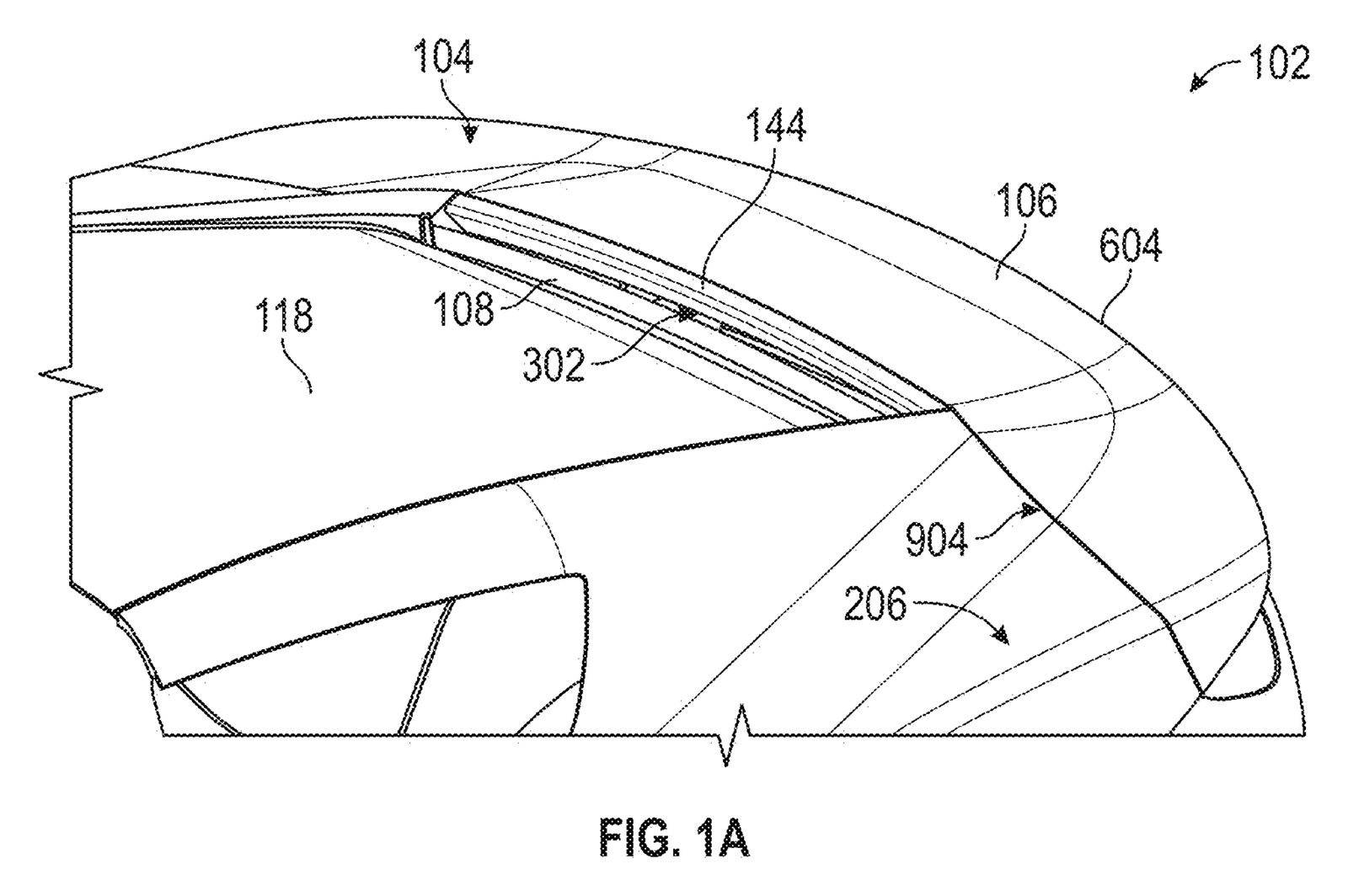
The engineering specifications detailed in patent US 2026/0285418 A1 highlight a departure from passive aerodynamic appendages. Filed in August 2025 as a continuation of an abandoned March 2025 filing by inventors David Lemire and James Michael Arthur Crook, the mechanism remains completely flush with the deck lid during standard transit. In this "road mode," a step in the main element's shape allows it to stow flush alongside a sub-panel hidden slat.
When triggered, the assembly deploys upward and backward via a four-bar linkage system, though the filing also notes alternative designs utilizing linear rails and lead screws. Powered by a dedicated wing controller, the hardware can execute a full deployment from a stowed position in under 3 seconds. The actuator architecture also allows the wing angle to adjust in under a quarter of a second. To optimize power consumption during sustained high-load maneuvers, Tesla specifies non-back-drivable actuators that lock the wing’s position without requiring continuous electrical draw.
Aerodynamic Coefficients and Hypercar-Tier Downforce
By the numbers, the engineering targets place the vehicle firmly in hypercar performance territory. According to the application data, the assembly is rated for “0 kg of downforce in DRS mode, and up to 700 kg of downforce in high downforce mode at top speed,” benchmarked at speeds above 100 mph. For comparison, McLaren’s dedicated track machine, the Senna, generates an 800 kg downforce ceiling.
The aerodynamic trade-offs are managed via explicit drag and downforce counts. Deploying the primary wing element introduces 350 drag counts (0.035 Cd) alongside 1,000 counts of downforce. Rotating the element flat into a Drag Reduction System (DRS) configuration strips away 250 counts of drag on straightaways. The wing controller arbitrates these states autonomously, ingesting real-time telemetry including vehicle speed, longitudinal acceleration, steering angle, brake input, GPS coordinates, and autonomous driving sensor data.
// Conceptual Wing Controller Logic State
if (gps.location == track_circuit) {
    wing.setMode(Mode.TRACK);
} else if (speed > 100 && braking_input > threshold) {
    wing.deployHighDownforce(700_kg);
} else if (acceleration.isStraightaway()) {
    wing.setDRSMode();
} else {
    wing.stowFlush();
}
Safety Protocols and Sensor Integration
Extending a large aerodynamic control surface far behind the rear bumper introduces critical collision risks, particularly regarding cyclists and motorcyclists. To mitigate this hazard, the patent details a dual-layer safety architecture consisting of both mechanical breakaways and predictive sensor intervention.
The mechanical fallback relies on calibrated latches. If an impact exceeds a predetermined force threshold, the assembly yields, folding backward until its trailing edge sits flush with the rear extremity of the bodywork. Concurrently, a predictive retraction system uses the vehicle's sensor suite—listed in the patent text as cameras, radar, and lidar—to initiate retraction prior to an anticipated rear-end collision. While Elon Musk has historically dismissed lidar as a crutch for autonomous navigation, its inclusion in the patent paperwork serves as foundational regulatory and engineering boilerplate.
Form Factor and the Upcoming Texas Unveiling
While the patent text avoids explicitly naming the chassis, technical illustrations in Figures 2A and 2B depict a low-slung, fastback 2+2 layout accented by an aggressive rear diffuser. This geometry aligns closely with updated design teasers pointing toward a “Cyber” redesign of the Roadster, moving past the initial prototype revealed back in 2017.

*Disclaimer: The technical analyses and security protocols detailed in this article are for informational purposes only. Always consult with certified IT and cybersecurity professionals before altering enterprise networks or handling sensitive data.*