

August Skies Illuminate: The Sturgeon Moon Peaks
Stargazers Anticipate Celestial Wonders and Brilliant Constellations
August nights offer a spectacular backdrop for astronomical observation in the Northern Hemisphere. This week, celestial enthusiasts can witness the radiant Sturgeon Moon and explore the captivating constellation Lyra, weather permitting.
Lunar Spectacle: The Sturgeon Moon Approaches Fullness
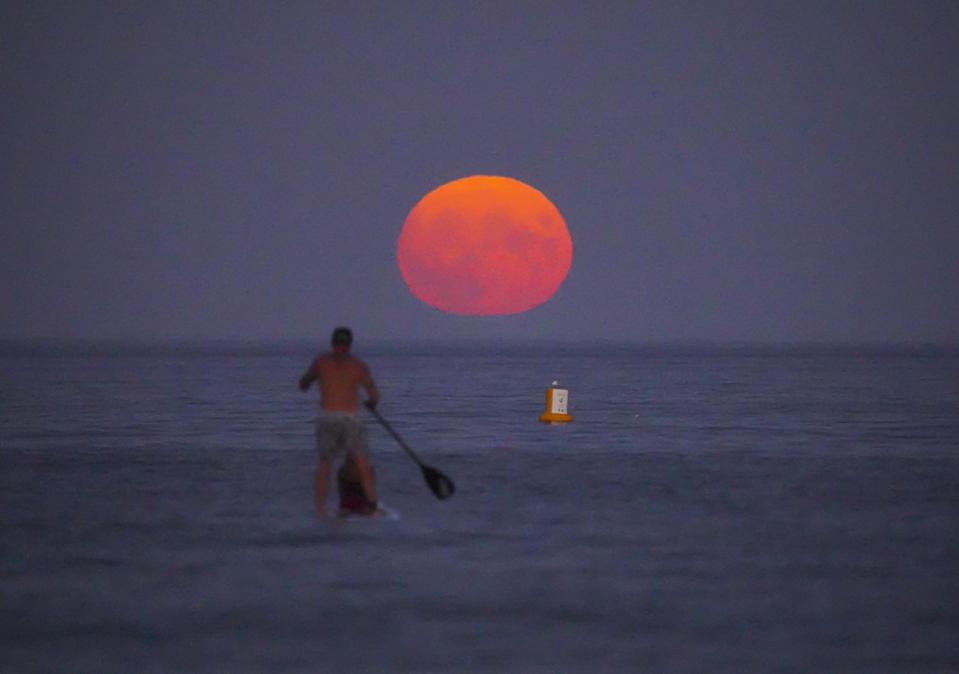
This week culminates with the Sturgeon Moon, a highlight of the August night sky. On Friday, August 8, the nearly full moon will ascend in the east near dusk. It will initially cast an orange glow, transitioning to a warmer yellow as it climbs higher. Observers are encouraged to find a location with an unobstructed view of the eastern horizon for the most dramatic moonrise experience.
While Friday offers the prime viewing opportunity, Saturday, August 9, presents a second chance to admire the Sturgeon Moon. The lunar body officially reaches its full phase at 3:56 a.m. EDT. It will rise shortly after sunset, presenting another opportunity to observe its luminous orange hue against the twilight sky.
Spotlight on Arcturus: A Summer Sky Beacon
This week’s featured star is Arcturus, a prominent celestial body in the constellation Boötes. It is readily identifiable in the western sky, particularly by following the arc of the Big Dipper’s handle – a celestial navigation technique known as the “arc to Arcturus.” Arcturus is a red giant star situated approximately 37 light-years from our solar system, making it the fourth brightest star visible in the night sky.
Discovering Lyra: A Compact and Dazzling Constellation
Despite the bright presence of the moon, several bright stars and constellations remain visible. Lyra, a small yet striking constellation, is centered around the brilliant star Vega. Vega forms the upper-left point of the expansive Summer Triangle, which can be observed in the southeast after dark. Within Lyra, a small parallelogram of stars accompanies Vega. The constellation also houses the well-known Ring Nebula (M57), which is discernible with smaller telescopes.
For precise viewing times tailored to your location, online planetariums such as Stellarium are recommended resources. The popularity of stargazing has surged, with over 50 million people in the US alone participating in the hobby annually (Sky & Telescope, 2023).