
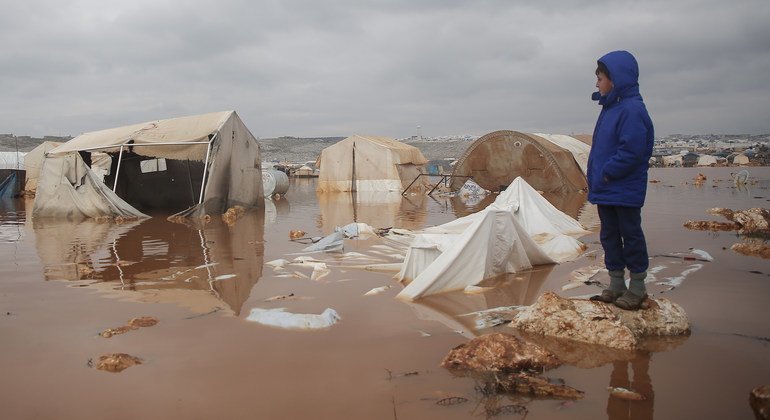
Northwest Syria is grappling with a deepening humanitarian crisis as heavy rainfall since Saturday triggered widespread flooding, impacting over 5,000 displaced people and damaging or destroying approximately 1,950 shelters, the United Nations reported Monday. The flooding, concentrated in parts of Idleb and northern Latakia governorates, has forced the temporary suspension of operations at a local hospital, prompting the deployment of mobile medical teams.
The latest disaster compounds existing challenges for a region already burdened by widespread displacement. While fighting has subsided in Aleppo, Al-Hasakeh, and Ar-Raqqa following a January 30th agreement, nearly 160,000 people remained displaced as of February 3rd, according to OCHA. Access to essential services remains severely limited, with ongoing electricity outages disrupting water systems, intermittent telecommunications, and limited food supplies. The presence of explosive ordnance and the suspension of schooling further exacerbate the precarious situation.
The UN’s relief coordination office, OCHA, confirmed that around 1,800 tents have sustained damage, with at least 150 completely destroyed in camps housing displaced families. Authorities have opened shelters and are preparing additional housing to accommodate those affected. Humanitarian organizations are working to relocate families, repair damaged shelters, and deliver emergency assistance, including food and essential non-food items.
The response effort itself has suffered a setback, with a Syrian Arab Red Crescent staff member killed and five others injured when their vehicle crashed while providing assistance to flood-affected communities. This incident underscores the risks faced by aid workers operating in the region.
The current flooding follows a winter storm that impacted several parts of Syria in late January, affecting approximately 2,800 displaced people across 37 camps in Aleppo and Idleb, as detailed in a flash update from OCHA. That storm resulted in damage to 1,758 tents and blocked access roads, hindering humanitarian access. The ongoing winter conditions continue to endanger families, with a significant funding gap – only $31 million of the $112 million required for life-saving winter assistance has been received.
Beyond the immediate crisis in Syria, the UN is also addressing the ongoing recovery from Hurricane Melissa, which devastated Cuba in late October 2025. Fuel shortages, stemming from the suspension of supplies from Venezuela, are now hindering the delivery of essential services and recovery efforts, impacting over two million Cubans – roughly one in five residents. The UN launched a $74 million Plan of Action in November 2025, but it remains only 23% funded, according to a UN statement.
Meanwhile, an international conference on eliminating child labor is scheduled to begin February 11th in Morocco, convened by the UN International Labour Organization (ILO). The meeting comes as global estimates indicate 138 million children remain in child labor, with agriculture accounting for 61% of cases. The world failed to meet the 2025 Sustainable Development Goal target for eliminating child labor, highlighting the persistent challenges in addressing this global issue.
