
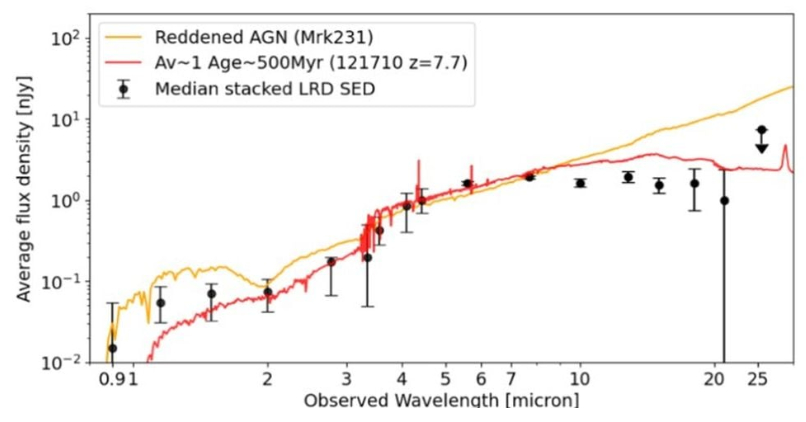
This article discusses a new theory that suggests “Little Red Dots” (LRDs) observed by the James Webb Space Telescope (JWST) might not be galaxies, but rather supermassive stars (SMSs) that are the progenitors of supermassive black holes (SMBHs).
Here’s a breakdown of the key points:
The Problem: Astronomers are finding SMBHs very early in the universe’s history, which is earlier than current theories predict they should have formed.
The Proposed Solution: Researchers Nandal adn Loeb propose that LRDs are the direct photospheric light of accreting SMSs in the final stages before they collapse.
Why SMSs?
Short Lifetime: The authors suggest SMSs have a short lifetime (≲ 10^3 yr) before collapse, which aligns with the rarity of LRDs.
Metal-Free: They developed atmospheric models for SMSs with 10^6 solar masses and no metals, as these are considered “Population III stars” which are expected to be metal-free.
Model Matches Observations: Their models successfully accounted for the observed luminosity and spectral features of LRDs, specifically mentioning the “V-shaped Balmer break” and the simultaneous presence of a strong, broad Hβ emission line with other Balmer lines in absorption. These features are attributed to the extended dense photosphere around SMSs.
Occam’s Razor: The SMS model offers a simpler, unified explanation for LRDs compared to other models (like active galactic nuclei) that require multiple components.
Future Work: The researchers acknowledge that this is a foundational study and suggest future work to explore different SMS masses and properties that could form the observed LRD population.
Observational Challenges: lrds are difficult to observe and are at the limit of JWST’s capabilities. Confirmation may require future, more powerful telescopes.
Significance: if proven, this theory could solve the mystery of how SMBHs formed so early in cosmic time.
In essence, the article presents a compelling new hypothesis that LRDs are not distant galaxies, but rather the dying embers of the very first massive stars, which then went on to form the supermassive black holes we see today.
