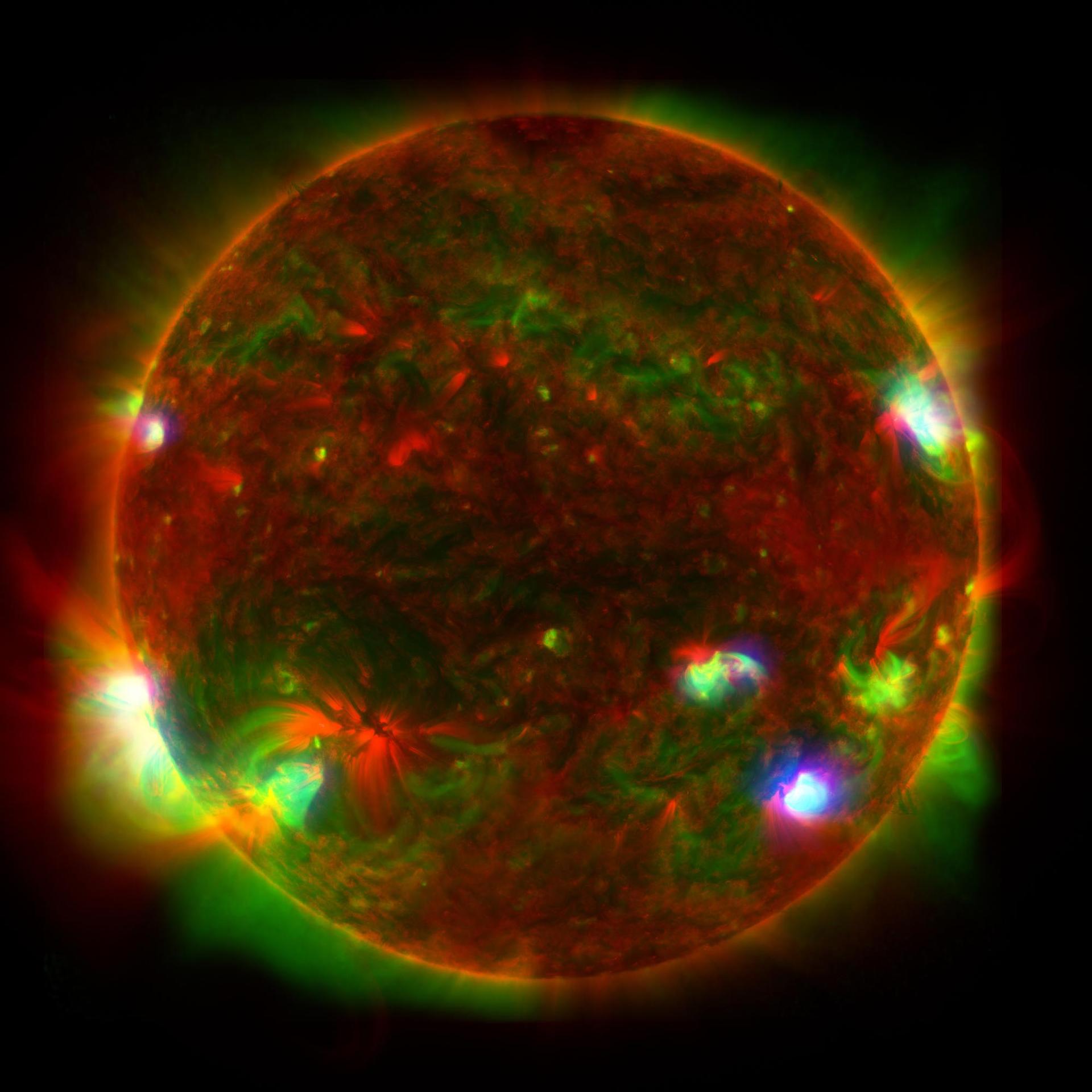
Sun’s death will destabilize outer solar system, study finds
When the Sun collapses into a white dwarf, its own death convulsions will destabilize the orbits of Jupiter, Saturn, Uranus, and Neptune within approximately 1 billion years, Tech Times reported on October 26, 2026.
The Tech TL;DR:
- New research published on September 21, 2026, in Astrophysical Journal Letters revises prior solar system stability timelines down from 30 billion years or a quintillion years to roughly 1 billion years.
- Asymmetric mass ejections from the dying Sun deliver directional gravitational kicks to the outer planets, driving orbital chaos rather than allowing smooth, peaceful orbital expansion.
- Simulations incorporating observed white-dwarf recoil velocities show that 96 percent of systems matching our solar system’s parameters become unstable within a 3-billion-year window.
Asymmetric Mass Ejections Drive Billion-Year Orbital Instability
The revised timeline comes from a study co-authored by Konstantin Batygin, Jim Fuller, and Fred C. Adams of the University of Michigan, whose 1999 book The Five Ages of the Universe first charted the deep future of planetary systems around dying stars. Tech Times reported that the study appeared in Astrophysical Journal Letters on September 21, 2026, with additional coverage detailed by the Italian news agency ANSA.
Previous dynamical work, including a 2020 study by Zink, Batygin, and Adams, treated stellar mass loss as a smooth, continuous process that would cause the giant planets’ orbits to expand without breaking their overall stability. The new research argues that stellar evolution on the red-giant branch is bumpy rather than smooth. Stars shed mass through episodic, asymmetric bursts that deliver directional gravitational kicks.
Independent physical evidence supports these directional jolts. Gaia measurements of white dwarfs in wide binary systems reveal that newly formed stellar remnants receive natal recoil velocities of approximately 0.75 kilometers per second, with observed amplitudes ranging between 0.25 and 4 kilometers per second. This signature confirms that final mass-loss events are directionally asymmetric.
Simulation Results Show How Ejection Masses Alter Planetary Trajectories
To quantify how these ejections alter planetary trajectories, Batygin’s team ran 672-simulation integration studies across various ejection masses and timing distributions, tracking each run for 3 billion years past white-dwarf formation.
| Ejection Regime | Ejection Mass (Solar Masses) | Planetary System Outcome |
|---|---|---|
| Small Kicks | ≤ 10⁻⁷ | Planetary behavior closely mirrors the smooth case. |
| Intermediate Kicks | Resonant coupling amplifies chaotic diffusion through phase space rather than suppressing it. | |
| Large Kicks | ≥ 10⁻⁵ | High-kick runs end badly on billion-year timescales in the majority of cases. |
Observed white-dwarf kick amplitudes and stellar-evolution models point to a fiducial ejection mass near 10⁻⁴ solar masses for our Sun. At that value, approximately 96 percent of simulated systems became unstable within 3 billion years of white-dwarf formation. Roughly 40 percent of those runs reached disruption or violent orbital scattering while the Sun was still in its red-giant phase.
The simulations reveal multiple potential endpoints for destabilized systems. Ejected giant planets from destabilized white-dwarf systems represent a plausible, though not yet established, contribution to the rogue-planet population.
Stellar Evolution Preempts Galactic Flybys
This dynamic inverts conventional long-term astrophysical forecasts. Prior models viewed passing stars as the primary threat to an aging planetary architecture, placing expected disassembly at roughly 100 billion years after white-dwarf formation, or up to a quintillion years in older pure orbital chaos models. By front-running stellar flybys, the Sun’s own dying convulsions become the primary agent of its outer planets’ destruction.
The study also provides a physical mechanism for a puzzle in stellar astrophysics: why polluted white dwarfs showing heavy elements appear to have a replenishment rate sustained over billions of years. Continued giant-planet instability in white-dwarf systems naturally resupplies the stellar surface with planetary debris over billions of years, matching surveys from the Sloan Digital Sky Survey and the Gaia mission.
While the theoretical modeling carries inherent uncertainties and probabilistic outcomes rather than deterministic forecasts, the findings demonstrate that our parent star’s final phase will actively undo the outer solar system.
# Analytical framework for stochastic planetary integration
import numpy as np

def calculate_ejection_kick(solar_mass_loss, asymmetry_factor):
    base_velocity = 0.75 # km/s natal recoil baseline from Gaia data
    return base_velocity * (solar_mass_loss / 1e-4) * asymmetry_factor

kick_regime = calculate_ejection_kick(1e-4, 1.2)
print(f"Computed stellar kick velocity: {kick_regime} km/s")