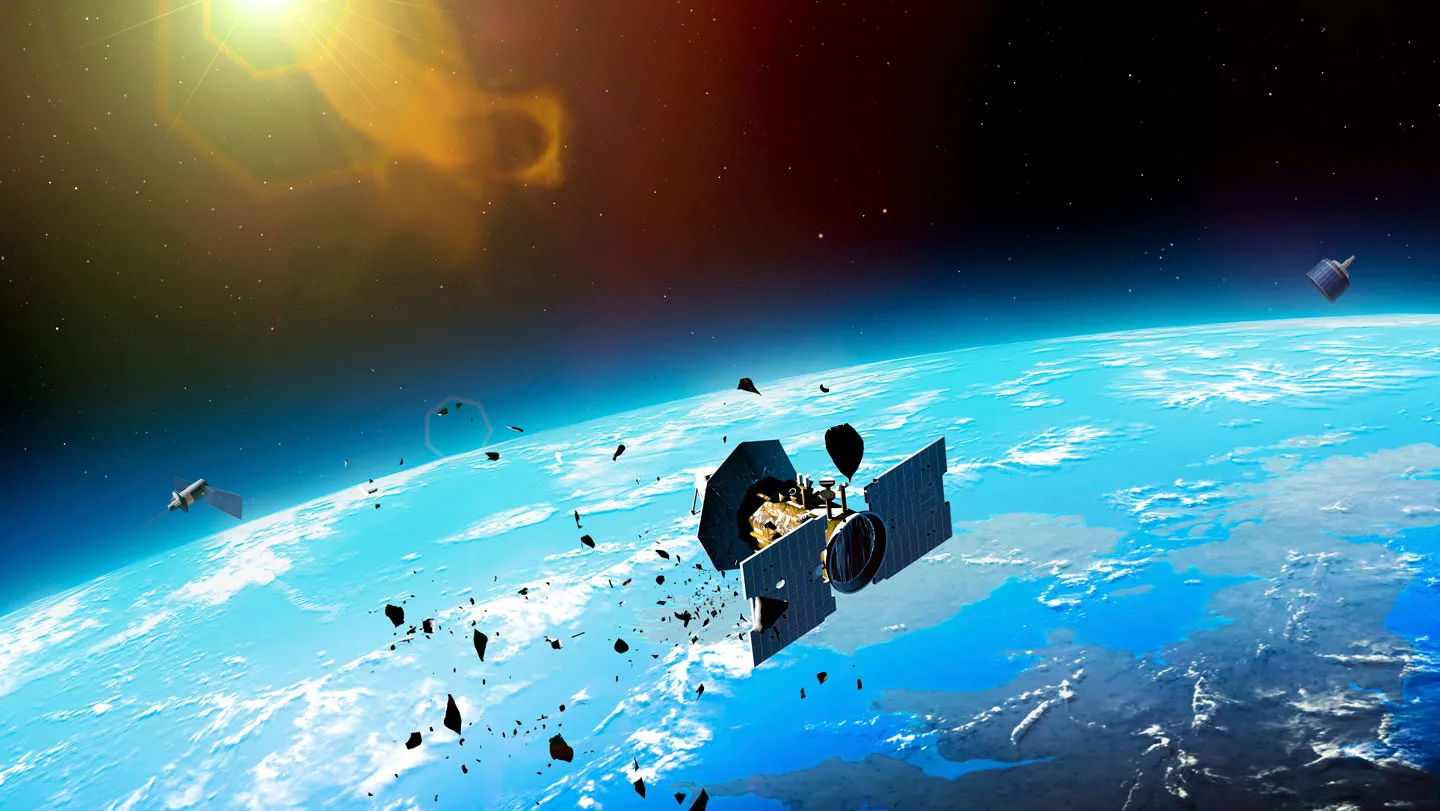
Sun’s 11-Year Cycle Accelerates Orbital Debris Decay-Peak Sunspots Speed Up Space Junk Fall
The Sun’s 11-year cycle isn’t just a cosmic rhythm—it’s now a critical variable in orbital mechanics, reshaping how we manage the growing crisis of space debris. New research reveals that as sunspot activity climbs toward its peak, low-Earth orbit (LEO) junk begins to plummet back to Earth at accelerated rates, a phenomenon that could force a reckoning in satellite operations, collision avoidance and even space law. The implications stretch far beyond astronomy, touching on public safety, regulatory frameworks, and the sustainability of Earth’s orbital infrastructure.
Key Clinical Takeaways:
- Space debris in LEO (400–2,000 km altitude) loses altitude sharply when solar activity exceeds ~67% of its 11-year peak, increasing collision risks for operational satellites.
- The effect is threshold-dependent: below 67% solar activity, decay rates remain stable; above this mark, orbital decay accelerates unpredictably.
- Current mitigation strategies—like robotic debris capture—are still experimental; the study underscores the need for real-time solar monitoring to adjust satellite trajectories proactively.
Solar Storms as Orbital Accelerators: The Physics of Uncontrolled Decay
The Sun’s magnetic field isn’t just a celestial curiosity—it’s a drag force on human-made objects in space. When solar activity intensifies, particularly during sunspot maxima, the upper atmosphere expands due to increased ultraviolet and X-ray radiation. This expansion thickens the atmospheric density at altitudes where most LEO debris resides (400–2,000 km), creating a frictional drag that pulls objects downward faster than predicted by traditional models.
Historical data from the NASA Solar System Exploration archive confirms this dynamic: over 36 years of tracking, researchers at the Vikram Sarabhai Space Centre (VSSC), India identified a nonlinear threshold at ~67% of peak sunspot activity. Once crossed, orbital decay rates spike, forcing debris into uncontrolled re-entry trajectories. The study, published in Frontiers in Astronomy and Space Sciences, is the first to quantify this effect with empirical rigor.
“This isn’t just about debris—it’s about the operational lifespan of satellites. If we don’t account for solar-induced drag, we risk losing critical assets like Starlink constellations or weather-monitoring platforms during peak activity cycles.”
From Theory to Crisis: The 36-Year Dataset That Changed Orbital Forecasting
The study’s N=17 sample—tracking debris from a Delta 1 rocket across three solar cycles (1986–2024)—reveals a step-function relationship between sunspot numbers and orbital decay. Below the 67% threshold, decay proceeds at a steady rate; above it, the rate of altitude loss doubles or triples within months. This finding contradicts prior assumptions that solar influence on debris was gradual and linear.

| Solar Activity Phase | Orbital Decay Rate | Impact on LEO Debris | Mitigation Challenge |
|---|---|---|---|
| Below 67% of peak sunspots | Stable (predictable models apply) | Minimal uncontrolled re-entries | Traditional tracking sufficient |
| Above 67% of peak sunspots | Accelerated (2–3× baseline) | Massive debris influx into lower orbits | Requires real-time solar adjustments to satellite trajectories |
The implications for space traffic management are immediate. Satellites in LEO—including internet “mega-constellations” like Starlink—must now factor solar cycles into collision-avoidance algorithms. The study’s authors warn that without adaptive strategies, the risk of Kessler Syndrome-like cascading collisions (where debris impacts create more debris) could rise exponentially during peak solar years.
Regulatory and Industrial Blind Spots: Where the Crisis Meets Clinical Triage
This research exposes a critical gap in both space law and orbital sustainability frameworks. Currently, no international treaty mandates solar-activity-aware debris mitigation. The Inter-Agency Space Debris Coordination Committee (IADC) relies on static orbital decay models, which now appear obsolete during high-sunspot periods. For industries and governments dependent on LEO assets—including space law specialists and satellite operators—this study is a wake-up call.
“The legal community is scrambling to update liability frameworks. If a satellite collides due to unaccounted solar drag, who bears responsibility? The manufacturer? The orbital traffic controller? This study forces us to rethink negligence thresholds in space.”
For companies developing robotic debris capture systems, the findings are a double-edged sword. While solar-induced decay could naturally clear some debris, the accelerated timeline demands faster intervention. Meanwhile, space insurance underwriters are already adjusting premiums for operators in LEO, citing the new probabilistic risk models derived from this research.
The Future: A Solar-Aware Orbital Economy
The next frontier lies in predictive solar monitoring integrated with AI-driven orbital mechanics. Agencies like ESA’s Space Debris Office and NASA’s Orbital Debris Program are exploring machine-learning models that ingest real-time sunspot data to adjust satellite deorbit maneuvers. Private sector players, including commercial space surveillance firms, are racing to deploy high-precision tracking networks capable of distinguishing between solar-induced drag and other decay factors.

Yet the most urgent need is cross-disciplinary collaboration. Astronomers, aerospace engineers, and space law attorneys must align on standardized mitigation protocols. For now, the study’s authors recommend:
- Real-time solar activity alerts for satellite operators, triggered at 60% of peak sunspot levels.
- Dynamic orbital debris maps updated hourly during high-solar periods.
- Liability reforms to clarify responsibility for solar-induced collision risks.
The clock is ticking. With the next solar maximum projected for 2025, the window to implement these changes is narrow. For stakeholders in the satellite industry, insurance sector, or legal sector, the time to act is now.
Disclaimer: The information provided in this article is for educational and scientific communication purposes only and does not constitute medical advice. Always consult with a qualified healthcare provider regarding any medical condition, diagnosis, or treatment plan.