
Astronomers Discover Most Powerful “Odd Radio Circle” Yet, Linking Mysterious Structures too Black Hole Activity
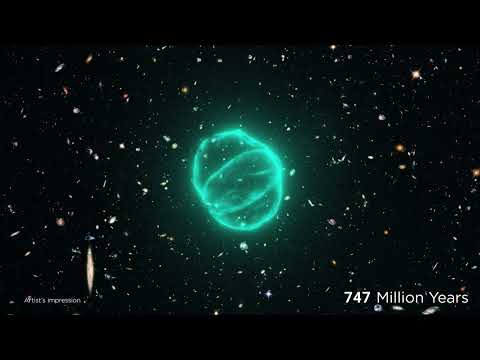
A newly discovered radio galaxy, J131346.9+500320,exhibits a striking double-ring system and is the most powerful “Odd Radio circle” (ORC) identified to date,bolstering evidence that these enigmatic structures are formed by the energetic activity of supermassive black holes. The discovery, detailed in a paper published in Monthly Notices of the Royal Astronomical Society, offers crucial clues to the origins of ORCs, which have puzzled astronomers as their initial detection.
ORCs are enormous circular features in space, far larger than our own galaxy, that emit strong radio waves. Only two of the roughly dozen known ORCs previously displayed a double-ring structure. Scientists theorize this configuration suggests a direct view down the axis of opposing outflows – similar to the twin jets frequently enough observed emanating from active black holes, though distinct from typical jet formations.
researchers believe galactic superwinds, or shockwaves generated by galactic mergers and black hole collisions, play a key role in ORC formation.”A large-scale shock induced by a galaxy-galaxy or black-hole merger, or a powerful superwind, could compress a dormant radio lobe and reaccelerate its particles to be visible as rings or broken shells,” the researchers write in their paper.
In the case of J131346.9+500320, a powerful black hole superwind appears to have revived fading synchrotron radiation from older radio lobes, creating the observed rings. The object’s light indicates the activity occurred long ago, making the ORC a “fossil relic” of past black hole activity.
Two additional radio galaxies, RAD J122622.6+640622 and RAD J142004.0+621715, were also analyzed in the study, both exhibiting radio circles at the ends of bent jets. These findings collectively strengthen the connection between black holes and the creation of ORCs.
“These discoveries show that ORCs and radio rings are not isolated curiosities - they are part of a broader family of exotic plasma structures shaped by black hole jets, winds, and their environments,” says astrophysicist Pratik Dabhade of the National Centre for Nuclear Research in Poland. Notably, the ORCs were initially identified by citizen scientists, highlighting the continued value of human observation alongside advanced technologies like machine learning.
