Study: Alzheimer’s Brain Phenotypes Inseparable From Aging, Limiting Age-Independent Biomarkers
Brain scans from more than 44,000 people show that removing age information from Alzheimer’s detection models cuts diagnostic accuracy by nearly 10 percentage points, challenging the widespread use of “brain-age gap” scores as a standalone biomarker.
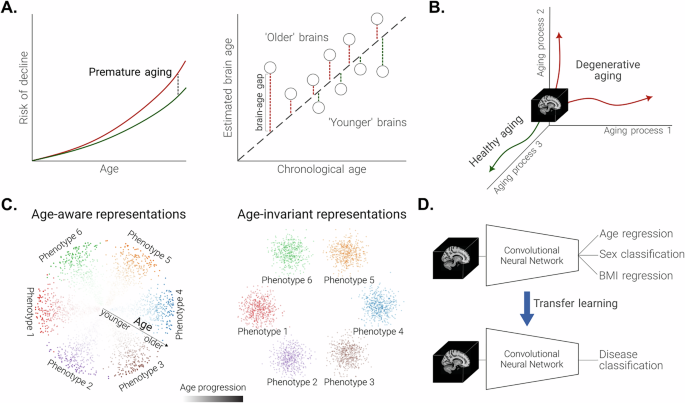
Researchers built three types of deep-learning models using MRI data from six population cohorts — UK Biobank, Cam-CAN, the Human Connectome Project, HCP-Aging, NKI-RS and SALD — totaling 44,482 scans with a mean age of 54.5 years, Nature reported. An “age-aware” model preserved chronological age in its learned representations; an “age-invariant” model was forced to discard it; and an “age-agnostic” model received no explicit age instruction.
When tested against 4,115 clinical scans from ADNI, OASIS and AIBL — comprising 565 Alzheimer’s patients, 1,493 with mild cognitive impairment and 2,057 healthy controls, mean age 72.3 — the age-aware and age-agnostic models both reached a median area under the curve of 0.85 distinguishing Alzheimer’s from healthy controls. The age-invariant model fell to 0.77, and a logistic regression on brain-age gap scored 0.72. The differences were statistically significant (p < 0.001 and p < 0.01, respectively). “This reveals a conceptual flaw in BAG: by subtracting chronological age, it discards the very information essential for accurate detection,” the authors wrote in the paper posted to PubMed Central. The team used the age-invariant model’s conditional decoder to simulate longitudinal aging trajectories for individual brains. Healthy aging and Alzheimer’s diverged along at least three independent anatomical dimensions — deep gray matter, frontoparietal cortex and temporal cortex. Alzheimer’s patients did not simply show accelerated aging; they exhibited pathological temporal shifts while retaining relatively preserved frontoparietal structure. Representational similarity analysis showed that even models pretrained to predict sex or body-mass index converged on age-related features when fine-tuned for Alzheimer’s detection, suggesting the disease phenotype cannot be decoupled from aging. The findings establish a hard limit for age-independent biomarkers and argue for multidimensional models that preserve aging structure rather than collapsing it into a single brain-age gap number.
This convergence suggests the disease phenotype cannot be decoupled from aging, even when models start from non-age tasks. The authors wrote that these results establish a hard limit for age-independent biomarkers.
The paper posted to PubMed Central concludes that the brain-age gap biomarker relies on an untested assumption: that Alzheimer’s can be identified through age-invariant brain phenotypes.
Nature reported the study’s central finding that removing age information from deep-learning models reduced Alzheimer’s detection accuracy by nearly 10 percentage points, challenging the brain-age gap biomarker. As a British weekly international scientific journal publishing peer-reviewed research across the natural sciences, Nature subjects manuscripts to rigorous editorial evaluation; fewer than 8% of submitted papers are accepted, and accepted papers undergo technical readability checks and peer review that validate methodological rigor before publication.
Source 1 reports that the study assembled a general population dataset of 44,482 brain images from six cohorts and a diseased dataset of 4,115 images from ADNI, OASIS, and AIBL. Source 2’s abstract states the research used invariant representation learning on MRI from 44,178 individuals to create neural representations that either optimally convey or remove age information while minimizing reconstruction distortion.