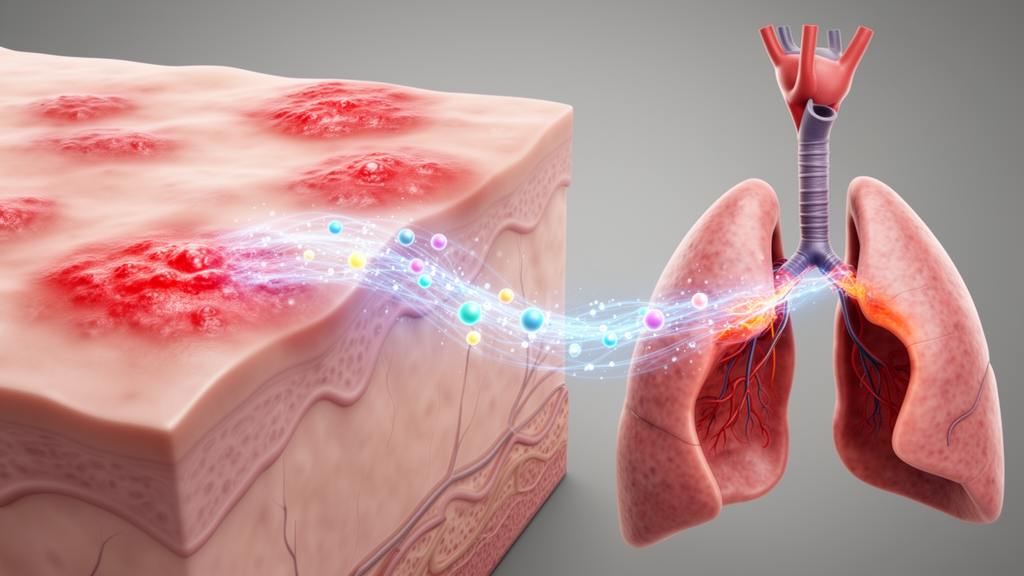
Study: 28.2% of Children With Early Urticaria Develop Allergic Airway Disease
- 28.2 percent of 17,319 children with early urticaria developed allergic airway disease over five years.
- Children with chronic urticaria had 42 percent higher odds of respiratory progression than those with acute hives.
- Allergic rhinitis appeared at a median age of 3.36 years, preceding asthma at 3.88 years in children with both conditions.
- Baseline blood counts showed population-level differences but poor individual predictive value (AUC 0.52–0.55).
The investigation, led by Jieqiong Liang and colleagues, analyzed electronic medical records from 2015 to 2018 tracking 17,319 infants and toddlers diagnosed with urticaria before age two, the journal reported.
Across the full cohort, 4,892 children — 28.2 percent — received a formal clinical diagnosis of allergic rhinitis, bronchial asthma, or both during the five-year follow-up period, while 12,427 remained free of respiratory complications.
Acute urticaria, defined as eruptions lasting less than six weeks, dominated the cohort at 97.38 percent (16,865 children). Chronic urticaria, persisting six weeks or longer, accounted for 2.62 percent (454 children). Children with chronic hives were slightly older at diagnosis (mean 1.49 years vs. 1.26 years) and more likely to be male (66.3 percent vs. 58.2 percent).
The divergence in outcomes was marked. By year five, cumulative incidence of isolated allergic rhinitis reached 27.75 percent in the chronic group versus 20.84 percent in the acute group.
Asthma incidence followed a similar pattern: 11.23 percent at five years for chronic urticaria patients compared with 7.12 percent for acute cases.
Multivariable logistic regression controlling for age and sex confirmed chronic urticaria as an independent predictor.
The adjusted odds ratio for the composite allergic airway outcome was 1.42 (95% CI 1.17–1.73). Category-specific models showed adjusted odds ratios of 1.37 for allergic rhinitis alone and 1.61 for the combined rhinitis-asthma phenotype. The association with asthma alone (aOR 1.62) did not reach statistical significance.

Among the 985 children who developed both conditions, allergic rhinitis consistently appeared first. Median onset age for rhinitis was 3.36 years (IQR 2.42–4.07) versus 3.90 years for asthma (IQR 2.94–5.05). This temporal sequence held regardless of initial urticaria type. In acute urticaria patients, rhinitis median onset was 3.36 years and asthma 3.90 years; in chronic urticaria patients, 3.45 years and 3.36 years respectively, with no statistically significant difference between phenotypes.
Among 2,992 children with baseline complete blood counts, those who later developed airway disease showed statistically higher median monocytes (0.50 vs. 0.48 ×10⁹/L), lymphocytes (3.69 vs. 3.40 ×10⁹/L), and eosinophils (0.08 vs. 0.06 ×10⁹/L). Neutrophils, basophils, CRP, total white count, and neutrophil-to-lymphocyte ratio showed no significant differences.
Receiver operating characteristic analyses yielded areas under the curve of 0.5254 for monocytes, 0.5334 for lymphocytes, and 0.5453 for eosinophils — values only marginally above 0.50.
“Although these circulating immune cells reflect underlying systemic inflammatory activation and type 2 immune background at an aggregate level, their standalone prognostic utility for forecasting individual disease progression in clinical practice remains extremely limited,” the authors wrote.
In the laboratory subgroup, female sex was associated with 27 percent lower odds of allergic airway disease (aOR 0.727, 95% CI 0.623–0.848). Older baseline age increased odds (aOR 1.822). Elevated red blood cell count (aOR 1.447) and lymphocyte percentage (aOR 1.645) were also significant, though the authors cautioned that total lymphocyte percentages do not distinguish specific T-cell subpopulations.
The researchers identified several constraints. The study relied on retrospective records from a single tertiary center and lacked data on household allergen exposures, parental allergy history, and genetic background. No external control group of children from the general population or with non-allergic skin conditions was included, preventing assessment of excess absolute risk beyond community trends.
Surveillance bias was documented: children who developed airway disease underwent baseline blood testing at substantially higher rates (24.9 percent vs. 15.2 percent), indicating more intensive medical contact may have amplified diagnostic detection over time.