
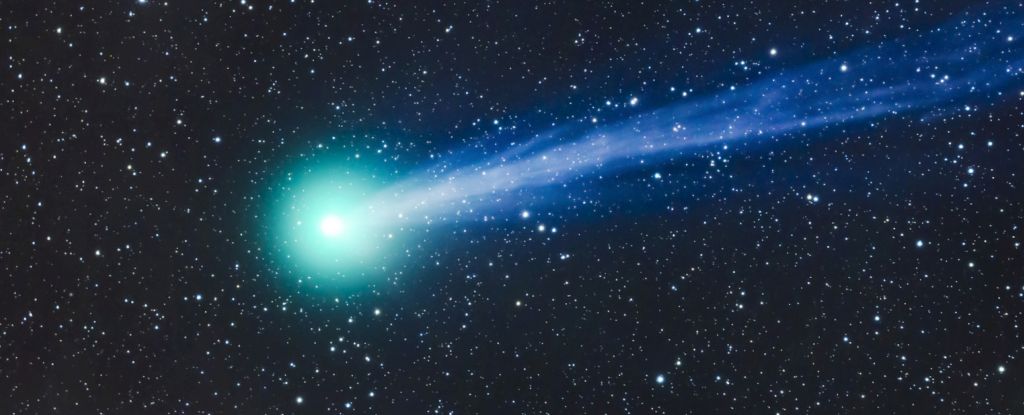
Interstellar Comet 3I/ATLAS Displays Unusual green Glow, Challenging Existing Cometary science
NAMIBIA – Images captured by astrophotographers Gerald Rhemann and Michael Jäger in namibia reveal that interstellar comet 3I/ATLAS is now exhibiting a vibrant blue-green gas coma and a developing tail, sparking a scientific puzzle over its unusual composition. The observations, made during the total lunar eclipse on the night of September 7, 2025, show a coma measuring 2.5 arcminutes across and a visible tail as of September 9.
This isn’t the first indication that 3I/ATLAS is unlike any comet previously studied. Observations from the James Webb Space Telescope (JWST) have already revealed a peculiar chemical makeup, with larger-than-usual proportions of carbon dioxide. Further analysis has also detected the presence of nickel and cyanogen, but these elements don’t explain the observed green fluorescence.
Comets typically display their glow as ices sublimate into a gas atmosphere – or coma - when approaching the Sun,with molecules fluorescing when stimulated by solar radiation. However, the molecule responsible for the green glow in most comets, diatomic carbon (C2), has not been detected in 3I/ATLAS. This absence is especially perplexing given the early detection of cyanogen.
A recent preprint led by astronomer Luis Salazar Manzano of the university of Michigan, Ann Arbor, suggests a strong depletion of carbon-chain molecules, including both C2 and C3. “Our upper limit on the C2-to-CN ratio,” the researchers write, ”places 3I/ATLAS among the most carbon-chain depleted comets known.”
The mystery surrounding 3I/ATLAS deepens as scientists await its closest approach to earth in December, hoping to gather more data and unravel the secrets of this interstellar visitor. The comet’s unique composition offers a rare opportunity to study materials from beyond our solar system and perhaps refine our understanding of cometary formation and evolution.
