Stop Brain Clutter Review: Personalized Meditation Starts With Questions, Not Categories
In a column for NewsBlaze, technology writer Alan argues that a meditation app called Stop Brain Clutter stands apart because it asks questions before it generates anything, building each session from the user’s own words rather than from fixed categories.
He tested the service in October.
The piece, a first-person review, describes a system that interviews the user, drafts a written script, and then hands control back before any audio is created. Alan writes that the personalization process, not the generated audio itself, is what makes the app interesting.
His conclusion is blunt. Alan writes that the underlying idea works.
The timing matters because the app enters a crowded field. Guided meditation apps typically sort users into broad buckets — sleep, stress, focus — and serve pre-recorded audio. Stop Brain Clutter, by Alan’s account, works in the opposite direction: it starts with what is going on with the individual, then builds the session around that.
Questions come before content
Alan writes that he really likes that the app assumes nothing, and instead asks questions. The first one is simple: “What should we call you?” He entered Alan.
Next, it asks what the user wants help with. The choices include Stress Relief, Sleep Support, Grief Support, Self-Compassion, Confidence Boost and Emotional Reset. Alan notes that several options target what he calls particularly modern problems: Doomscroll Overload, Overstimulated & Overwhelmed and Racing Mind from Too Much Input.
He chose Sleep Support, though he writes that he does not usually need help sleeping. He picked it deliberately, wanting a straightforward subject that would make the finished meditation easy to assess.
The app then asks for direction — Calm, Reframe or Empower. He chose Calm.
Where personalization gets personal
From there, the questionnaire moves past menus and into the user’s own words. Alan typed that he felt “mentally busy after a long day” and wanted to wind down before sleep. His stated goal: calm, mentally quiet and ready to sleep.
“This is where the process starts to feel significantly different from choosing a generic meditation by category.”
That shift, from picking a category to describing a state of mind, is the hinge of his argument. He writes that he is telling the app where he is mentally, what occupies his thoughts and where he wants the session to take him.
Length, tone and an optional deeper question
The app then asks how long the meditation should run — five, 10 or 20 minutes. He chose 10. Tone options include Gentle & Nurturing, Empowering & Confident, Spiritual & Mystical, and Grounded & Practical, and more than one can be selected.
He picked Gentle & Nurturing combined with Grounded & Practical, judging the pair appropriate for a sleep session. He also had a testing reason: avoiding spiritual language made it easier to judge how closely the finished script followed his input.
A final, optional question asks whether there are old beliefs from the past the user would like to let go of. Alan left it blank rather than invent a personal issue for the sake of a test.
He notes one hiccup: the onboarding had a small interface issue when he tested it in October, though he writes that it did not affect the personalization process he set out to assess.
The script arrives before the audio
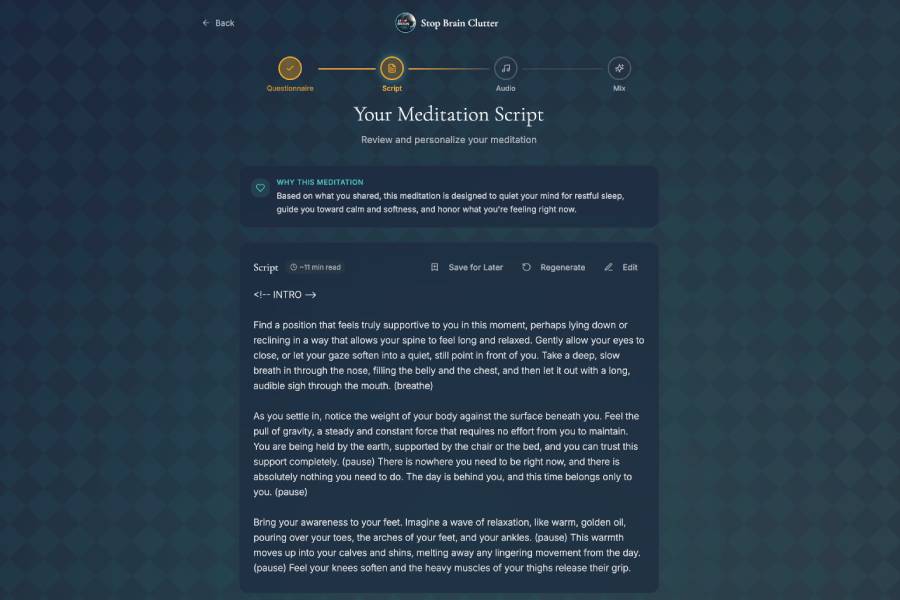
Once the questionnaire was complete, the app generated his meditation — and, in his telling, this is where the product shows its hand. It did not push him straight to a finished recording. It showed the script first.
The result was estimated at about 11 minutes, close to the 10-minute length he requested, according to the column. The app also explained its reasoning, saying the session was built around what he told it: quieting his mind for restful sleep and moving toward calm.
He judged the language a match for the direction he chose. The script encouraged him to leave the day behind, relax physically and set aside the mental busyness he had described.
Then came the step he singles out as possibly the most important part of the system. The app offered options to edit, regenerate, refine or save the script, plus a section for further refinement if the first result missed the mark. He could change wording he disliked before any audio existed.
The workflow, as he lays it out: describe what is going on, receive a script, review it, then create the audio. He writes that this interests him more than fully automated generation, because he retains control over the words first.
A wellness boundary the app keeps visible
Alan gives the app credit for what it does not claim. Stop Brain Clutter describes itself as a general-wellness product, not medical, psychological or therapeutic care, and asks users to acknowledge that its material does not replace professional care.
He argues that the disclaimer matters because some of the available topics — grief, stress, sleep, emotional wellbeing — sit close to territory where an app should not posture as treatment. Alan writes that Stop Brain Clutter doesn’t do that, and its disclaimer keeps that boundary visible.
That distinction has practical weight. Anyone dealing with persistent sleep problems, grief or acute stress would, as the column implies, still need a licensed therapist, physician or counselor; a generated meditation sits alongside such care, not in place of it.
The column’s verdict rests on a single test case: one user, one session, one subject. Alan does not claim more. He writes that the developers turned a fairly complex personalization process into something simple to use, and that the app begins not by asking which meditation he wants to hear but by asking what is going on with him.
What the piece does not address is how the audio performs over repeated use, how the app handles more emotionally loaded subjects like grief in practice, or whether the October interface issue was fixed. Those questions stay open.
Actor Will Roberts introduced Alan to Stop Brain Clutter and encouraged him to test it himself, the column says.
The review ends where it began, with the sequence that defines the product: the questions come first, the user’s own answers shape the session, and the words stay editable until the user says otherwise.