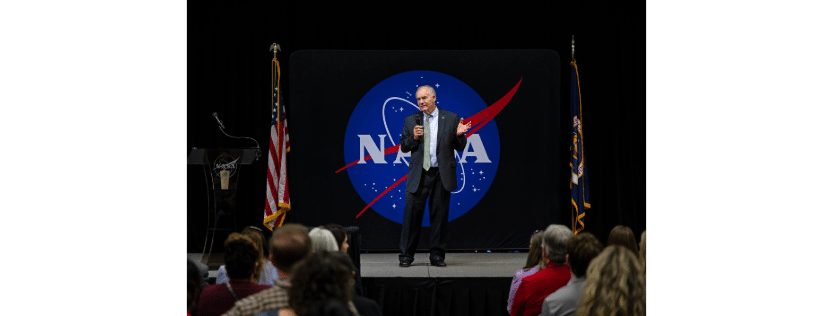
Stephen Cash Opens Von Braun Space Exploration Symposium
“Some of y’all may be as surprised as I am to be here,” Stephen Cash told the crowd Tuesday, stepping up to open the 26th Von Braun Space Exploration Symposium just weeks after retiring from the Marshall Space Flight Center. Cash returned to lead the NASA center where he started his career over four decades ago, taking over as director last Monday.
Returning to Marshall After Four Decades
Cash spent 46 years in the aerospace business before stepping away into retirement. His return to the agency as director marks a rapid shift from civilian life back into active leadership at the Huntsville facility. “This is a job I’d do for free,” Cash said at the symposium. “I appreciate being back at Marshall and with you guys today. What I love about Marshall is we’re truly a family.”
Organized by the American Astronautical Society alongside the Marshall Space Flight Center, the annual event runs through Wednesday on the University of Alabama in Huntsville campus. UAH President Donald Leo pointed out the institution’s historical ties to the federal space program. “UAH was founded to move the nation’s space mission forward,” Leo said. “We’ve always been a bridge from government and academia to the space industry.”
Annual Theme Focuses on Lunar Infrastructure and Propulsion
This year’s theme, “Accelerating Exploration,” centers heavily on humanity’s return to the moon, sustainable lunar infrastructure, advanced space propulsion, and workforce evolution. Panel sessions tackle Artemis II and III, space propulsion flash talks, building utilities for sustained lunar operations, moon base supply chain resilience, space nuclear technology, and managing the new NASA workforce.
American Astronautical Society President Ron Birk outlined a slate of eight core priorities for the national space program.
Cash Pushes for NASA Agility and External Partnerships
In his first public appearance since taking the director’s post, Cash emphasized that the federal agency is undergoing structural changes to prepare for deep space missions. “We’re making NASA more agile,” Cash said. “We’ve been doing the same thing for a long time and we need to be doing it differently.”
Cash stressed that meeting mission timelines requires close cooperation across government agencies, academic institutions, and private industry. He signaled an open-door policy for external stakeholders looking to contribute to lunar exploration efforts. “I want to be a part of this,” Cash said. “That’s one of the reasons I came back. I’ve been in this business 46 years; it’s all about partnerships. If anyone wants to talk, my office is always open.”