
Mars Rover Finds Mysterious Spheres
Perseverance Rover Uncovers Ancient Martian Rocks with Unknown Origins
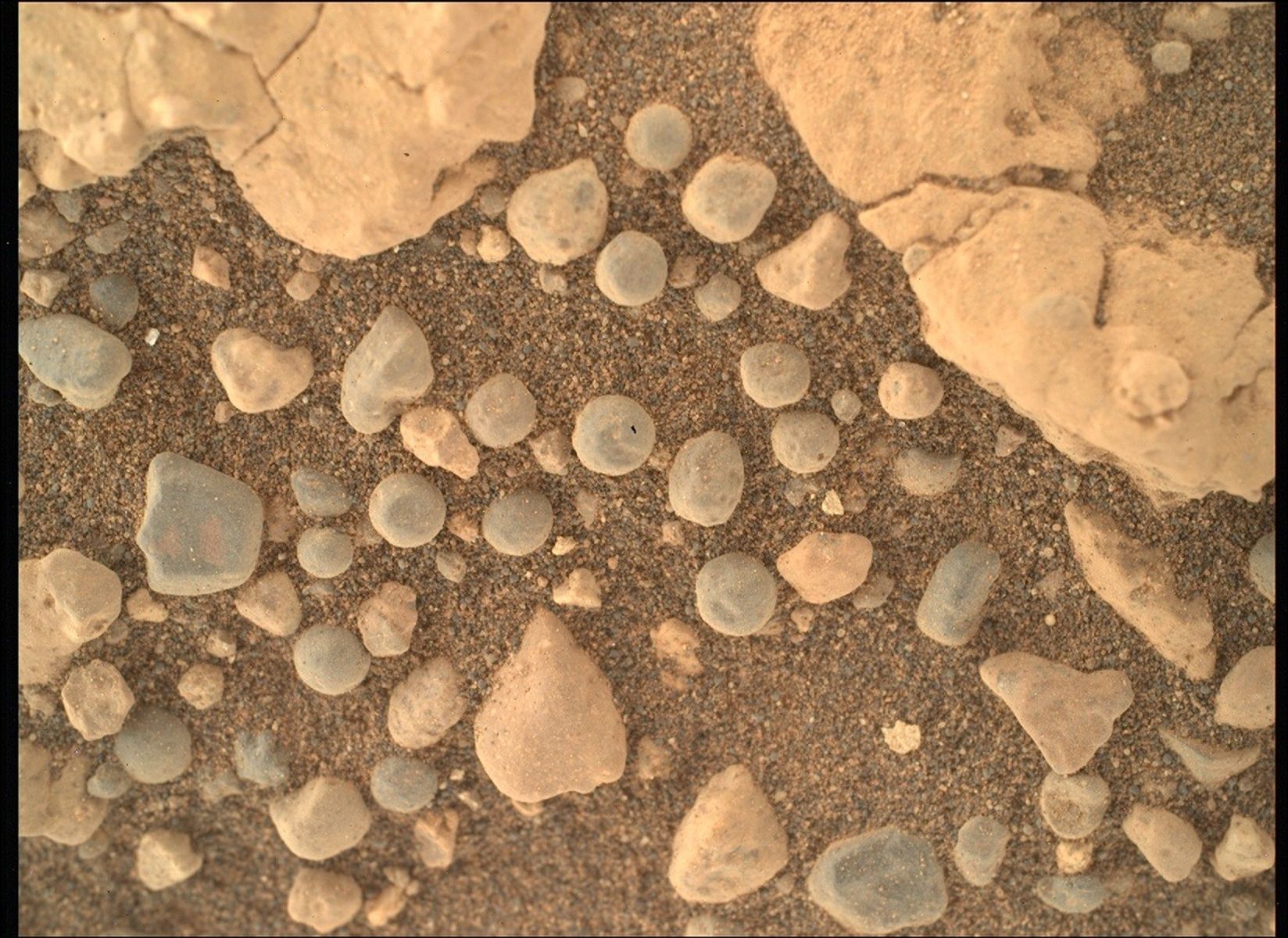
NASA’s Perseverance rover has captured striking images of enigmatic, perfectly spherical rock formations on Mars. These findings have ignited scientific curiosity, drawing parallels to previous discoveries but hinting at distinctly different geological histories.
“Rowsell Hill” Yields Unexpected Findings
On Martian day 1,555 of the Mars 2020 mission, Perseverance utilized its WATSON camera and SHERLOC instrument to examine spherule-rich regolith at a location informally named “Rowsell Hill.” The detailed, close-up images reveal these small, rounded objects embedded in the Martian soil, sparking a debate about their formation.
Echoes of “Blueberries” with a Twist
This discovery echoes the famous “blueberries” found by the Opportunity rover decades ago near Meridiani Planum. Those hematite-rich spherules were understood to have formed within groundwater-saturated sediments. However, preliminary analysis suggests the “Rowsell Hill” spherules possess a basaltic composition, pointing towards a more fiery genesis.
Impacts or Eruptions: The Origin Story
Scientists hypothesize that these basaltic spheres likely originated from either a significant meteoroid impact or a volcanic eruption. In both scenarios, the intense heat would have melted rock, creating molten droplets that rapidly cooled and solidified into spherules. These then would have rained down on the Martian surface. The precise origin remains a key question for the science team, who are continuing to gather data.
Unlocking Mars’ Dynamic Past
Understanding the source of these spherules could offer crucial insights into Mars’ ancient history. If linked to impacts, they might reveal details about the composition of early meteoroids and the prevalence of cratering. Conversely, if they are volcanic in origin, they could preserve evidence of past volcanic activity in the Jezero crater region. As of early 2024, over 20% of Mars’ surface has been mapped in detail by orbiters, providing a broader geological context for such discoveries (National Space Society).
The perseverance rover’s ongoing mission to collect diverse samples for potential return to Earth aims to unlock more secrets about the Red Planet’s geological evolution and its potential for past life.
