
Space Explosion Influences Young Star, Challenging Planet Formation Theories
Table of Contents
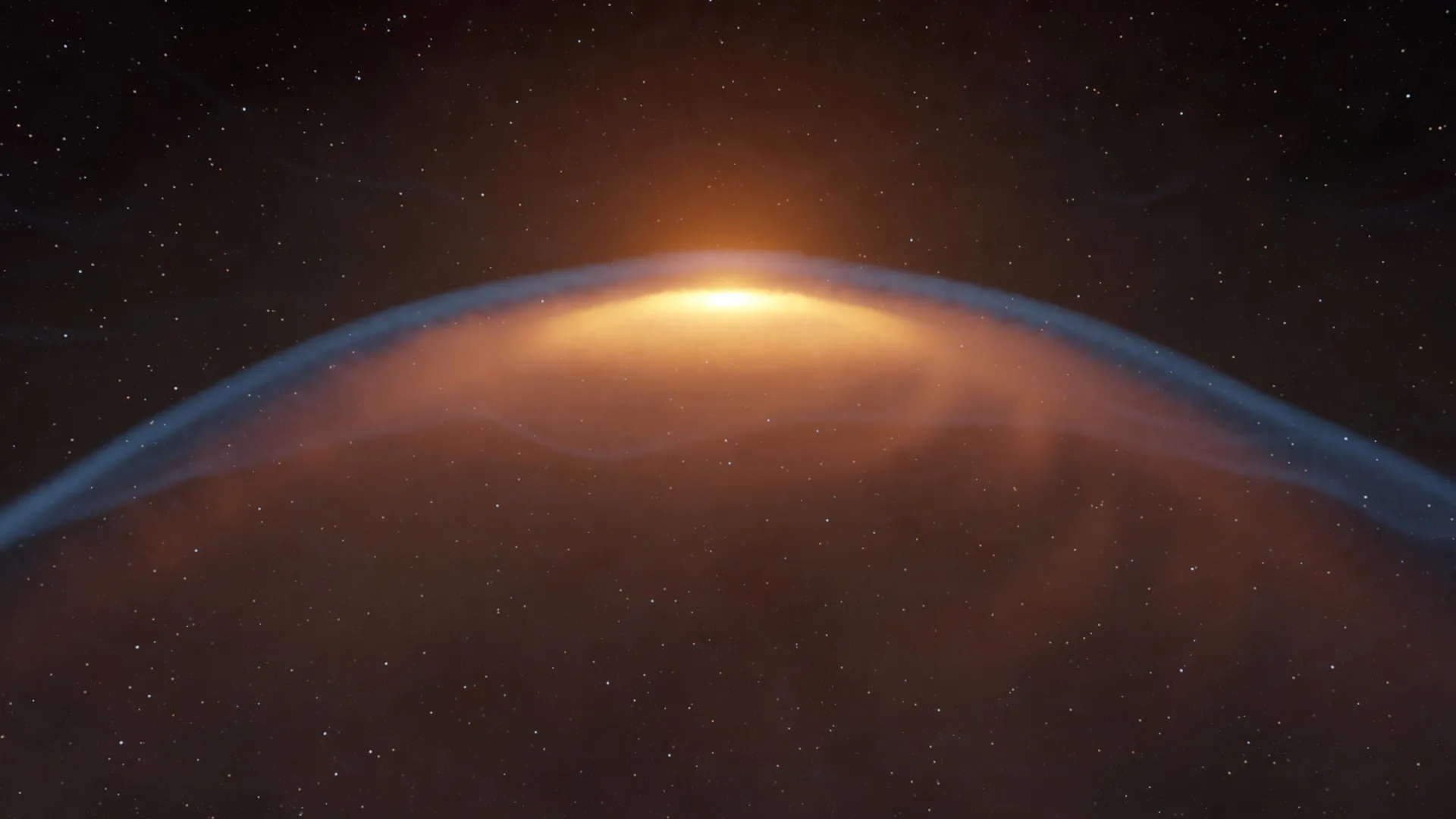
Astronomers have observed a rare cosmic event where an explosion in space is actively impacting the young star that initiated it, suggesting a more turbulent habitat for planet formation than previously understood.
Astronomers have observed an explosion in space that is pushing back against and influencing the baby star which triggered the explosion in the first place.If explosions like this one are common around young stars,then the young stars and their planets are exposed to a harsher environment than previously thought.
Stars and their associated planetary systems are formed from the gravitational collapse of molecular clouds in space. As a cloud collapses, it retains its angular momentum, causing it to evolve into a spinning structure known as a protoplanetary disk. Stars and planets form within a protoplanetary disk, but not all of the material is incorporated into the new stars and planets. Some of the material is ejected through powerful jets aligned with the rotation axis of the disk. These jets help remove excess angular momentum and matter from the protoplanetary disk.
A team of Japanese astronomers was reanalyzing archival data for protoplanetary disks from the Atacama Large Millimeter/submillimeter Array (ALMA), when they unexpectedly discovered an explosively expanding bubble structure near one of the disks. That disk, known as WSB 52, is located 441.3 light-years away in the direction of the constellation Ophiuchus. Further detailed analysis revealed that a shock front created by the expanding bubble was colliding with the disk and distorting it. Similar expanding bubble structures have been detected around other young stars, but none of them have shown signs of collision between the bubble and the disk. This phenomenon was also not predicted theoretically.
The team found that the center of the bubble aligned with the disk’s rotation axis.The chances of a bubble aligning with the axis of the disk by random chance are effectively zero, indicating that this alignment is not random. This led the research team to conclude that a jet aligned with the axis of the disk triggered the expansion of the bubble. According to their explanation, a high-speed jet emitted from WSB 52 hundreds of years ago collided with cold gas near the disk, causing the gas to compress. The increased pressure from the compression caused the gas to explode, which resulted in the formation of the expanding bubble.
Masataka Aizawa at Ibaraki University, who led this research, explains, “in science fiction, there are scenes where a beam is fired at something to destroy it, causing an explosion with debris flying back at the shooter. similar things occur in real astronomical phenomena, but with greater intensity. Through this finding, I once again realized that nature is far more complex than humans think. In future research, I hope to further explore the effects of the explosions on the formation of stars and planets.”
Background on Protoplanetary Disks
Protoplanetary disks are fundamental to our understanding of star and planet formation. They represent the leftover material from the star’s birth, providing the building blocks for planets, asteroids, and comets. Studying these disks allows Astronomers to observe the early stages of planetary system development.
Historically, models of planet formation assumed a relatively stable environment within these disks. Though, recent observations, like the one described above, suggest that these environments are far more dynamic and potentially violent than previously thought.This challenges existing theories and necessitates a reevaluation of the conditions necessary for planet formation.
Frequently Asked Questions
What is a protoplanetary disk?
A protoplanetary disk is a rotating disk of gas and dust surrounding a young star, from which planets are believed to form.
What caused the explosion?
The explosion was likely caused by a high-speed jet emitted from the star colliding with nearby cold gas, compressing it and causing it to explode.
How does this discovery impact our understanding of planet formation?
This discovery suggests that young stars and their planets may be exposed to a harsher environment than previously thought, potentially influencing the types of planets that can form.
Disclaimer: This article reports on scientific research and does not provide any health, financial, or legal advice.
