
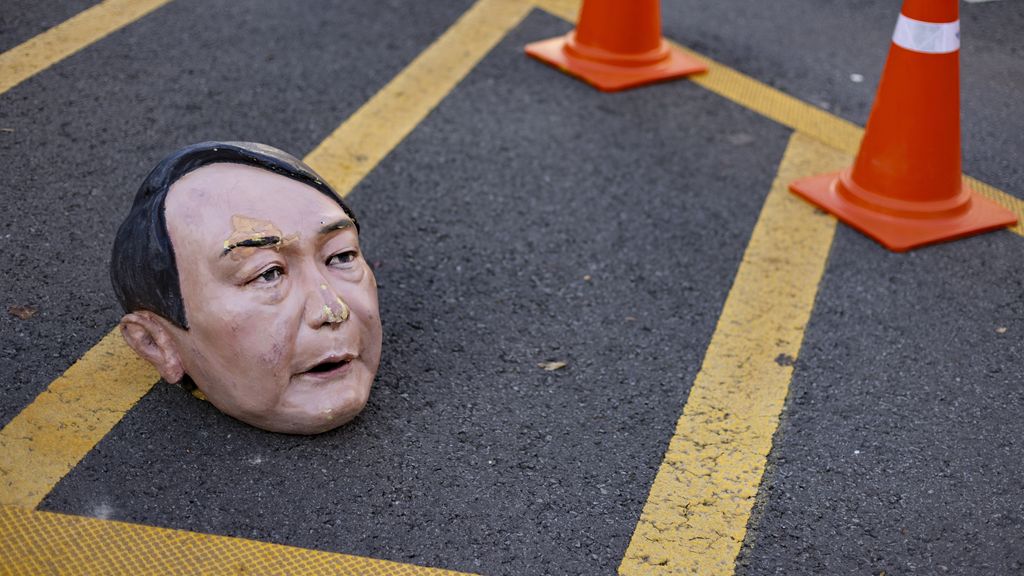
SEOUL – Former South Korean President Yoon Suk Yeol faces a potential death sentence after a Seoul court is scheduled to deliver its verdict Thursday in his trial for insurrection, stemming from his brief imposition of martial law in December 2024. The case, which has deeply divided South Korea, centers on Yoon’s attempt to invoke emergency powers, a move critics denounced as an assault on the nation’s democratic institutions.
Yoon, 65, pleaded not guilty to the charges, which also include abuse of power and obstruction of justice. Prosecutors have requested the maximum penalty, arguing his actions threatened the country’s hard-won democracy. Seven former military officers and senior police officials, accused of participating in the attempted imposition of martial law, also await sentencing, with prosecutors seeking prison terms ranging from 10 years to life for them, including former Defense Minister Kim Yong-hyun.
The crisis began on December 3, 2024, when Yoon announced the imposition of martial law during a televised address, citing unspecified threats to national security. The declaration, the first of its kind in South Korea in over four decades, triggered immediate backlash and widespread protests. The move involved attempts to restrict the National Assembly and control the media, actions that were swiftly challenged by lawmakers and the public.
Despite the declaration, the National Assembly defied the attempt to block its proceedings, convening an emergency session and voting 190-0 to lift the martial law order. Footage from the time showed soldiers appearing hesitant to confront protesters and lawmakers attempting to enter the parliament building, some gaining access through windows. Within hours, Yoon was forced to rescind the order, bowing to mounting pressure from the public and political opposition.
Yoon’s justification for the martial law declaration centered on claims that the opposition, which held a majority in the National Assembly, was sympathetic to North Korea and undermining national security. Yet, experts have questioned the validity of these claims, suggesting Yoon may have been attempting to circumvent the legislative process and consolidate power. His legislative proposals had consistently been blocked by the opposition, leading to a political stalemate.
The fallout from the crisis was swift, and severe. Yoon was impeached by the National Assembly shortly after lifting martial law. His arrest followed, though initially hampered by the continued protection of his presidential guard. Several ministers and members of his cabinet resigned or were arrested in connection with the events. Han Duck-soo, then Prime Minister, was sentenced to 23 years in prison for his role in the attempted power grab, a sentence longer than initially sought by prosecutors.
The impeachment of Yoon was later overturned by the Constitutional Court, but he was subsequently arrested for repeatedly failing to appear at summons related to the investigation. The Constitutional Court ousted Yoon from office, paving the way for a snap presidential election in June 2025, which was won by Lee Jae Myung.
While the death penalty has been sought in Yoon’s case, South Korea has not carried out an execution since 1997. Experts suggest that even if convicted and sentenced to death, Yoon’s sentence is likely to be commuted to life imprisonment, and he may eventually receive a pardon from a future president. The case has evoked memories of earlier periods of authoritarian rule in South Korea, particularly the violent suppression of pro-democracy protests in 1979 and 1980, including the “Gwangju Uprising,” where hundreds, potentially thousands, were killed.
The verdict is expected to be broadcast live across South Korea, and the outcome will likely have a lasting impact on the country’s political landscape. The court’s decision will be closely watched both domestically and internationally as a test of South Korea’s commitment to democratic principles.
