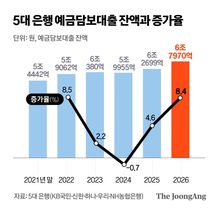
South Korean Deposit and Insurance Loan Balances Rise Sharply
South Korean households are increasingly turning to deposit-backed loans and insurance contract loans as a final liquidity lifeline, circumventing traditional household debt regulations. As of October 23, 2026, the combined balance of these unregulated credit lines across major commercial banks and insurance firms has surged, signaling a potential vulnerability in the nation’s financial stability as these funds are frequently diverted into volatile stock and real estate markets.
Surge in Unregulated Lending Channels
Data compiled by the Korea Daily (JoongAng Ilbo) indicates that the five major commercial banks—KB Kookmin, Shinhan, Hana, Woori, and NH NongHyup—held 6.797 trillion won in deposit-backed loans as of October 23. This figure represents an 8.4% increase since the end of 2025, nearly doubling the 4.6% growth rate recorded during the previous year. These loans allow borrowers to borrow up to 95% of their deposit or savings account balances, providing immediate cash without requiring the formal credit checks associated with standard personal loans.
A similar trend is visible in the insurance sector. According to statistics from the Korea Life Insurance Association, the contract loan balance at the three largest life insurers—Samsung Life, Hanwha Life, and Kyobo Life—reached 33.426 trillion won by the end of August 2026. This reflects a 6.3% increase compared to the end of last year, marking the sharpest growth in five years and far outpacing the 1.2% growth seen throughout all of 2025.
Tightening Debt Restrictions Drive Growth in Asset-Backed Loans
The acceleration of these loan types is a direct consequence of the “balloon effect” caused by tightening household debt restrictions. Following the government’s June 2025 measures, housing mortgage limits were sharply curtailed. By June 2026, commercial banks moved to cap credit loan limits at 100 million won, with overdraft facilities limited to 50 million won. Because deposit-backed and insurance-contract loans are secured by assets already held by the financial institution, they are excluded from the Debt Service Ratio (DSR) calculations and total household debt caps.
For the lender, the default risk is essentially zero; if a borrower fails to repay, the bank simply liquidates the pledged deposit or insurance policy. For the borrower, these instruments provide a method to access capital when traditional lending channels are blocked. An official from the banking sector noted that whenever total volume regulations triggered an “open run” on bank loans, home buyers and other individuals in need of rapid liquidity pivoted immediately to these unregulated products.
Risks to Financial Stability and Asset Quality
While these loans appear secure from the perspective of individual financial institutions, economists warn of broader systemic implications. A significant portion of this borrowed capital has been deployed into high-risk assets. During the period between April and June 2026, as the domestic stock market experienced volatility, the volume of these loans grew in tandem with speculative investment activity.
This scenario threatens the fundamental funding base of financial institutions and could suppress domestic consumption in sectors such as hospitality and retail.
As the fiscal year concludes, the trajectory of these loan balances remains a critical indicator of household financial stress. The potential for a sharp correction in asset prices, should the market sentiment shift, remains the primary risk factor for both the borrowers and the stability of the broader financial system.