
The Unrecognized Genius of Sophie Germain: A Pioneer in Mathematics adn Physics
On January 9,1816,a strangely condescending letter arrived for Marie-Sophie Germain. Though she had won the prestigious “Grand Mathematics Prize” from the Paris Academy of Sciences for her groundbreaking work on the theory of elastic waves, the letter offered no congratulations, pointedly noting she was the sole entrant, and casually mentioned the lack of readily available tickets to the award ceremony. This incident encapsulates the challenges faced by Germain, a self-taught mathematical and physical genius who overcame immense societal barriers to make significant contributions to science. Her story stands as a testament to perseverance, intellectual brilliance, and the frustrating history of recognizing women in STEM fields.
Early Life and the Pursuit of Knowledge Against the Odds
Born in 1776, in paris, France, Marie-Sophie Germain’s path to mathematical discovery wasn’t conventional. her father, a wealthy silk merchant, initially discouraged her interest in scholarly pursuits, deemed unsuitable for a woman of her standing. however, Germain’s captivation with mathematics began in her youth, sparked by reading books from her father’s library. During the French Revolution, a period of relative confinement for Germain, she voraciously consumed mathematical texts, essentially teaching herself the subject.
Her parents attempted to suppress her intellectual inclinations, believing they were unfeminine and would hinder her chances of a suitable marriage. They reportedly withheld heating and comfortable clothing, hoping to discourage her studies. Yet, Germain’s dedication proved unwavering. She continued her learning in secret, studying late into the night by candlelight, often wrapped in quilts to stay warm. This display of resilience highlights the extraordinary lengths she went to pursue her passion amidst societal constraints.
Overcoming Barriers: Correspondence and a Male Pseudonym
Germain’s self-education wasn’t limited to textbooks. She recognized the importance of engaging with the wider mathematical community. Though, women were effectively barred from higher education, including the prestigious École Polytechnique. Undeterred, she obtained lecture notes from the École Polytechnique, submitting solutions to problems under the pseudonym “Antoine-August Le Blanc.”
This assumed identity allowed her to correspond with leading mathematicians of the time, including Joseph-Louis Lagrange and Carl Friedrich Gauss. Her correspondence with Gauss, initially believing “Le Blanc” was a mature scholar, was particularly impactful. Eventually, Gauss discovered Germain’s true identity and acknowledged her remarkable talent, stating, “But when a woman, as of her sex, our customs and prejudices, encounters infinitely more obstacles than men in familiarizing herself with their knotty problems, yet overcomes these fetters and penetrates that which is most hidden, she doubtless has the most noble courage, extraordinary talent, and superior genius.” [1]
The Grand Mathematics Prize and the Study of Elasticity
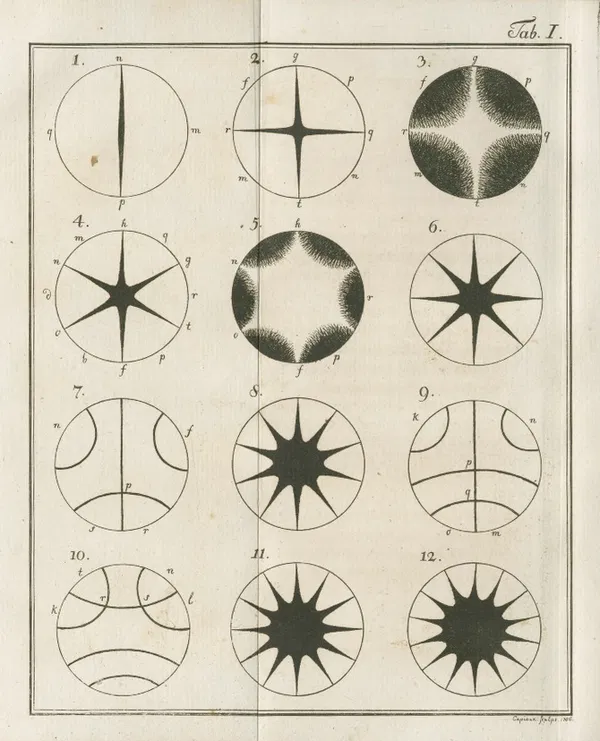
Germain’s most celebrated work revolved around the mathematical description of vibrating surfaces, specifically building upon the earlier work of Ernst Chladni. Chladni, frequently enough considered the “father of acoustics,” had demonstrated how patterns, now known as Chladni figures, formed when sand was sprinkled on a vibrating plate. For three consecutive years, the French Academy of Sciences offered a prize for a mathematical clarification of these patterns. Despite the lack of other submissions, Germain tirelessly pursued a solution.
Her 1816 submission,“Research on the Vibrations of Elastic Plates,” [2] marked a significant advancement in the understanding of wave phenomena. While her approach was described as “awkward” by some contemporary mathematicians, it was nevertheless a pioneering endeavor, correctly identifying the mathematical principles governing vibrations. The Academy awarded her the prize in January 1816, but the accompanying letter, as previously mentioned, lacked the recognition and respect she deserved.
Contributions to Number Theory and Fermat’s Last Theorem
beyond her work in acoustics, Germain made significant contributions to number theory. She collaborated extensively with Adrien-Marie Legendre on his proof of Fermat’s Last theorem, a notoriously arduous problem in mathematics. Fermat’s Last Theorem states that there are no positive integers a, b, and c that can satisfy the equation an + bn = cn for any integer value of n greater than 2.
Germain identified a specific class of prime numbers,now termed “Germain primes,” (where both p and 2p + 1 are prime) that were crucial in narrowing the scope of possible solutions to the theorem. Though her contributions weren’t fully acknowledged during her lifetime – her work was initially relegated to a footnote in Legendre’s publications [3] – her insights formed a foundation for andrew Wiles’ eventual complete proof of Fermat’s Last Theorem in 1994.
A Legacy Delayed but Ultimately Recognized
Despite her notable achievements, Germain faced constant obstruction and lacked institutional recognition during her life. She never held an official academic position or received the full accolades she deserved. In 1831, Gauss advocated for an honorary degree from the University of Göttingen, but Germain succumbed to breast cancer shortly before it coudl be conferred.
In the decades following her death, Germain’s accomplishments gradually gained recognition. Today, she is celebrated as a brilliant mathematician and a pioneering figure for women in science. Her story serves as a powerful reminder of the systemic barriers that historically prevented women from contributing their talents to STEM fields and underscores the importance of fostering inclusivity and recognizing talent nonetheless of gender. The Germain primes, named in her honor, stand as a lasting tribute to her enduring legacy.
Key Takeaways:
- sophie Germain overcame significant societal barriers to pursue her passion for mathematics and physics.
- She made groundbreaking contributions to the theory of elasticity, particularly in understanding the vibrations of plates.
- Her work on number theory and Fermat’s Last Theorem laid crucial groundwork for later advancements.
- Germain’s story highlights the importance of recognizing and supporting women in STEM fields.
- Despite facing prejudice and a lack of institutional support, Germain’s dedication and intellect left an indelible mark on the world of mathematics.
Sophie Germain’s life is a powerful inspiration. Her dedication to knowledge, her resilience in the face of adversity, and her lasting contributions to science continue to resonate today, reminding us of the brilliance that can be unleashed when we challenge societal norms and embrace the potential of all minds.
Published: 2026/01/09 17:08:10
