Sony Rehomes Retired Aibo Robot Dogs to Hospitals for Patient Therapy
“The owners feel as though they are sending off what has become to them like their own child,” said Yoshiyuki Katsuno, a Sony official who oversees the company’s robot adoption program. Sony Group Corp. began an “adoption program” for retired Aibo robotic dogs, repurposing the units to serve as companions in hospitals and care facilities.
The robotic pets, which originally launched in 1999, are no longer in production and are currently sold out, according to fastcompany.com. Under the new adoption program, owners who can no longer keep their units donate them to the Tokyo-based company. Sony then performs repairs and software upgrades to ready the units for their new roles.
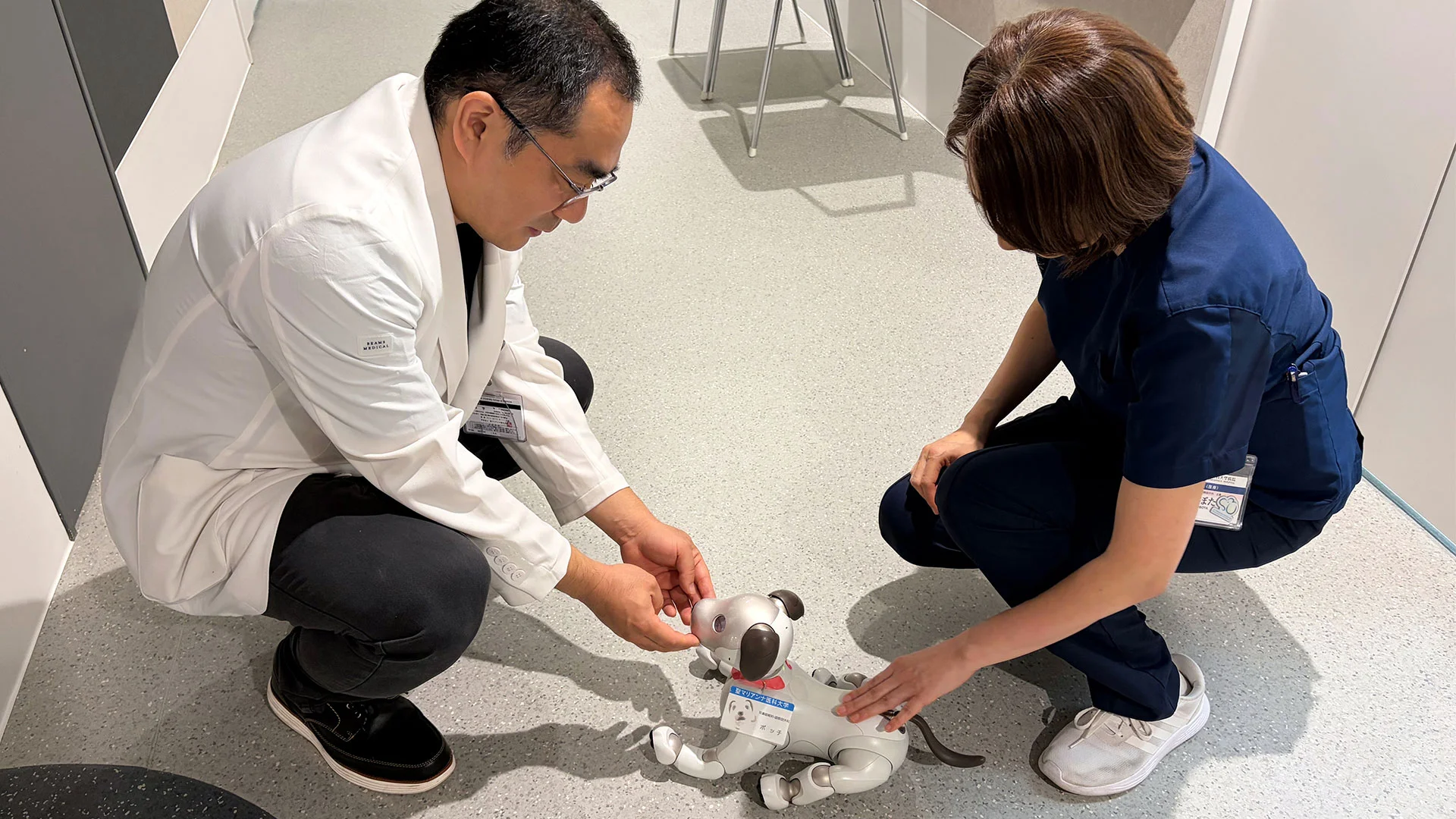
At the St. Marianna University School of Medicine in Kawasaki, the robots are integrated into clinical care to help patients manage stress and anxiety. Dr. Manabu Komori, of the hospital’s department of otolaryngology, reported that the robots assist in calming children who are reluctant to undergo medical examinations.
“Going to a hospital is basically not very pleasant,” Komori said.
The hospital utilizes both robotic and live therapy animals. Staff said that robotic alternatives avoid the temperament issues and feeding requirements associated with live animals. Dr. Komori said that while the robots offer distinct advantages, they are not necessarily better than living therapy animals.
Dr. Manabu Komori, of the department of otolaryngology at St. Marianna University School of Medicine, reported the robots help motivate children who are reluctant to undergo medical examinations.
“Going to a hospital is basically not very pleasant,” Komori said, noting that while the robots offer advantages over live therapy animals, they are not necessarily better.
“If you want some emotional attachment, you want a cute shape,” he said, reflecting on the deliberate design choice that aligns with Japanese cultural values.
Each Aibo is equipped with sensors and digital cameras, allowing the unit to recognize its name, the faces of its owners, and its surroundings. The robots simulate puppy-like behavior, including barking, head-cocking, and sleeping, while also monitoring their own internal mechanical performance.
The reliance on a “cute” or “kawaii” aesthetic is a deliberate design choice that aligns with Japanese cultural values regarding harmony and communication. Jerry Wang, executive chairman of FF EAI Robotics Ecosystem, said that while his company produces more “foreboding-looking” patrol robots, cuteness remains essential for building emotional connections.
Sony Group Corp. operates as a highly diversified global conglomerate with businesses spanning video games, music, film, and electronics, generating roughly ¥12.48 trillion JPY ($83.4 billion USD) in the 2025 fiscal year. Its Game & Network Services division alone contributed around ¥4.69 trillion JPY ($31 billion USD). The company’s robotics division, exemplified by the Aibo robotic dogs launched in 1999, integrates sensors and digital cameras to simulate behavior and monitor performance, serving therapeutic roles in medical settings.
Sony has not disclosed the total number of units sold or the specific financial terms of the adoption program. “The initiative aims to foster human interaction and provide emotional solace for patients and staff alike,” said Katsuno.