Solving the Mystery of Venus’ Extreme Atmospheric Anomalies
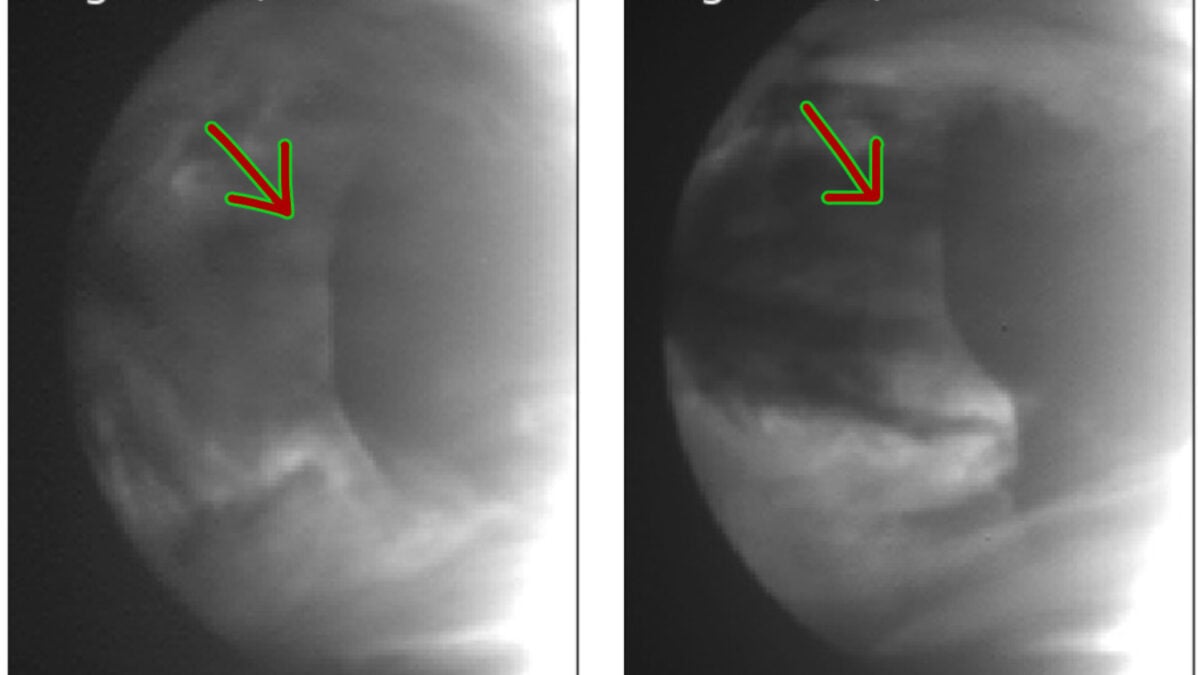
For a decade, the data coming off the Akatsuki orbiter didn’t match the simulations. Astronomers were staring at massive, acidic cloud walls on Venus that defied every existing atmospheric model—essentially a persistent system bug in our understanding of planetary fluid dynamics. We finally have the patch.
The Tech TL. DR:
- The Root Cause: A “hydraulic jump” is forcing sulfuric acid vapor upward, creating cloud fronts spanning roughly 6,000 kilometers.
- The System Impact: This mechanism is likely the primary driver for Venus’ unusually high wind speeds and planet-wide atmospheric circulation.
- The Data Source: Findings published in the Journal of Geophysical Research: Planets resolve a long-standing discrepancy between orbital observations and theoretical models.
In the world of systems architecture, we call this a bottleneck issue. For years, the Venusian atmosphere looked like a broken build; colossal waves of acidic clouds were sweeping the planet, but the physics didn’t add up. The “anomaly” wasn’t a fluke of sensor noise or a transient glitch—it was a structural feature of the environment that we simply lacked the telemetry to explain. The recent breakdown by an international research team, led by Takeshi Imamura of the University of Tokyo, identifies the culprit as the largest known hydraulic jump in the solar system.
To understand a hydraulic jump think of it as a sudden transition in flow regime—similar to what happens when a fast-moving stream of water hits a slower pool and creates a standing wave. On Venus, this jump forces sulfuric acid vapor into higher atmospheric strata, where it bunches into massive, dense walls. This isn’t just a visual curiosity; it’s a kinetic engine. By driving these fronts, the hydraulic jump maintains the planet’s extreme wind velocities, effectively acting as the “clock speed” for Venusian atmospheric movement.
Venusian Atmospheric Stack vs. Earth Baseline
When you strip away the PR-friendly “sister planet” narrative, the hardware specifications of Venus are a nightmare for any deployment. While Earth’s atmosphere is a balanced, low-latency system, Venus is a high-pressure, high-corrosion environment that would melt most off-the-shelf sensors in minutes. The discovery of the hydraulic jump highlights just how different the “OS” of Venus is compared to our own.
| Metric | Venus (The Anomaly Stack) | Earth (The Baseline) |
|---|---|---|
| Primary Cloud Component | Concentrated Sulfuric Acid | Water Vapor / Ice |
| Driver of Circulation | Large-scale Hydraulic Jumps | Solar Heating / Coriolis Effect |
| Frontal Scale | ~6,000 km (Massive) | Variable / Regional |
| Atmospheric Density | Extreme / High Pressure | Moderate / Standard |
Processing this level of planetary data requires more than just basic telemetry. It requires massive compute clusters capable of running complex fluid dynamics simulations. For enterprises attempting to model similar high-stress fluid environments—whether in chemical processing or aerospace—the ability to parse “noisy” orbital data into a coherent physical model is a high-value skill. This is why many firms are now augmenting their internal R&D with specialized data analytics firms and cloud computing consultants to handle the sheer scale of the simulation workloads.
Implementation: Simulating a Fluid Jump
For the devs in the room, a hydraulic jump can be modeled as a change in the Froude number ($Fr$), where the flow transitions from supercritical ($Fr > 1$) to subcritical ($Fr < 1$). While the Venusian jump is planetary in scale, the underlying logic can be represented in a basic Python simulation to visualize the height increase of the "jump" based on the ratio of initial and final flow velocities.
import numpy as np def calculate_hydraulic_jump_height(y1, fr1): """ Calculates the conjugate depth (y2) after a hydraulic jump. Y1: Initial flow depth fr1: Initial Froude number """ # Conjugate depth formula for rectangular channels y2 = (y1 / 2) * (np.sqrt(1 + 8 * (fr1**2)) - 1) return y2 # Venusian simulation parameters (Simplified) initial_depth = 1.0 # Normalized unit froude_number = 2.5 # Supercritical flow final_depth = calculate_hydraulic_jump_height(initial_depth, froude_number) print(f"Initial Depth: {initial_depth}") print(f"Post-Jump Depth: {final_depth:.2f}") print(f"Amplitude Increase: {((final_depth - initial_depth) / initial_depth) * 100:.2f}%") This basic logic is the seed of the models used by the University of Tokyo team. To scale this to a 6,000-kilometer front, you’re looking at massive parallelization across GPUs, likely utilizing Conda-forge environments for dependency management and high-performance computing (HPC) clusters to handle the Navier-Stokes equations at a planetary scale.
The Debugging Process: From Akatsuki to Publication
The resolution of this mystery follows a classic debugging lifecycle: observation, hypothesis, failure, and finally, the “aha” moment. The Akatsuki orbiter provided the raw logs (the images of the cloud walls), but the existing “documentation” (atmospheric models) couldn’t explain why the clouds persisted or how they grew to such a scale. The breakthrough came when researchers stopped trying to fit the data into old models and instead looked for a new mechanism—the hydraulic jump.
“Thanks to this research, we’re now able to show that this cloud disruption is caused by the largest known hydraulic jump in the solar system,” stated Takeshi Imamura, the study’s first author.
This finding doesn’t just solve a puzzle; it changes the requirements for future missions. If the atmosphere is driven by these massive jumps, any probe attempting a descent must be hardened against extreme, unpredictable wind shear and concentrated acidic surges. This is a hardware problem that cannot be solved with software patches. Companies specializing in industrial hardware hardening and advanced materials engineering are the only ones capable of building a chassis that wouldn’t be shredded by the Venusian “clock speed.”
As we look toward the next generation of planetary exploration, the lesson here is clear: when the data contradicts the model, the model is the bug. The “anomaly” is usually where the real physics—and the real innovation—is hiding. For those of us in tech, it’s a reminder to trust the telemetry over the documentation.
*Disclaimer: The technical analyses and security protocols detailed in this article are for informational purposes only. Always consult with certified IT and cybersecurity professionals before altering enterprise networks or handling sensitive data.*