
Understanding and Predicting Space Weather: The Need for Advanced Observation
The sun constantly emits a stream of charged particles known as the solar wind, creating dynamic “space weather” patterns. While large-scale eruptions like coronal mass ejections (CMEs) – vast clouds of plasma averaging 34 million miles in diameter – are well-known drivers of extreme space weather, scientists are increasingly focused on smaller, yet possibly impactful, features within the solar wind: flux ropes.
These flux ropes, ranging from 3,000 too 6 million miles wide, present a challenge to current space weather modeling. Existing simulations are either too large-scale to capture these features or too focused on the broader solar wind to adequately represent them. A new simulation developed by researchers has bridged this gap, allowing for the observation of both intermediate-sized flux ropes and large CMEs.
This simulation reveals that these tornado-like flux ropes likely form as CMEs interact with slower-moving solar wind, essentially “flinging aside” spinning plasma. While some of these vortices quickly dissipate, collisions between fast and slow solar wind streams can create more persistent structures.
Current space weather forecasting relies heavily on observing solar eruptions directly from the sun. However, researchers emphasize that this approach is insufficient for detecting flux ropes. “If hazards are forming between the sun and Earth, simply looking at the sun isn’t enough,” explains Mojtaba Akhavan-Tafti, an associate research scientist involved in the study.
The ability to accurately predict space weather is critical for protecting vital infrastructure. Disruptions caused by geomagnetic storms triggered by the solar wind can impact electric grids, airline operations, and even agricultural practices. Currently, spacecraft positioned between the Earth and the sun monitor solar wind speed and magnetic field orientation – geomagnetic storms are most likely when the magnetic field is oriented southward. Though, eruptions directed away from Earth, or with initially northward-pointing fields, can still generate southward-pointing vortices that would bypass these monitoring stations.
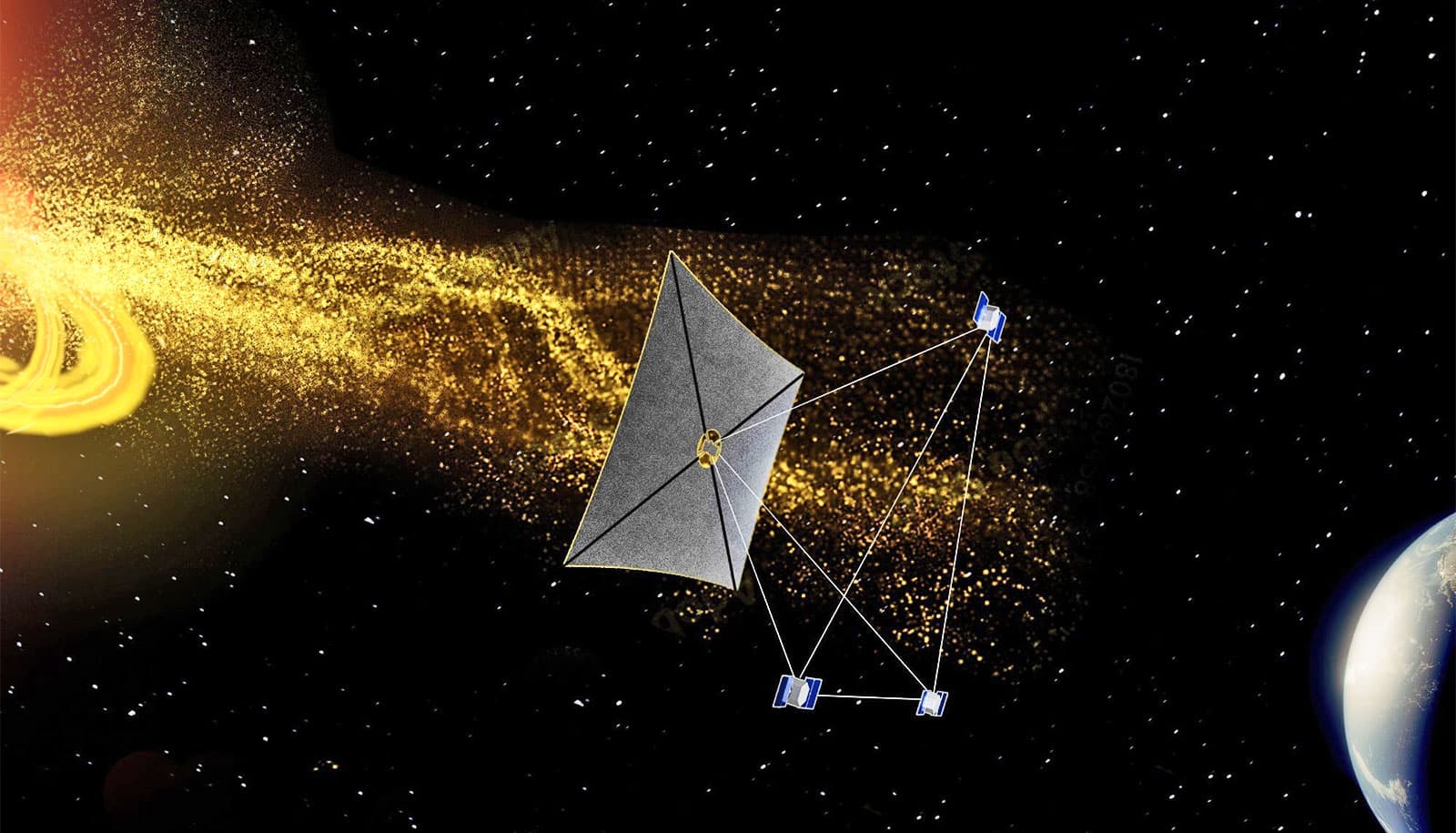
This limitation highlights the need for a more thorough observational network. researchers compare the current single-spacecraft system to monitoring a hurricane with only one wind gauge – providing some data, but lacking a complete picture. To address this, they are proposing the Space weather Investigation Frontier (SWIFT), a constellation of four spacecraft.
The SWIFT constellation would be arranged in a triangular-pyramid formation around the L1 Lagrange point, approximately 200,000 miles apart. Three probes would form the base of the pyramid, while a fourth “hub spacecraft” positioned further from the sun would serve as the apex. This configuration would allow for a more detailed understanding of how the solar wind evolves as it travels towards Earth,potentially speeding up space weather warnings by 40%.
A key innovation enabling the apex spacecraft’s position is a large, lightweight aluminum sail developed through NASA’s Solar Cruiser mission. This sail, covering roughly a third of a football field, would utilize the pressure of photons from the sun to maintain the spacecraft’s position without requiring significant fuel consumption.
This advanced observational approach is considered a matter of national security, aiming to proactively identify and predict the behavior of Earth-bound flux ropes and improve the reliability of space weather warnings.
