
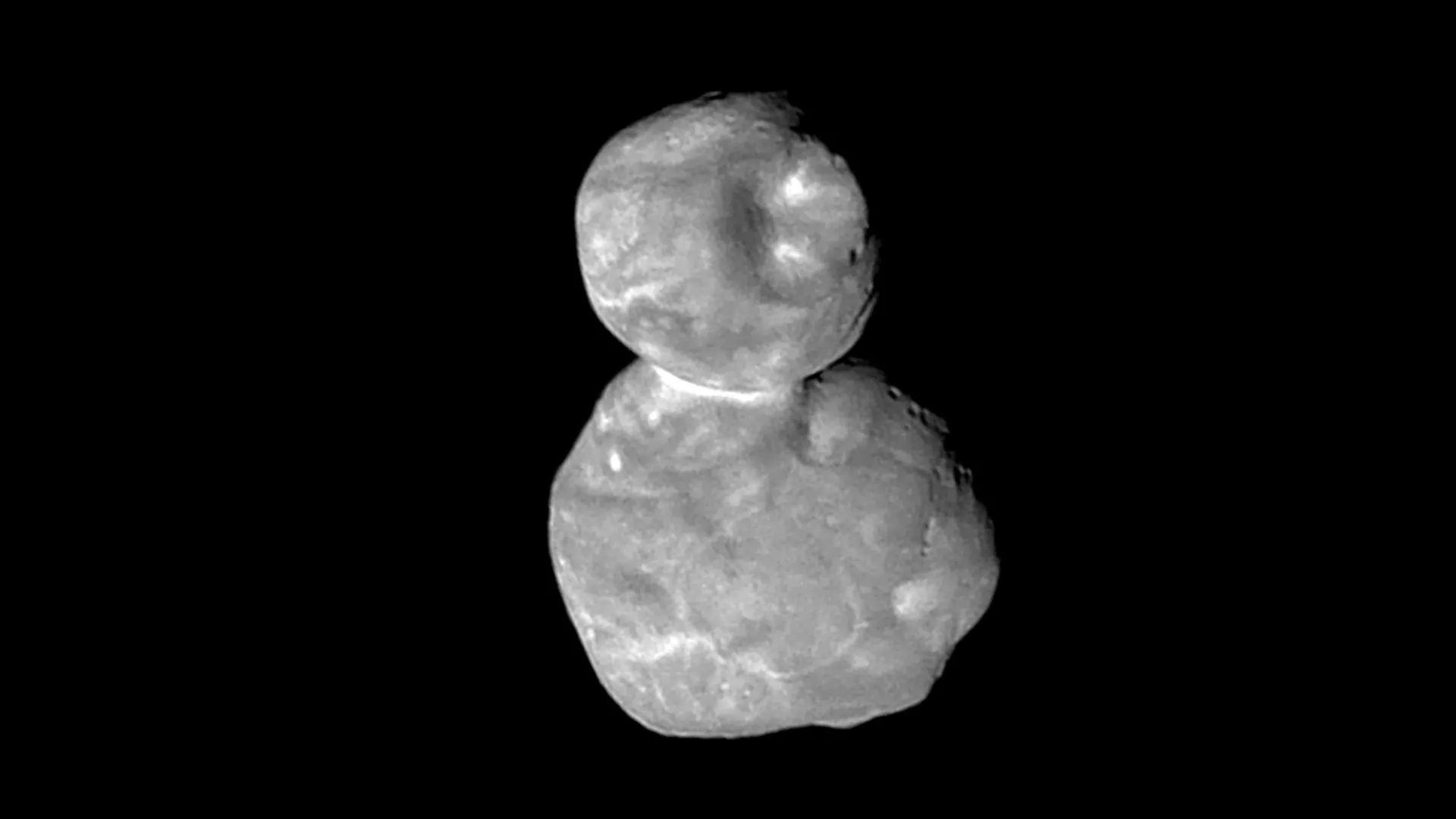
A decades-old puzzle about the shapes of objects in the distant Kuiper Belt may have been solved by a Michigan State University graduate student’s computer simulations. The simulations demonstrate how these icy bodies, often resembling snowmen with two connected lobes, can form through a process called gravitational collapse.
Beyond the asteroid belt, past the orbit of Neptune, lies the Kuiper Belt, a region containing remnants from the solar system’s formation. These remnants, known as planetesimals, are the building blocks of planets. Approximately 10 percent of these planetesimals are contact binaries – objects with two distinct lobes connected to each other. The origin of these unusual shapes has long been a subject of debate among astronomers.
Jackson Barnes, a graduate student in Earth and Environmental Science at MSU, developed the first simulation that successfully reproduces the formation of contact binaries through gravitational collapse, a process where matter shrinks under its own gravity. His research, published in the Monthly Notices of the Royal Astronomical Society, addresses a key question in understanding the early solar system.
Previous attempts to model the formation of these objects treated collisions as interactions between fluid blobs, resulting in spherical shapes. Barnes’s simulation, however, utilized the high-performance computing cluster at MSU’s Institute for Cyber-Enabled Research (ICER) to create a more realistic environment. This allowed the objects in the simulation to retain their structural integrity, enabling them to settle against each other rather than merging completely.
“If we consider 10 percent of planetesimal objects are contact binaries, the process that forms them can’t be rare,” said Seth Jacobson, Professor of Earth and Environmental Science at MSU and senior author on the paper. “Gravitational collapse fits nicely with what we’ve observed.”
The snowman-like shape of Arrokoth, a Kuiper Belt object visited by NASA’s New Horizons spacecraft in 2019, brought the phenomenon to wider attention. Images from the flyby revealed Arrokoth’s distinctive two-lobed structure, prompting further investigation into the prevalence of similar shapes among other Kuiper Belt objects. Subsequent observations confirmed that roughly one in ten planetesimals in the region exhibit this characteristic form.
The Kuiper Belt, a vast ring of icy debris, is considered a relatively undisturbed relic of the early solar system. The sparse population of this region means collisions are infrequent, allowing fragile structures like contact binaries to survive for billions of years.
Planetesimals themselves formed from a rotating disc of dust and pebbles surrounding the young Sun. As these clouds of particles collapsed under gravity, they sometimes fragmented into two separate bodies that began orbiting each other. Barnes’s simulation shows these pairs gradually spiraling inward, gently contacting and fusing without a violent collision, thus preserving their rounded shapes.
Barnes’s model represents a significant advancement over previous attempts to explain the formation of contact binaries. He believes the simulation could also be adapted to study more complex systems involving three or more connected objects. The research team is currently working on refining the simulation to better represent the behavior of collapsing clouds.
As NASA continues to explore the outer solar system with future missions, researchers anticipate discovering more of these uniquely shaped objects, providing further opportunities to test and refine their understanding of planetesimal formation.
