SKKU Boosts PCEC Efficiency via New Interfacial Contact Tech
Sungkyunkwan University Researchers Address Interfacial Resistance in Protonic Ceramic Cells
A research team led by Professor Wonyoung Lee at Sungkyunkwan University developed a nanocoating method to improve energy efficiency and durability in protonic ceramic electrochemical cells.
The Tech TL;DR:
- Researchers targeted interfacial contact resistance between dense electrolytes and porous electrodes in protonic ceramic cells.
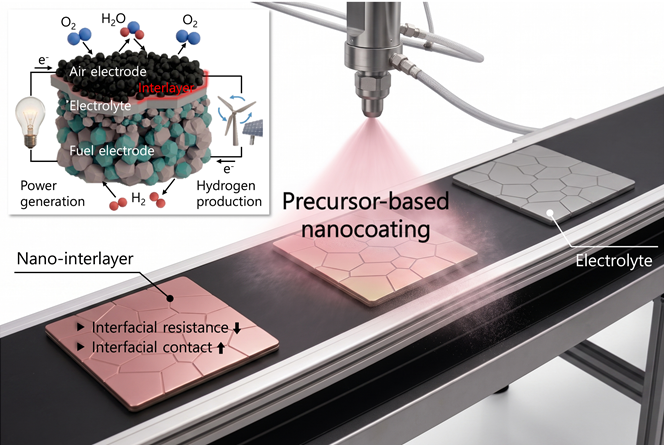
- An electrostatic spray deposition technique applies a dense nanometer-scale interlayer to increase contact area.
- The modified cells maintained stable operation under rapid temperature changes and handled methane and ammonia fuels directly.
Dual-Mode Clean Energy Limitations in Conventional Cells
Protonic ceramic electrochemical cells operate in two modes within a single system. They generate clean electricity from hydrogen without pollutants as fuel cells, and they use electricity to split water to produce hydrogen as electrolyzers. These devices operate efficiently at lower temperatures than conventional alternatives, making them valuable for future hydrogen infrastructure.
However, performance is bottlenecked inside conventional cells. The interface between the dense, smooth electrolyte and the porous, sponge-like electrode often lacks complete physical contact. This physical gap creates undesirable interfacial contact resistance, which stops materials from realizing their intrinsic performance limits.
Quantifying Contact Coverage as a Design Parameter
To measure how contact area influences resistance, the team fabricated experimental model cells with varying degrees of physical contact. Detailed analyses demonstrated that interfacial resistance systematically decreases as contact coverage—the proportion of components in direct physical contact—increases.
Following this quantitative analysis, the researchers identified contact coverage as a primary design parameter governing cell performance. Addressing this physical gap required a precision deposition method capable of operating across microscopic surfaces without clogging porous structures.
Electrostatic Spray Deposition of Nanometer Interlayers
To implement this principle in real cells, the researchers applied electrostatic spray deposition. This technique uses electrostatic forces to uniformly spray microscopic liquid droplets onto a target surface.
Using this process, the team deposited an extremely thin, dense nanometer-scale interlayer across the electrolyte surface. This interlayer successfully increased the physical contact area between the electrode and electrolyte.
Cells built with this new interlayer demonstrated substantially improved performance over conventional cells in both power generation and hydrogen production modes. The cells also maintained stable operation under rapid temperature changes, backed by strong adhesion between the electrode and electrolyte.
Direct Fuel Flexibility and Industrial-Scale Scaling
Beyond pure hydrogen, the modified cells exhibited excellent performance and stability when directly fueled with methane or ammonia. Both fuels are currently drawing interest as alternative energy carriers for next-generation power systems.
The electrostatic spray deposition process also enabled uniform fabrication on large-area substrates. This capability demonstrates potential for industrial-scale commercialization beyond standard laboratory environments.
No matter how advanced a new material may be, it cannot deliver its full performance if the interfaces between components are not properly connected. This study is significant because it quantitatively defines microscopic contact behavior and simultaneously maximizes both cell performance and durability using a scalable precision nano-process. Wonyoung Lee
The research team expects this technology to apply broadly to large-scale clean energy power plants, hydrogen-powered vehicles, and eco-energy storage systems. Funding for the project was provided by the National Research Foundation of Korea and the Ministry of Science and ICT, alongside the Korea Research Institute of Chemical Technology.