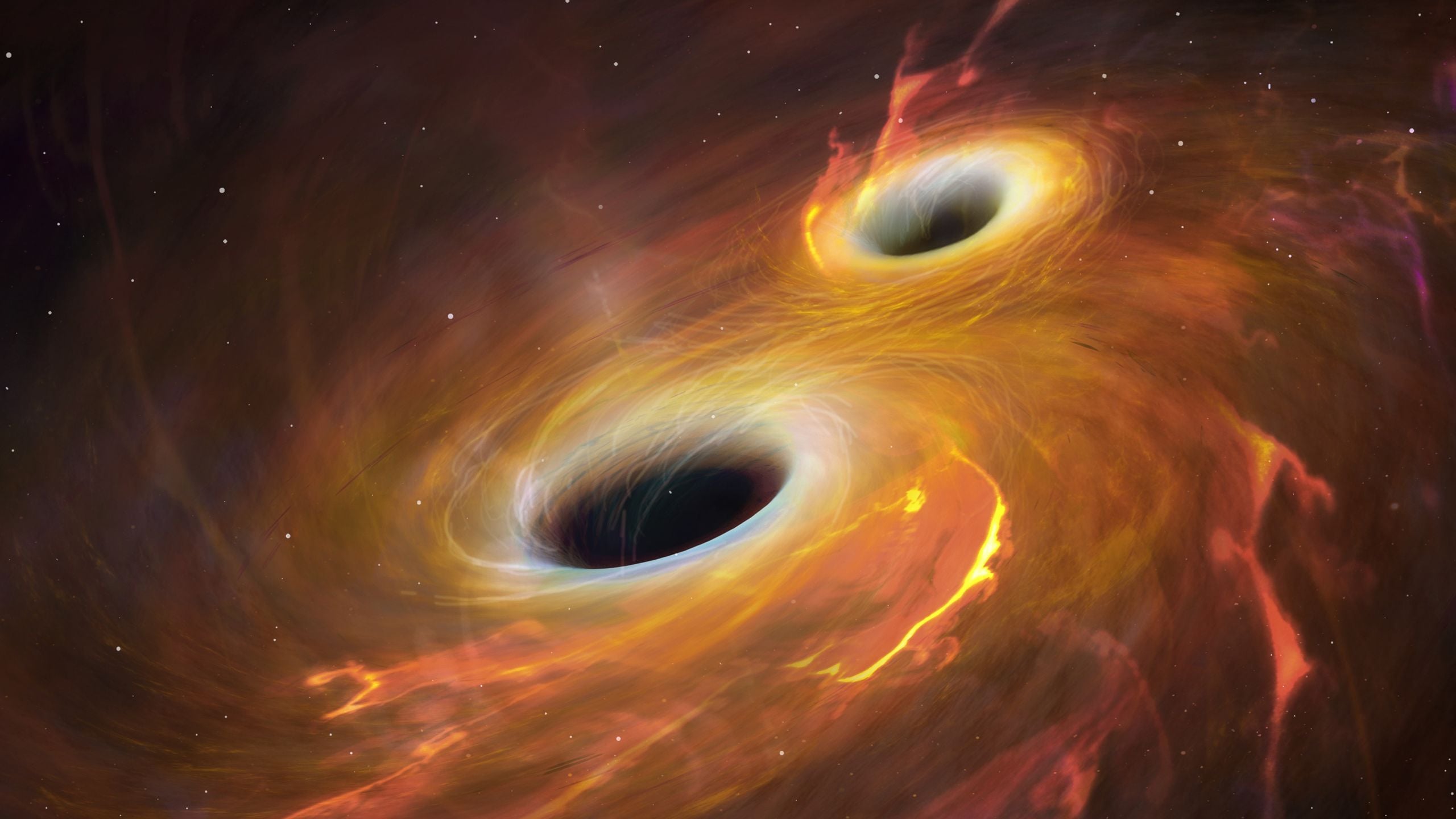
Simulated Colliding Wormholes Produce Unique Gravitational Waves
Simulated Wormhole Collisions Yield Shrunk Horizons
Traversable wormholes interacting in a simulated binary system can form a common apparent horizon that inexplicably shrinks rather than grows. Physicist Nikita M. Shirokov of the Moscow Institute of Physics and Technology and machine learning engineer Ilya Nachevsky of the Higher School of Economics published the preprint on arXiv detailing three-dimensional simulations of Ellis-Bronnikov wormholes.
The Tech TL;DR:
- New simulations show that binary Ellis-Bronnikov wormholes can attract, repel, or collapse into black holes with shrinking horizons.
- Interactions generate short, sharp bursts of gravitational waves that lack the classic chirping pattern of merging black holes.
- Early Universe wormhole signals would be stretched below current detector frequencies, limiting immediate observational astronomy use.
The Mechanics of Phantom Scalar Fields
Unlike non-traversable Einstein-Rosen bridges, an Ellis-Bronnikov wormhole relies on a hypothetical phantom scalar field. This field features unusual negative-energy properties designed to prevent the throat from pinching shut. However, the delicate balance is highly volatile. Even small disturbances can trigger a runaway inflation process or a complete collapse into a black hole.
To evaluate these dynamics, Shirokov and Nachevsky varied initial separations, trajectories, and scalar field properties in their 3D models. The results demonstrated diverse outcomes, ranging from gravitational scattering where the throats expanded dramatically to direct plunges.
Apparent Horizon Contraction Defies Standard Theory
When two simulated wormhole throats plunged toward each other, a common apparent horizon enclosed both structures. Under Stephen Hawking’s 1971 black hole area theorem, the surface area of a black hole’s event horizon can only increase or stay the same under ordinary circumstances. That theorem relies on energy behavior assumptions that the phantom scalar field deliberately violates.
As the exotic negative-energy field fell into the collapsing region of space, the simulated apparent horizon lost approximately 28 percent of its area. While this specific setup involves an apparent horizon rather than a true event horizon and utilizes a theorem-violating field, the contraction provides a striking counterpoint to standard gravitational expectations.
Gravitational Wave Signatures Without the Chirp
As massive objects like black holes spiral inward, their changing motion emits gravitational waves characterized by a distinctive chirp that grows stronger and higher in frequency. The massive Ellis-Bronnikov wormholes modeled in the new study also generate gravitational waves during movement and interaction, but the resulting signal profile differs significantly.
Interactions produced short, sharp bursts of gravitational waves rather than continuous chirps. The precise shape and strength of the signal depended directly on whether the wormholes plunged together or merely grazed each other in passing. Closest flybys produced particularly strong bursts even when a common apparent horizon failed to form.
Cosmic Expansion Hinders Detection of Early Wormhole Signals
Detecting these signals remains a significant practical hurdle. According to the authors, primordial wormholes would generate emissions lengthened by the expansion of the cosmos down to frequencies well underneath the operational limits of facilities like LIGO alongside the planned LISA mission. Detecting these specific bursts would require wormholes to form much later in cosmic history, though current models offer no established mechanism for such late-stage generation.
Unusual gravitational wave signals have surfaced before. Since its detection in 2019, the anomalous event GW190521 has been examined continuously as a potential indicator of unusual spacetime dynamics. While the new simulations do not establish a direct connection to that historical event, the ongoing analysis illustrates why mapping the possible signatures of hypothetical objects remains a valuable endeavor.