Scoliosis Spinal Rod Migrates to Groin 20 Years After Surgery
A 43-year-old woman recently underwent surgical intervention to remove a spinal instrumentation component that had migrated from her lumbar spine to her groin area twenty years after her initial scoliosis corrective surgery.
- Delayed hardware migration is an exceptionally rare complication that can occur decades after spinal fusion if the bone-metal interface loses stability.
- Persistent or shifting pain in the lower back, hip, or groin area in patients with a history of spinal instrumentation requires immediate diagnostic imaging to rule out hardware failure.
- Early detection is critical to preventing neurovascular injury, as migrated components can track along anatomical pathways such as the psoas muscle.
Pathogenesis of Delayed Hardware Migration
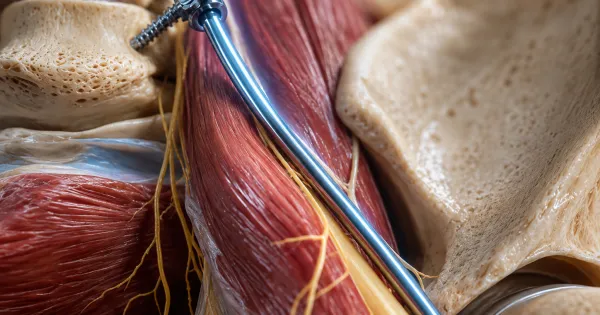
The patient presented with progressive lumbar pain two decades after undergoing an anterior lumbar fusion for idiopathic scoliosis. Initial radiographic evaluation revealed loosening of the fixation screws and the detachment of a metal rod from the spinal construct. According to the clinical report, the patient subsequently experienced a shift in pain localization to the hip and groin, prompting further investigation. Imaging confirmed that the detached rod had migrated caudally, tracking along the psoas muscle—a primary hip flexor that originates at the lumbar vertebrae and inserts into the femur—eventually reaching the anterior hip region.
This migration mechanism underscores the potential for pseudoarthrosis, or “false joint” formation, in spinal surgery. When a solid fusion fails to develop completely, the micro-motion at the site of the vertebrae exerts repetitive mechanical stress on the hardware. Over years, this stress can fatigue the fixation points, causing screws to loosen and rods to disconnect. Once liberated, the hardware follows the path of least resistance through soft tissue. In this instance, the rod reached the vicinity of the femoral nerve, which is essential for knee extension and sensory function in the lower limb.
Clinical Management and Surgical Intervention
The surgical team performed an anterior hip approach to retrieve the migrated metal component. The procedure was successful, with no permanent neurovascular injury reported. Following the removal, the patient showed significant symptomatic improvement. The clinical team has since outlined a multi-stage plan to remove the remaining instrumentation and address residual spinal deformity. The case report serves as a clinical reminder that while spinal hardware is designed to be permanent, it is not biologically integrated into the bone in the same way as a natural graft, making long-term monitoring essential.
Epidemiological Context and Patient Awareness
The migration of spinal rods is classified as an exceptionally rare event. Literature on the topic remains limited to isolated case reports and small cohorts, where hardware fragments have been recovered from the retroperitoneum, thigh, or near the knee. Because these events are statistically uncommon, they do not necessitate routine, frequent imaging for asymptomatic patients. However, clinical consensus dictates that any new or worsening pain in the back, flank, hip, or groin must be evaluated promptly. This is particularly urgent if the pain is accompanied by physical symptoms such as palpable masses, sensory deficits, or motor weakness in the lower extremities.

Medical professionals emphasize that patients should not rely on self-diagnosis or ignore persistent symptoms under the assumption that a successful surgery remains permanent indefinitely. As the medical community continues to refine long-term outcomes for scoliosis surgery, the focus remains on early identification of mechanical failure to avoid complex revisions.
Disclaimer: The information provided in this article is for educational and scientific communication purposes only and does not constitute medical advice. Always consult with a qualified healthcare provider regarding any medical condition, diagnosis, or treatment plan.
>Worth a look
- Japan Launches Virus Therapy to Target Esophageal Cancer Cells
- CORTIS Hits Career High with 12.93M Monthly Listeners and Dominates Korean Charts
- Why Snapchat Messages Took Three Years To Uncover In Family Insurance Case (newsdirectory3.com)
- Why Movie Theaters Are Still So Cold, 100 Years Later (daybreakwire.com)