
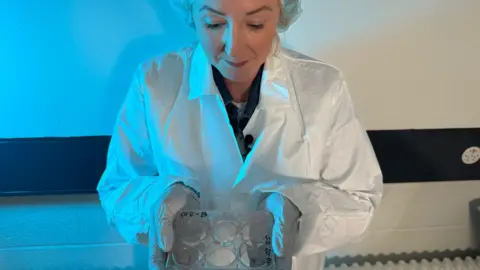
Scientists are pioneering a radical new form of computing, building “living computers” from human cells, a development that could revolutionize fields from medicine to artificial intelligence.Researchers are harnessing the inherent computational abilities of biological systems, moving beyond traditional silicon-based technology.
The convergence of biology adn computer science promises a future where computers are not merely tools made of inert materials, but dynamic, self-repairing systems grown from living tissue. This emerging field, still in its early stages, has the potential to create devices with unparalleled energy efficiency and processing power, while also raising profound ethical questions about the nature of life and technology. The work is driven by a desire to overcome the limitations of current computing architectures and to explore entirely new paradigms for information processing.
Dr. Andrew Adamatzky, a professor at the University of the West of England, has been at the forefront of this research. He and his team have demonstrated that networks of human kidney cells can perform basic computational tasks, mimicking the logic gates found in conventional computers. “When you have a movie of science fiction, or a book, I always felt a bit sad because my life was not like in the book,” Adamatzky said. “Now I feel like I’m in the book, writing the book.”
The team’s experiments, detailed in recent publications, involve growing networks of approximately 32,000 human kidney cells on an agar plate. By applying different stimuli – such as light or chemical signals – researchers can control the electrical activity within the cell network, effectively creating a biological circuit. These circuits have been shown to solve simple mathematical problems and even exhibit rudimentary forms of memory.
While these “bio-computers” are currently far slower and less complex than their silicon counterparts, the potential for advancement is significant. Researchers believe that by optimizing cell networks and developing more elegant methods for controlling their activity, it may be possible to create bio-computers capable of performing complex calculations and even learning.
The implications of this technology are far-reaching.In medicine, living computers could be used to create highly sensitive biosensors for detecting diseases or to develop personalized drug therapies. In artificial intelligence, they could lead to the creation of more energy-efficient and adaptable AI systems. However, the development of living computers also raises ethical concerns about the potential for misuse and the need for careful regulation. Further research is needed to fully understand the capabilities and limitations of this emerging technology, and to ensure that it is developed responsibly.
