
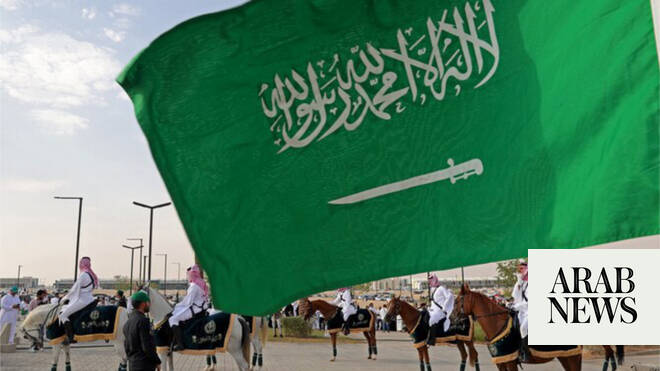
RIYADH – Saudi Arabia marked its Founding Day on February 22nd, commemorating the establishment of the First Saudi State in 1727. The observance, formalized in 2022, signifies a shift in the Kingdom’s historical narrative, emphasizing a three-century journey of state-building and unification rather than solely focusing on the 1932 establishment of the modern Kingdom.
The origins of the Saudi state trace back to Diriyah, where Imam Mohammed bin Saud established the First Saudi State, initiating a period of organized governance and political unity. According to historical accounts, Ibn Saud was the emir of Diriyah, a town near present-day Riyadh, and was involved in financing merchant journeys. This initial state laid the groundwork for a stable political entity centered on shared leadership, and principles.
Following a period of fluctuation, the Second Saudi State emerged under Imam Turki bin Abdullah bin Mohammed bin Saud, preserving the concept of unity despite regional challenges. This phase safeguarded the legacy that would eventually lead to the modern Saudi state. The establishment of the First Saudi State in 1727, and the subsequent alliance between Imam Mohammed bin Saud and Muhammad bin Abdul Wahhab, proved foundational, though the precise details of that early alliance have been subject to evolving historical interpretation.
A pivotal moment in the Kingdom’s history occurred on January 15, 1902, when King Abdulaziz bin Abdulrahman bin Faisal Al-Saud recaptured Riyadh. This event marked the beginning of a process of unification that ultimately brought much of the Arabian Peninsula under a single banner. King Abdulaziz’s efforts culminated in 1932 with the proclamation of the Kingdom of Saudi Arabia, establishing a modern state with defined institutions and governance structures.
The discovery of oil shortly thereafter dramatically reshaped the Kingdom’s economic trajectory. The first commercial shipment of Saudi oil in 1938 initiated a new economic era, providing resources for infrastructure development, public services, and modernization. Oil revenues facilitated the growth of cities and improvements in living standards, establishing Saudi Arabia as a significant economic force.
Today, Saudi Arabia is undergoing another significant transformation with the implementation of Saudi Vision 2030, spearheaded by King Salman and Crown Prince Mohammed bin Salman. The Vision aims to diversify the economy, develop human capital, and promote sustainable growth, reducing reliance on oil revenues.
Economic indicators demonstrate progress toward these goals. Gross domestic product has grown from SR2.6 trillion ($693 billion) in 2016 to nearly SR4.7 trillion by 2024, representing an average growth rate of approximately 8 percent. The National Industrial Development and Logistics Program contributed roughly SR986 billion to non-oil GDP in 2024, highlighting its role in diversifying the economy. Non-oil activities now account for 55.6 percent of total GDP, while the Kingdom’s dependence on oil revenues has decreased from 90 percent to around 68 percent.
The tourism sector has also experienced substantial growth, with over 122 million domestic and international tourists visiting in 2025. Preliminary estimates from the Ministry of Tourism indicate total tourism spending reached approximately SR300 billion, a 6 percent increase compared to the previous year.
The commemoration of Founding Day, acknowledges not only the historical origins of the Kingdom but also three centuries of resilience, transformation, and state-building. The Kingdom continues to pursue its Vision 2030 goals, with ongoing projects and initiatives aimed at further economic diversification and modernization.
