
Samsung Pay Fees: Card Companies Face Mounting Costs & Potential Impact on Consumers
South Korea’s card payment network is facing a critical juncture as Samsung Pay’s potential imposition of transaction fees threatens to squeeze already-thin margins for card issuers. The dispute, rooted in decades of regulated fee structures and escalating competition in the mobile payment space, is poised to impact profitability and potentially consumer benefits, forcing card companies to seek innovative cost management solutions and potentially legal counsel.
The Squeeze on Korean Card Issuers
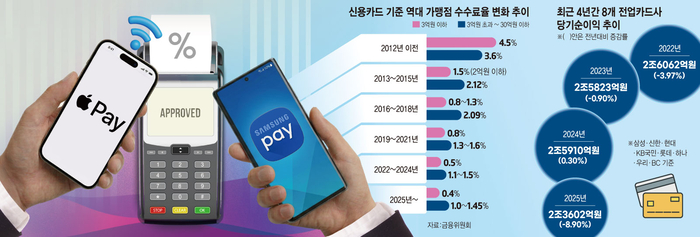
The current conflict stems from a long-standing issue: artificially suppressed interchange fees. For fifteen years, the South Korean government has actively intervened in card transaction fees, capping rates to protect small and medium-sized enterprises (SMEs). As of 2024, credit card interchange fees for merchants with annual sales under 300 million won (approximately $220,000 USD) stand at a mere 0.4%, a dramatic decrease from the 4.5% charged in 2012. This regulatory environment, while beneficial for merchants, has steadily eroded the profitability of card issuers. The vast majority – 96% – of Korean merchants fall into this SME category, making fee increases virtually impossible without government approval.
Samsung Pay’s Leverage and the Authentication Cost Factor
Samsung Pay’s move to potentially charge transaction fees adds another layer of complexity. While Samsung maintains it’s simply seeking fair compensation for its platform, card companies argue they are already absorbing significant costs related to Samsung Pay usage. Specifically, card issuers bear the expense of biometric authentication – the fingerprint or iris scans used to verify transactions. Each authentication event costs approximately 3 won (roughly $0.002 USD), a seemingly small amount that quickly accumulates with the widespread adoption of Samsung Pay. According to data from the Bank of Korea, mobile card payments accounted for 68.2% of total card transactions in 2025, highlighting the scale of this hidden cost. Bank of Korea Statistics
Profitability Under Pressure: A Look at Recent Performance
The financial strain on Korean card companies is already evident. Combined net profits for the eight major Korean credit card companies – Samsung, Shinhan, Hyundai, KB Kookmin, Lotte, Hana, Woori, and BC Card – decreased by 8.9% in 2025, falling to 2.3602 trillion won (approximately $1.74 billion USD) from 2.5910 trillion won the previous year. While loan and installment revenue increased, a 442.7 billion won decline in merchant discount revenue directly reflects the impact of fee regulations. This trend is unsustainable, and the potential addition of Samsung Pay fees could push some issuers into the red.
“The Korean card market is uniquely vulnerable due to the decades-long price controls. Unlike the US or Europe, where interchange fees are market-driven, Korean issuers operate under a constant regulatory shadow. This makes it incredibly difficult to absorb additional costs, even seemingly small ones.” – Jaehoon Kim, Portfolio Manager, KB Asset Management.
The Ripple Effect: Consumer Benefits at Risk
The most immediate consequence of increased costs will likely be a reduction in consumer benefits. Card companies will be forced to curtail rewards programs, reduce cashback offers, and potentially increase annual fees to offset the financial burden. This could lead to a shift in consumer behavior, with more individuals opting for prepaid cards or alternative payment methods that offer fewer rewards but lower costs for merchants. This dynamic is already observable; the growth of prepaid card usage is outpacing that of traditional credit cards.
Apple Pay’s Influence and the Platform Power Dynamic
The situation is further complicated by the growing influence of Apple Pay. Currently, Apple Pay operates primarily through a partnership with Hyundai Card, but expansion to Shinhan Card, KB Kookmin Card, and Toss Bank is underway. This expansion is fueling Samsung’s argument for comparable fees, creating a platform power dynamic where card issuers are caught in the middle. Samsung argues that if they are not compensated similarly to Apple, it creates an unfair competitive disadvantage. The increasing penetration of iPhones among younger demographics – with iPhone market share exceeding 60% among those aged 18-29 – adds urgency to the situation. Statista – Smartphone OS Market Share in South Korea
Navigating the Legal Landscape and Seeking Expert Guidance
Card companies are actively exploring their legal options, seeking clarification on the government’s regulatory authority and the fairness of Samsung’s proposed fees. This requires specialized expertise in Korean financial regulations and antitrust law. Leading Korean corporate law firms specializing in financial litigation are currently advising card issuers on potential legal challenges. The outcome of these deliberations will significantly shape the future of the Korean payment ecosystem.
The Need for Modern Risk Management and Compliance
Beyond legal counsel, card issuers need to bolster their risk management and compliance frameworks to navigate this evolving landscape. The increasing complexity of regulations and the emergence of new payment technologies demand robust systems for monitoring transactions, detecting fraud, and ensuring compliance with evolving standards. Specialized risk and compliance consulting firms are well-positioned to assist card companies in strengthening their defenses against financial and regulatory risks.
A Looming Restructuring of the Card Fee System
The Samsung Pay dispute is not an isolated incident; it’s a symptom of a fundamentally flawed fee structure. The long-term solution lies in a comprehensive re-evaluation of the card fee system, one that balances the interests of merchants, consumers, and card issuers. This will likely involve a phased increase in interchange fees, coupled with measures to protect vulnerable SMEs. The government’s next triennial review of card fee rates, scheduled for late 2026, will be a critical moment.
“The Korean government needs to recognize that artificially suppressing interchange fees has unintended consequences. It stifles innovation, reduces competition, and ultimately harms the long-term health of the payment ecosystem.” – Dr. Sun-Hee Park, Professor of Finance, Seoul National University.
The coming fiscal quarters will be pivotal for Korean card issuers. Successfully navigating this crisis requires proactive legal strategies, robust risk management, and a willingness to embrace innovative solutions. For businesses seeking to partner with reliable and experienced providers in these areas, the World Today News Directory offers a curated selection of vetted financial consulting firms and legal experts ready to assist. The future of the Korean payment landscape hinges on adapting to these challenges and forging a sustainable path forward.