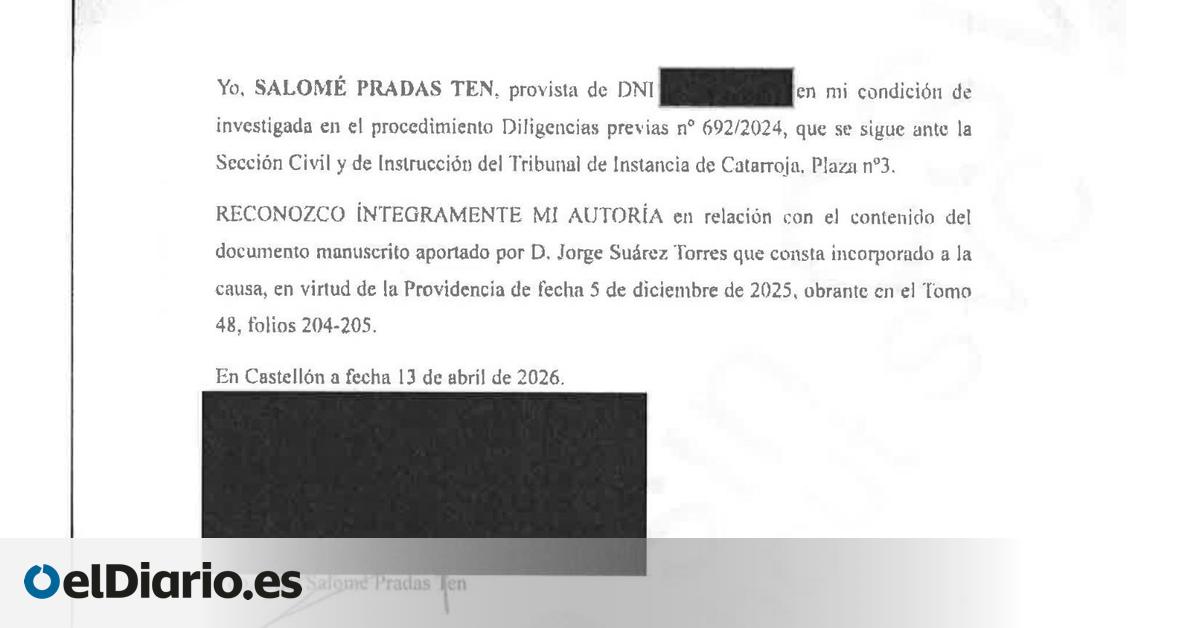
Salomé Pradas Admits Authorship of Handwritten DANA Emergency Notes
Former Valencia Regional Minister Salomé Pradas has formally admitted before a notary that she authored the handwritten notes used during the October 29, 2024, flash flood emergency. This admission comes as legal proceedings intensify over the delayed emergency alerts that preceded a catastrophe claiming 230 lives in the province of Valencia.
This is more than a dispute over penmanship. It is a battle over the exact moment the government realized the magnitude of the disaster and why that knowledge did not translate into immediate public warnings.
For months, the legal defense of the regional government has leaned on the theory of an “information blackout,” suggesting that state agencies failed to warn them in time. However, the admission of these notes—and the testimony of those inside the Integrated Operational Coordination Center (Cecopi)—paints a different picture. It suggests a leadership that was aware of the danger but hesitated on the execution of life-saving alerts.
The Paper Trail of a Catastrophe
The handwritten document, provided to the court by Jorge Suárez, the Deputy Director of Emergencies, contains a chillingly specific set of instructions. Pradas’ notes explicitly mention the demand for the population to avoid riverbeds and the recommendation that people “elevate” themselves to at least the first floor of their buildings.
The notes specifically identify high-risk areas: Ribera Alta, Ribera Baixa, Horta Sud, and the Hoya de Buñol. Most tellingly, the word “confinement” appears to have been crossed out and replaced with the phrase “staying at home.”
It is a stark contrast to the public narrative of confusion. These were not vague concerns; they were specific tactical directives written by the person in charge of the emergency response.
Now, Pradas is attempting to block a court-ordered handwriting analysis. Her defense argues that such a procedure is not “mandatory” and should be subject to the “principle of necessity.” They claim that since she has already admitted to the notes, a forensic analysis is redundant and would constitute an unnecessary deprivation of liberty if coerced.
When the legal stakes involve hundreds of deaths, the “necessity” of evidence is rarely a matter of convenience. For the families of the victims, this legal maneuvering is a distraction from the core failure: the gap between knowing a flood is coming and telling the people to run.
The Anatomy of a Delay
The tragedy of the Valencia floods was not a lack of data, but a failure of communication. The “Es-Alert” system—the EU-standard cell broadcast designed to warn everyone in a specific geographic area—was available. It was simply not used in time.
Testimony from Jorge Suárez reveals that the technical side of the emergency response had the alerts ready early. Yet, the messages were delayed by “legal and linguistic doubts” regarding the use of the Valencian language, raised by political leaders. Even as officials debated grammar and legal liability, the river Magro was already causing fatalities in Utiel.
The timeline of the decision-making process at the Cecopi reveals a systemic paralysis:
| Time (Oct 29, 2024) | Action/Event | Source of Testimony |
|---|---|---|
| 17:00 | Suggestion made to send a mass mobile message to the population. | Aurora Roca (Press Chief) |
| 17:15 – 17:38 | Formal notification that messages could be sent to the public. | Jorge Suárez (Deputy Director) |
| 20:11 | First “Es-Alert” finally dispatched. | Jorge Suárez (Deputy Director) |
| 20:28 | President Carlos Mazón arrives at the Cecopi center. | UME Commander |
| 20:57 | Second “Es-Alert” dispatched. |
The delay is staggering. For over three hours, the technical capacity to save lives existed, but the political will to trigger the alarm did not.
Power Struggles in the Command Center
The investigation has too exposed a vacuum of leadership at the top. While Carlos Mazón was the President of the Generalitat, a commander from the Military Emergencies Unit (UME) testified that he felt no leadership from the President during the crisis.
“The counselor [Salomé Pradas] was the one in command. I did not perceive any leadership from the former president in the management of the emergency.”
This testimony aligns with other accounts suggesting that Pradas was the sole decision-maker in the room. If the counselor was indeed the one “calling the shots,” her handwritten notes become the primary evidence of her state of mind and her awareness of the risk.
This level of administrative failure creates a legal nightmare for the region. Navigating the subsequent liability claims is a logistical minefield, and victims are increasingly turning to specialized liability lawyers to ensure that “linguistic doubts” are not accepted as a valid excuse for negligence.
The Myth of the Information Gap
The defense’s attempt to blame state agencies like the Júcar Hydrographic Confederation (CHJ) for a lack of communication has been systematically dismantled. Aurora Roca, the Press Chief for Emergencies, testified that the staff at the Cecopi were not in an “information bubble.”
Everyone had a mobile phone. Everyone knew the magnitude of the storm. The “blackout” was not a lack of information, but a failure to act on it.
When regional infrastructure is decimated by such a failure, the recovery process is slowed by the same bureaucracy that caused the disaster. Local municipalities are now scrambling to find emergency restoration contractors who can rebuild without relying on the flawed coordination structures that failed them in October.
The admission of the notes by Salomé Pradas closes one door—the question of who wrote them—but opens another: Why, if she knew the population needed to “elevate” to the first floor and avoid riverbeds, did it grab until after 8:00 PM to send a text message to the people of Valencia?
As the court continues to examine the “body of writing” and the sequence of events, the case serves as a grim reminder that in disaster management, a handwritten note is a record of intent, but a delayed alert is a record of failure. For those seeking to prevent such catastrophes in the future, consulting risk management consultants is no longer optional—it is a necessity for survival in an era of extreme weather.
The tragedy of 230 lives lost cannot be undone by a notary’s signature, but the truth of who held the pen—and who held the power—is finally coming to light.