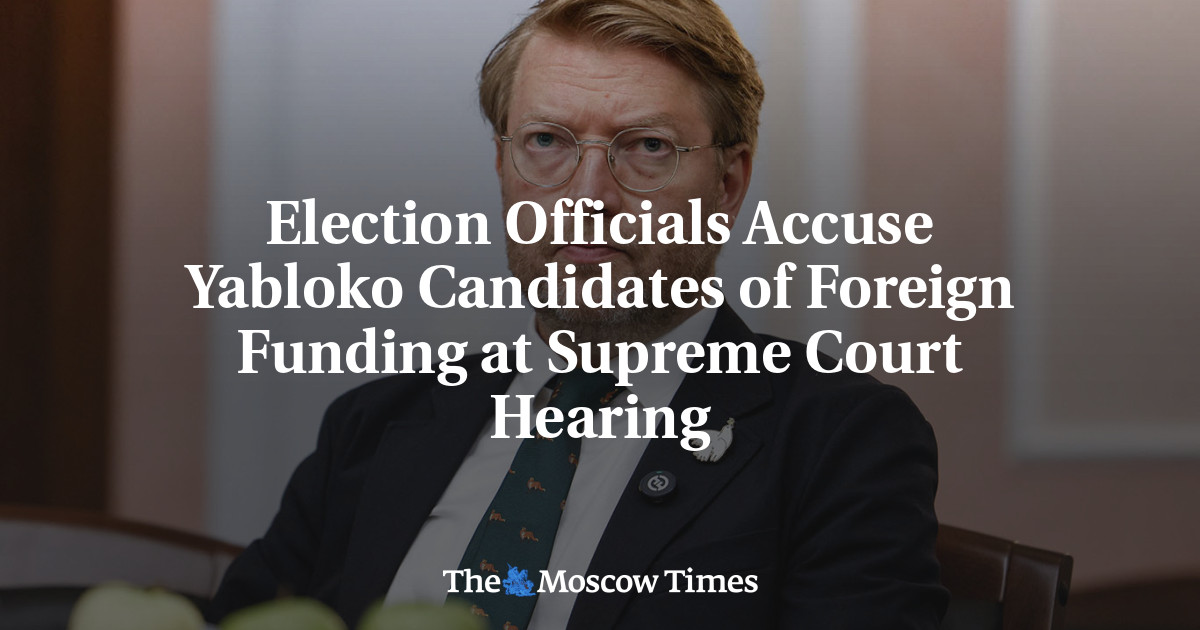
Russian Supreme Court Bars Yabloko, Russia’s Only Pro-Peace Party, From Elections
On August 10, 2026, the Russian Supreme Court barred the Yabloko party from participating in the upcoming State Duma elections scheduled for September, according to coverage by Kyiv Post and BBC. Legal counsel representing the nationalist Rodina party brought forward the successful lawsuit, claiming that Yabloko engaged in extremist promotion and accepted funding from abroad, which Judge Vyacheslav Kirillov ultimately upheld. Because of this decision, the sole registered political party running on an anti-war platform has been excluded from the nationwide party-list ballot.
Origins of the Legal Dispute and Foreign Funding Allegations
The legal challenge against Yabloko began on August 7, 2026, when the nationalist Rodina party filed its disqualification lawsuit with the Supreme Court, according to Kyiv Post. Rodina leader Alexei Zhuravlyov asserted that his party uncovered violations committed by Yabloko, telling reporters outside the courthouse that the party is full of people who work for the West and hold Western values. During the Monday hearing, Central Election Commission authorities presented evidence indicating that several Yabloko candidates received foreign financial transfers in 2025, based on data supplied by Russia’s financial watchdog, Rosfinmonitoring.
Yabloko leader Nikolai Rybakov rejected the allegations during the court proceedings. Rybakov stated that the party is funded by Russian citizens, noting that citizens had donated 16,900,000 rubles (roughly $204,885) to the party, which authorities had labeled as foreign financing. According to Ostorozhno Novosti, Rybakov told supporters outside the courthouse that the party would appeal the ruling within the five-day deadline.
Public Dissent and Demonstrations Outside the Moscow Courthouse
Hundreds of Yabloko supporters gathered outside the Moscow courthouse during the eight-hour hearing on August 10, 2026, according to BBC and Kyiv Post reports. Demonstrators carried apples as a symbol of support, chanting slogans such as "Russia" and "Yabloko," while others chalked messages like "For Yabloko. For freedom" on the pavement. Security forces prepared to disperse the crowd, with a police officer warning through a loudspeaker that individuals had two minutes to leave before facing potential military enlistment office processing, as reported by Kyiv Post.

Since the start of Russia’s full-scale invasion of Ukraine in February 2022, public opposition and dissent have faced strict suppression under wartime censorship laws, making the courthouse gathering a rare instance of public mobilization, notes BBC. Yulia Navalnaya, widow of late opposition leader Alexei Navalny, commented on the development by stating that the Kremlin is scared of the fact that millions of Russians now have a chance to express their views on the war.
Political Implications for the Upcoming September Elections
Yabloko has contested every parliamentary election since 2003, maintaining an anti-war stance through multiple conflicts, including the war in Chechnya, the 2014 annexation of Crimea, and the invasion of Ukraine. In the 2021 parliamentary elections, the party secured 1.34% of the vote. With the disqualification of Yabloko, all 10 remaining political parties participating in the upcoming ballot either support the war or avoid openly criticizing it, according to BBC reporting.

Independent election watchdogs have seen their capacity to monitor and challenge electoral processes heavily restricted. Political analysts note that without an active anti-war political force on the ballot, voter turnout among opposition supporters may decline, potentially benefiting the ruling United Russia party, whose ratings have faced pressure amid inflation, drone strikes, and internet restrictions.
As the legal appeals process moves forward within the five-day window, the exclusion of Yabloko solidifies the removal of organized electoral dissent from Russia’s 2026 parliamentary ballot, leaving opposition voices with limited avenues for public participation.