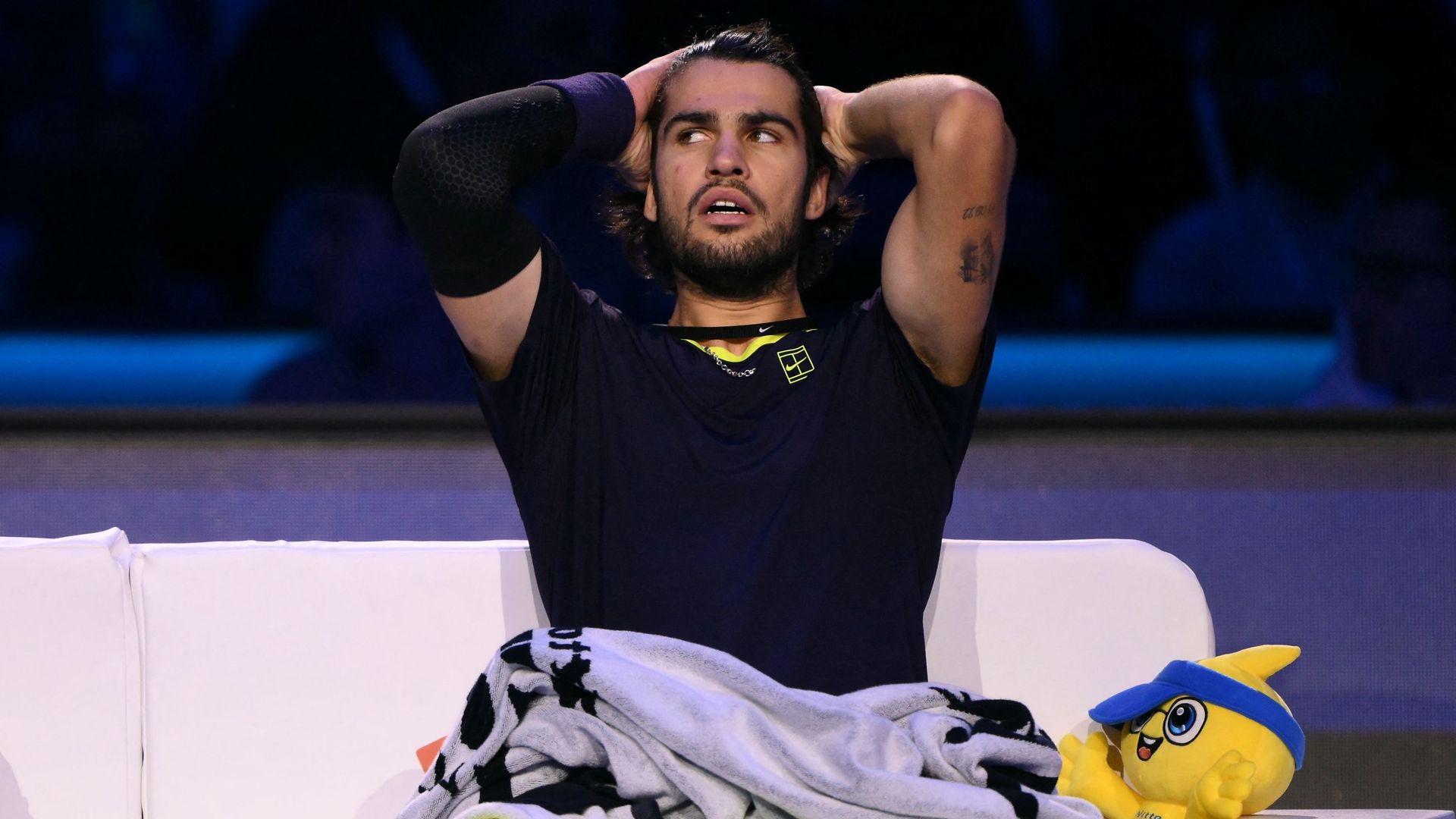
RTBF: Alcaraz Cancels Training for Scans, Set to Play Friday If Cleared
TURIN — Carlos Alcaraz dismantled Daniil Medvedev 6-2, 6-4 in Turin on Wednesday while taking treatment on his left thigh, then canceled his Thursday training session to wait for scan results, RTBF reported.
He will still play his final group match on Friday.
A time-out at 2-1
The Spanish world No. 3 called for the medical time-out at 2-1 in the second set against Medvedev, per Sudinfo’s report from the Ivan Lendl group match. A bandage went on the thigh, and Alcaraz closed out his eleventh straight win — a streak built on titles in Vienna and Paris before Turin.
Then came the part that turned a routine round-robin win into a risk assessment. Alcaraz was due to train on Thursday, RTBF reported, but pulled out of the session pending the definitive results of scans performed that morning. The Murcian, the outlet noted, feared making the problem worse.
Alcaraz ha decidido seguir jugando en Turín, pero hay que entender que lo hace sabiendo que hay un RIESGO. Sea lo que sea que haya salido en esa resonancia, bien una elongación o una rotura (grande o pequeña), hay algún problema en esa zona y Carlitos se expone a que se le… https://t.co/c4USTCl2QI pic.twitter.com/Sn9qpwlVZ0
What the hamstring injury could cost
The stakes frame everything else. Alcaraz has already secured his semifinal place after two group wins, but he cannot withdraw without surrendering the one major title missing from his collection — the ATP Finals, where he lost last year’s final to Jannik Sinner, according to Le Soir.
Two months beyond this week sits the Australian Open, where he is the defending champion. A grade-2 hamstring tear, according to José Moron, editor-in-chief of Punto de Break, would cost him four to eight weeks on the sidelines.
Alcaraz did not hide the problem after the Medvedev match.

“I can feel it a little, I won’t lie about that,” he said at his press conference, Eurosport reported. “I was playing very well and unfortunately, I suddenly felt a small problem with my hamstring. Just a little.”
He described his on-court response in the same session:
“I felt something during the match, but I think everyone could see I was able to keep playing good tennis. I moved fine. I didn’t want to push myself to the limit, I had a break in hand. I just tried to stay calm and play smoothly, relaxed.”
Positive scans, guarded relief
The diagnosis picture firmed up on Thursday. Alcaraz underwent an MRI and a scan of the thigh, and the results were positive enough that his participation in the tournament is not compromised for now, Le Soir reported, citing the Spanish daily Marca, which added that his condition will be closely monitored.
RTBF’s own reporting aligned: Spanish press indicated the situation is not serious and that Alcaraz decided to take the court Friday against Italy’s Flavio Cobolli.
Not everyone read the reassurance the same way. Moron, who has followed the Spaniard’s season closely, warned against treating the improved scans as an all-clear, We Love Tennis reported.
“Alcaraz has decided to keep playing in Turin, but you have to understand he is doing it knowing there is a RISK. Whatever the MRI showed — a strain or a tear, big or small — there is a problem in that zone, and Carlitos exposes himself to aggravating it if he pushes on. A serious grade-2 tear could keep him out for four to eight weeks, and the Australian Open starts in less than two months.”
The wrist injury memory
Moron’s point carries weight because of what happened earlier this season. Alcaraz’s wrist problems forced him to miss Roland-Garros and Wimbledon, Le Soir noted — a four-and-a-half-month absence that reminds anyone tracking his calendar how quickly a “small” injury becomes a Grand Slam deficit.

Alcaraz himself leaned on that history:
“I’ve been through moments like this before,” he said after the Medvedev win. “I’m learning to know my body better. Past experience lets me react the right way, on court and off it.”
Favorite without the rival
The on-court form makes the gamble harder to second-guess and harder to justify at once. Alcaraz beat Frances Tiafoe 6-2, 6-2 in his opener on Monday, then took down Medvedev in straight sets in 1 hour and 11 minutes, with the match-turning break coming early in each set.
He is the tournament favorite, and Sinner, who beat him in last year’s final and won the title in 2024 as well, is absent this year.
The physical mechanics of the injury explain the caution. A hamstring strain versus a tear sits on a spectrum that only imaging — the MRI Alcaraz underwent Thursday — can separate, and load management decisions over the next 48 hours will weigh each extra set played in Turin against a January title defense in Melbourne.
Moron added that Alcaraz’s condition after the tournament will need assessing before the Davis Cup is contemplated. For amateur athletes tracking the same kind of injury, the practical lesson from the elite setup is the sequence Alcaraz followed: stop the aggravating activity, image the area promptly, and let a sports-medicine physician and physiotherapist set the return-to-play timeline rather than pain levels alone.
Dead rubber, live risk
Friday’s match against Cobolli, who has already collapsed in this group — Le Soir noted the Italian was on the wrong end of a 6-0 second set against Tiafoe — is dead rubber for Alcaraz’s semifinal place but live for his rhythm, his title bid and a market watching the futures board in Melbourne shift with every bulletin from Turin.

What happens next is on the record: Alcaraz plays Cobolli on Friday, with Le Soir reporting he will be watched attentively for the rest of the tournament. The deciding evidence, as RTBF put it, arrives with the end of the week.
Disclaimer: The insights provided in this article are for informational and entertainment purposes only and do not constitute medical advice or sports betting recommendations.