
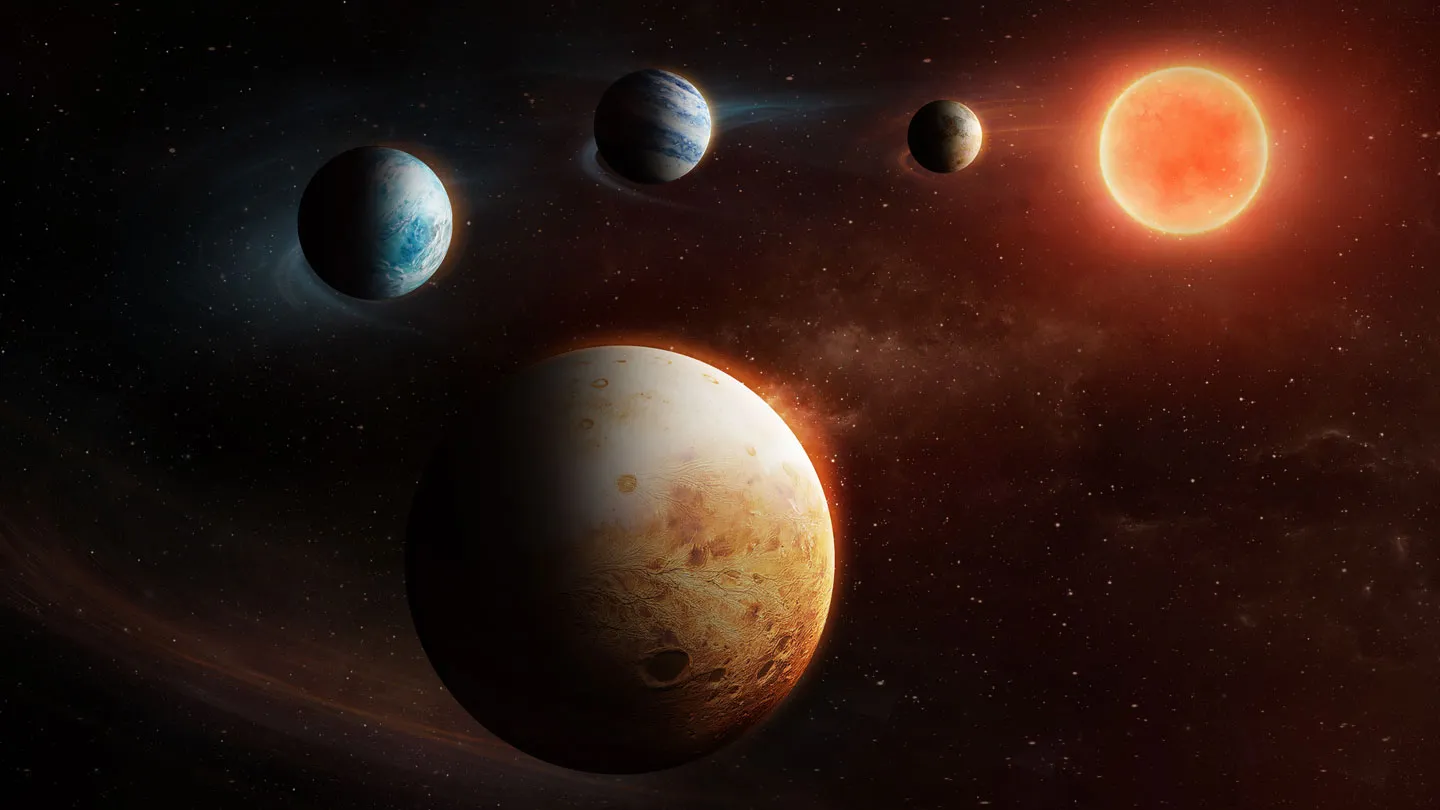
Astronomers have discovered an exoplanet system that defies conventional planetary formation theories, featuring a rocky planet orbiting alongside gas giants in an unexpected arrangement. The system, designated LHS 1903, presents a configuration – rocky-gaseous-gaseous-rocky – that challenges existing models of how planets form around stars.
The discovery, reported February 12 in the journal Science, centers on a red dwarf star located approximately 116 light-years from Earth. LHS 1903 is about half the mass of our sun and is orbited by four planets, all with relatively short orbital periods of less than 30 days. The planets range in size from roughly 1.4 to 2.5 times the radius of Earth, placing them in the size range between super-Earths and mini-Neptunes.
The initial detection of the system was made in 2019 by NASA’s Transiting Exoplanet Survey Satellite (TESS). Subsequent observations from both ground-based telescopes and space-based observatories allowed scientists to precisely determine the planets’ masses and densities, providing insights into their potential compositions.
Current planetary formation theory suggests that rocky planets should form closer to a star, where the intense radiation can strip away the atmospheres of less dense worlds. Gas giants are expected to coalesce further out, where volatile materials are more abundant. “This [LHS 1903] follows that pattern beautifully for the first three planets,” said Andrew Cameron, an astronomer at the University of St. Andrews in Scotland. “Then, something weird happened to the fourth planet.”
The fourth planet in the system, based on its density, appears to be rocky, even as the two planets closer to the star are believed to be enveloped in gaseous atmospheres. This arrangement is akin to finding a Venus-like planet beyond the orbit of Neptune in our own solar system. The unusual configuration suggests a history of planetary migration within the system.
Researchers hypothesize that the outer planets of LHS 1903 may have migrated inward over time, potentially through gravitational interactions with other bodies in the system. A similar process is thought to have reshaped our own solar system in its early stages, causing Jupiter and Saturn to shift their orbits and influencing the distribution of asteroids.
The migration could have involved a large impact on the fourth planet, stripping away its atmosphere, or a scattering of planet-building material from the outer system. Cameron suggests the fourth planet may have formed late in the system’s evolution, “just as the system ran out of gas.”
The European Space Agency’s CHEOPS satellite contributed to the detailed characterization of the planets in the LHS 1903 system, providing precise measurements of their sizes. Further study of this unusual system could refine our understanding of the diverse ways in which planetary systems can evolve.
