Robotics Faces Uncertain Future After Jensen Huang’s Departure
Robotics firms face an uncertain future following the departure of Jensen Huang, whose advocacy and financial backing helped shape the industry over the past decade.
The Tech TL;DR:
- NVIDIA’s board accepted Jensen Huang’s resignation on Nov. 12, leaving CFO Colette Kress to serve as interim CEO during the search for a permanent successor.
- Physical AI revenue at NVIDIA nearly tripled year over year, reaching a projected track toward $25 billion for fiscal 2027, which accounts for about 6% of the company’s annual revenue projection of more than $400 billion.
- Industry leaders express concern that a new executive team may not maintain the same level of keynote attention, early-stage venture funding, and hardware development support for robotics startups.
Days before Christmas in 2023, Serve Robotics faced imminent bankruptcy after a major investor pulled out of a committed funding round, leaving the sidewalk delivery robot maker without cash for payroll.
Co-founder and CEO Ali Kashani contacted Huang, who spoke with him at 6 a.m. the following day and arranged dinner with his executive team to structure a rescue package, The Robot Report reported. NVIDIA led a financing round that restored the company, and Serve Robotics celebrated a public listing on Nasdaq four months later.
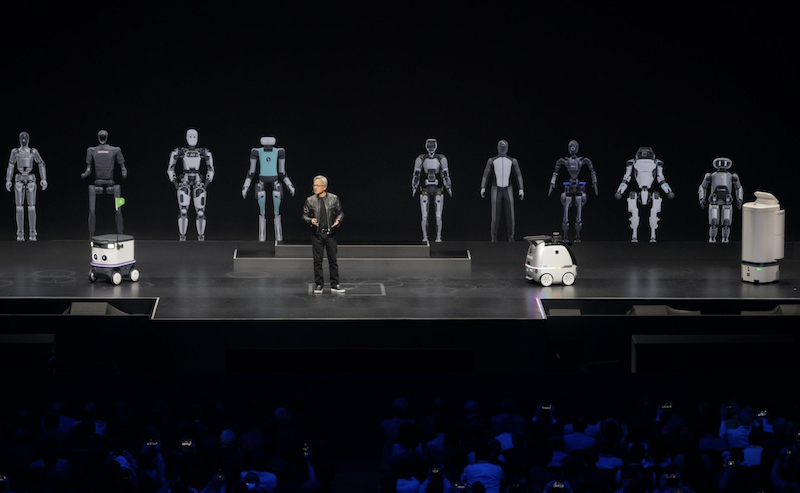
“Jensen was fantastic in painting the vision,” said Yaro Tenzer, co-founder and CEO of RightHand Robotics, noting how Huang expanded investor imagination regarding robotics potential. NVIDIA reported during its third-quarter earnings call that physical AI revenue nearly tripled year over year, tracking past $25 billion in fiscal 2027, according to insightex.si. That total represents roughly 6% of the company’s projected annual revenue exceeding $400 billion.
Since introducing the Isaac robotics platform in 2017, NVIDIA built an extensive software and hardware stack spanning GPUs, CUDA, the Omniverse and Isaac Sim simulation environments, Isaac Lab, the GR00T and Cosmos foundation models, Isaac ROS software, and Jetson embedded computing.
Jan Zizka, co-founder and CEO of Brightpick and co-founder of Photoneo, participated in an early-access program for the Jetson TX1 computing platform and said that Huang pushed the market forward by investing before demand materialized.

Under Huang, NVIDIA backed multiple robotics ventures including Figure AI, NEURA Robotics, Skild AI, Wayve, Waabi, and Serve Robotics.
Deepak Jayaraj, vice president of hardware engineering and manufacturing at Four Growers, said that Huang’s steady attention during marathon keynotes made it significantly easier for founders to pitch investors. “Jensen’s style will be hard to copy,” Jayaraj said, adding that he would judge the incoming leadership by which robotics programs they continue to fund.
Next CEO faces data center rivalry and regulatory scrutiny
NVIDIA’s next chief executive inherits mounting data center competition and potential regulatory oversight following the midterm elections. Robert Little, co-founder and former CEO of ATI Industrial Automation, questioned whether a negative financial shift in data center profitability might prompt the company to cut research funding not yielding immediate returns.
“What’s the first thing you do when you start to see a negative financial situation? You cut anything that’s not making money,” Little said.
Observers are also monitoring NVIDIA’s pending $12.9 billion acquisition of Hugging Face, whose LeRobot initiative serves as a core resource for developers. Despite potential strategic shifts, Little argued that the robotics momentum has grown too strong to stall completely. “The flywheel has been created and it is spinning now,” Little said, adding that “We’re too far in. The momentum has been created, and now it’ll just carry itself through.”
Zizka expressed a more cautious perspective regarding the disruption of trust built across the ecosystem. “The best possible case is that it will continue,” Zizka said, “But I think this is a negative.” Tenzer suggested that humanoid developers face a critical test over the next 12 months as they attempt to prove viable business use cases to skeptical investors.
Born in Taipei in 1963, Huang immigrated to the United States at age nine and later earned a master’s degree from Stanford University before co-founding Nvidia in 1993.
He led the company for more than three decades, steering it from near-bankruptcy in the 1990s to a market capitalization exceeding $5 trillion in October 2025, making it the first company to reach that milestone. His tenure saw Nvidia expand from graphics processors into high-performance computing and artificial intelligence, a shift that underpinned the robotics investments now in question.
“Somebody needs to get on that stage and show some of the cool things that are happening and have this charisma and have the ability to do it,” Tenzer said. “I think this is where Jensen will be missed.”