Retinotopy Constrains Neural Manifold Topology in Macaque Visual Cortex
Neural activity in the primary visual cortex of rhesus macaques is constrained by retinotopy, according to research published in Nature.
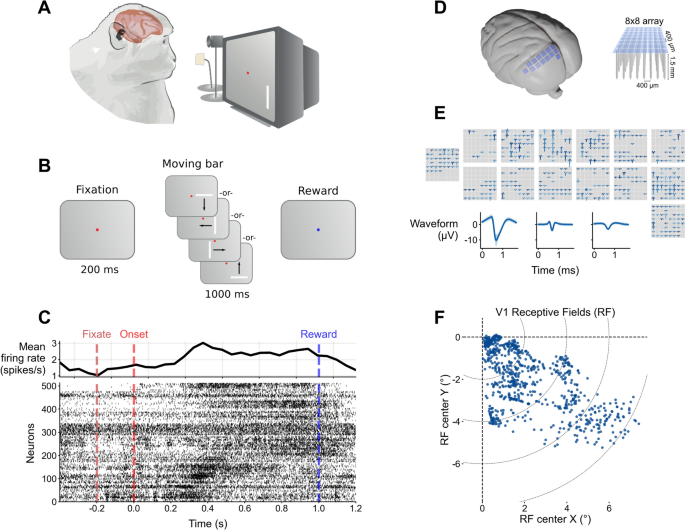
By analyzing data from 896 electrodes implanted in two macaques, researchers found that the geometric arrangement of the visual field dictates the underlying structure of neural manifolds. The stimuli were presented on a 19 inch CRT monitor with a resolution of 1024 by 768 pixels and an 85 Hz refresh rate, positioned at a viewing distance of 50 cm.
The study utilized 14 8×8 Utah arrays from Blackrock Microsystems to record electrical potential at a 30 kHz sampling rate. These electrodes reached 1.5 mm into the gray matter, targeting deeper layers of the visual cortex.
The researchers monitored neural responses while the animals performed a fixation task, reacting to a white bar sweeping across a 19-inch CRT monitor. During these trials, a high-contrast bar measuring 20 dva in length and 0.19 dva in thickness, with a luminance of approximately 92 cd/m², swept across the visual field at a speed of 20 dva/s.
To isolate the neural signals, the team applied a semi-automatic spike-sorting workflow using Kilosort4. This process identified 513 single units in one macaque and 186 in the other. Once the data was binned into 50 ms windows, the team used isomap embedding to visualize the neural manifolds in three-dimensional space and verify topological features through persistent homology.
The researchers contrasted these experimental observations with a phenomenological response model. This model simulated neural activity without recurrent interactions, relying instead on Gaussian-like responses across a 10×10 grid of neurons. The simulation confirmed that the observed “H1” topological features—representing one-dimensional loops—were robust and not mere artifacts of dimensionality reduction.
The analysis demonstrated that the topology of the neural manifold is tightly linked to the spatial layout of the stimulus. By varying parameters such as noise levels and grid spacing, the researchers showed that the “ratio of the death to the birth radius” of the longest H1 bar remained consistent, indicating genuine structural properties.
The study concluded that these manifold shapes are a direct consequence of how retinotopic input drives population activity across the cortical surface.