
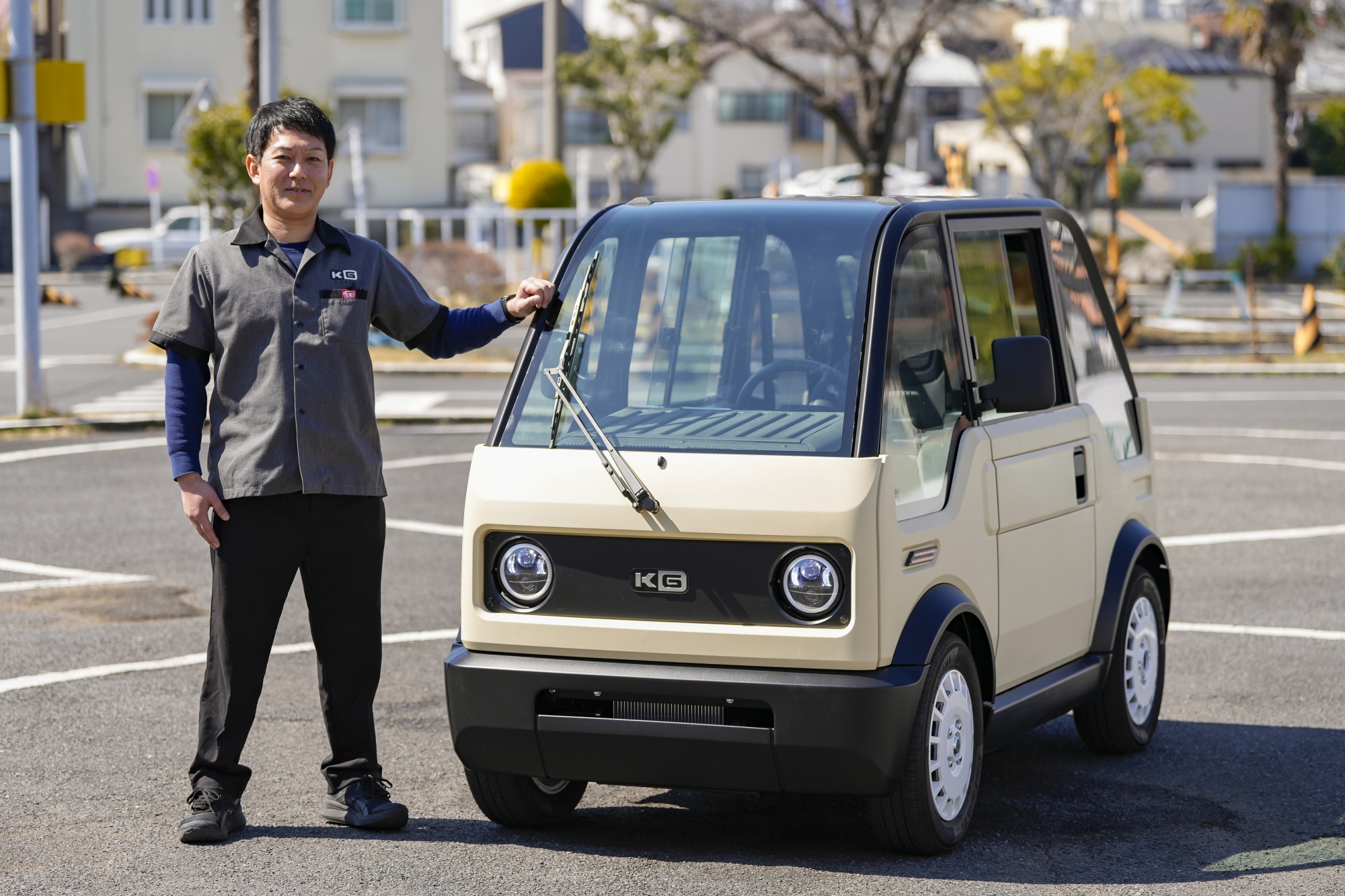
Japan’s Ultra-Small EV Revolution: KG Motors’ Mibot Challenges market Giants
CITY – May 3, 2024 – KG Motors’ Mibot, an ultra-small EV from japan, is experiencing a surge in popularity, challenging the dominance of larger automakers. The compact EV’s appeal stems from its cost-effectiveness and suitability for urban environments,mirroring consumer shifts. The company’s CEO aims to emulate the Honda Super Cub’s success. This innovative approach may redefine the EV landscape.
Japan’s Ultra-Small EV Revolution: KG Motors’ Mibot Challenges Market Giants
While electric vehicle (EV) adoption in Japan lags behind global trends,a hiroshima Prefecture startup,KG Motors,is experiencing a surge in orders for its single-seater,ultra-small EV,the mibot. This rise in popularity reflects changing transportation needs driven by increased environmental consciousness and an aging population.Developers are focusing on creating a practical “national car” suitable for everyday use.
The Mibot: Compact and Cost-Effective
The Mibot EV, developed by KG Motors in Higashihiroshima City, is a compact vehicle measuring approximately 2.5 meters in length and 1.1 meters in width, with a weight of 430 kg. It can be fully charged in about five hours using a standard household outlet, providing a range of 100 kilometers. The price, including tax, is 1.1 million yen.
Did You Know?
the Mibot’s compact size and electric powertrain contribute to lower running costs compared to traditional gasoline vehicles. This makes it an attractive option for budget-conscious consumers.
Demand Outstripping Expectations
KG Motors is currently finalizing the model specifications for mass production. The company reports having already received orders for over 2,200 of the 3,300 units slated for delivery by June 2027. This demand surpasses the number of EVs sold by Toyota Motor in Japan last year, which was approximately 2,000 units.
Legal changes Fueling popularity
Recent legal changes classifying the Mibot as a “Category 1 Motorcycle” (Diecar) have contributed to its popularity. The Mibot offers advantages over traditional mopeds, such as a roof and a maximum speed of 60 km/h, while avoiding the need for two-stage right turns.Furthermore, it is exempt from vehicle inspections, and its automobile tax is comparable to that of a motorcycle, resulting in lower maintenance costs.
Pro Tip
Consider the Mibot as an option to a moped if you value weather protection and increased stability. The legal benefits and lower running costs can make it a smart choice for urban commuting.
A New Value Proposition for EVs
While major automobile manufacturers worldwide are transitioning to EVs to reduce carbon dioxide (CO2) emissions, challenges related to price, charging time, and range have slowed sales.KG Motors aims to attract users by minimizing vehicle performance to essential requirements and reducing costs, possibly demonstrating a new value proposition for EVs.
Production Scale and Ambitions
KG motors plans to commence production at its new factory in Higashihiroshima City starting in October. Full-scale mass production is scheduled to begin next year, with the goal of achieving profitability quickly. The company aims to produce 10,000 units per year in the fiscal year ending June 2016, a figure comparable to the sales volume of brands like Jeep and Porsche in Japan last year.
The “Reiwa Super Cub” Vision
chief Executive Officer Kusunoki Kazunari, who has experience in starting a company that handles custom car parts and founded KG Motors in 2022, explained that the advantages of mibot are that it allows you to find the “most flavorful” thing about cars and mopeds.
Kusunoki Kazunari,CEO,KG Motors
Kusunoki aims to emulate the success of Honda motorcycles,which achieved a cumulative production volume exceeding 100 million units,envisioning the Mibot as a “Reiwa Super Cub,” referencing the iconic Honda Super Cub motorcycle that gained popularity in post-war Japan due to its convenience.
Evolving Mobility Landscape
Recent revisions to vehicle classifications under the Road Transport Vehicle Act and the Road Traffic Act have led to the emergence of various small mobility options, including electric kickboards and electric bikes with pedals. Consumer preferences are diversifying, making it uncertain whether the Mibot will achieve widespread popularity like traditional passenger cars and motorcycles.
According to Kusunoki, most of the existing ultra-small four-wheel evs are treated as two-seater light passenger cars, so they will not be able to receive vehicle inspections or tax benefits.
Kusunoki Kazunari, CEO, KG Motors
Addressing Rural Transportation Challenges
As Japan’s labor force shrinks due to aging and young people migrate to cities, rural public transportation systems, such as railways, buses, and taxis, are declining. This makes it increasingly arduous for elderly individuals to travel. Kusunoki notes that public transportation is becoming “devastating” in rural areas,including Hiroshima,where KG Motors is headquartered,leading to a situation where residents “are unable to live without cars.”
Cost-Effectiveness as a Competitive Edge
With stagnant incomes, car maintenance costs significantly impact households. Kusunoki believes that the Mibot’s combination of convenience and low cost provides a competitive advantage.
Toyota’s “Multipathway” strategy
Toyota, japan’s largest automobile manufacturer, has adopted a “Multipathway
” strategy, focusing on developing a wide range of products, including hybrid vehicles, fuel cell vehicles, and gasoline vehicles, rather than solely focusing on EVs. This reflects a more cautious approach to electric vehicles compared to some European manufacturers.
Slow EV Adoption in Japan
The acceptance of EVs in the Japanese market has been gradual. According to Bloomberg NEF (BNEF), EVs accounted for approximately 3.5% of total vehicle sales in Japan in 2023, significantly below the global average of 18%.
Challenging the skepticism
Kusunoki also acknowledges that he feels that there is a big rejection reaction to EVs in Japan. Many people seriously believe that evs will not become popular, saying that “what Toyota said was right,” and that EVs will not become popular, but he has declared that he “doesn’t think so at all.”
Kusunoki Kazunari, CEO, KG Motors
