Regeneron Study: Enhertu Plus Bispecific Antibody Clears Tumors in Mice, Triggers Immune Memory
Researchers at Regeneron Pharmaceuticals have demonstrated a combination therapy that cleared tumors in mice and triggered a durable immune memory, according to a study published in the journal Nature Communications.
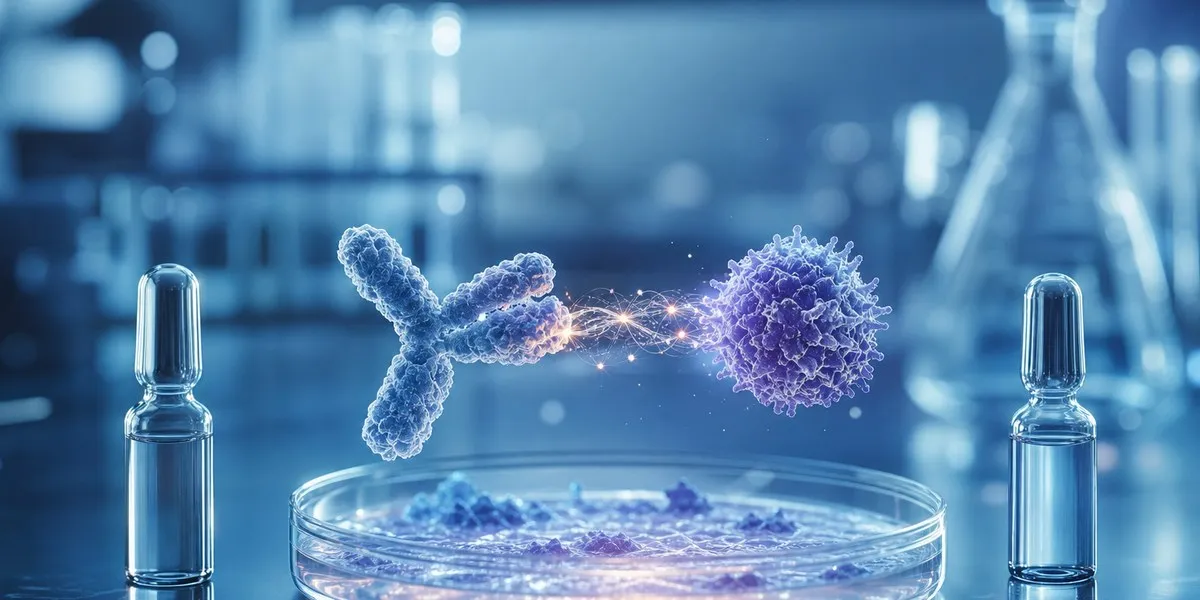
The experimental regimen pairs the antibody-drug conjugate Enhertu with a bispecific antibody designed to amplify T-cell activation.
The Tech TL;DR:
- The combination therapy achieved complete tumor clearance in all nine test subjects in a breast cancer model, outperforming Enhertu monotherapy.
- The treatment appears to induce an immune memory effect, allowing the subjects to reject reintroduced cancer cells without further clinical intervention.
- The experimental bispecific antibody is currently undergoing early phase 1/2 clinical trials to evaluate safety and efficacy in human models.
Enhertu and Bispecific Antibody Synergy
Enhertu, known clinically as trastuzumab deruxtecan, functions by targeting the HER2 protein to deliver a cytotoxic payload directly to tumor cells. While effective in various cancers, clinical outcomes often hit a ceiling due to tumor resistance or insufficient immune engagement. Regeneron researchers sought to lower this barrier by introducing a bispecific antibody that binds simultaneously to a tumor-associated protein and CD28, a critical co-stimulatory receptor on T cells.
This dual-binding mechanism provides the signal required to mobilize T cells effectively. In laboratory models, Enhertu alone achieved a complete response in fewer than 50% of mice at the highest dosage, UA.NEWS reported. When the bispecific agent was introduced, the success rate reached 100% in the nine-mouse cohort. A similar strategy utilizing an antibody targeting EGFR produced tumor rejection in 75% of subjects with resistant breast cancer models, according to ScienceAlert.

Immune Memory and Cellular Dynamics
The therapeutic effect relies heavily on the presence of CD8 T cells. Researchers observed that depleting this cell population completely nullified the treatment’s efficacy. In colorectal cancer models, the combination of the bispecific antibody and 5-fluorouracil required both CD8 T cells and natural killer (NK) cells to inhibit tumor growth. The absence of both cell types rendered the regimen ineffective, ScienceAlert noted.
Post-treatment analysis revealed an increase in T-cell receptor diversity, suggesting the immune system developed a broader recognition of tumor antigens. Mice that remained tumor-free for at least four weeks rejected reintroduced breast cancer cells without further treatment. However, when different colorectal tumor cells were introduced, the animals still developed tumors, indicating that the immune memory is specific to the primary tumor’s characteristics.
Clinical Translation and Development Constraints
While the study provides a proof-of-concept for bispecific-enhanced chemotherapy, the researchers emphasized that mouse models do not fully capture the toxicity profiles or systemic immune responses seen in human patients. Regeneron funded the research, and the authors are current or former employees who have filed patent applications related to the findings. The experimental antibody component is already being evaluated in phase 1/2 clinical studies, as reported by UA.NEWS.
Regeneron Pharmaceuticals, founded in 1988 by Leonard Schleifer and George Yancopoulos, initially focused on neurotrophic factors before expanding into cytokine and tyrosine kinase receptors. The company developed aflibercept, a VEGF inhibitor, and later partnered with Sanofi on immuno-oncology programs including the PD-1 inhibitor cemiplimab.
In 2020, Regeneron received a $450 million U.S. government contract under Operation Warp Speed to manufacture the monoclonal antibody cocktail REGN-COV2, which was administered to President Donald Trump following his COVID-19 diagnosis.
# Basic conceptual logic for bispecific T-cell activation
# Target_A: Tumor antigen
# Target_B: CD28 (T-cell co-stimulator)
def activate_t_cell(tumor_cell, t_cell):
    if bispecific_antibody.binds(tumor_cell.target_A) and bispecific_antibody.binds(t_cell.CD28):
        t_cell.trigger_cytotoxic_response()
        return True
    return False
The study results were published in Nature Communications. The experimental antibody utilized in the trials is currently moving through early-stage clinical development to determine if these results can be replicated in human oncology applications.