
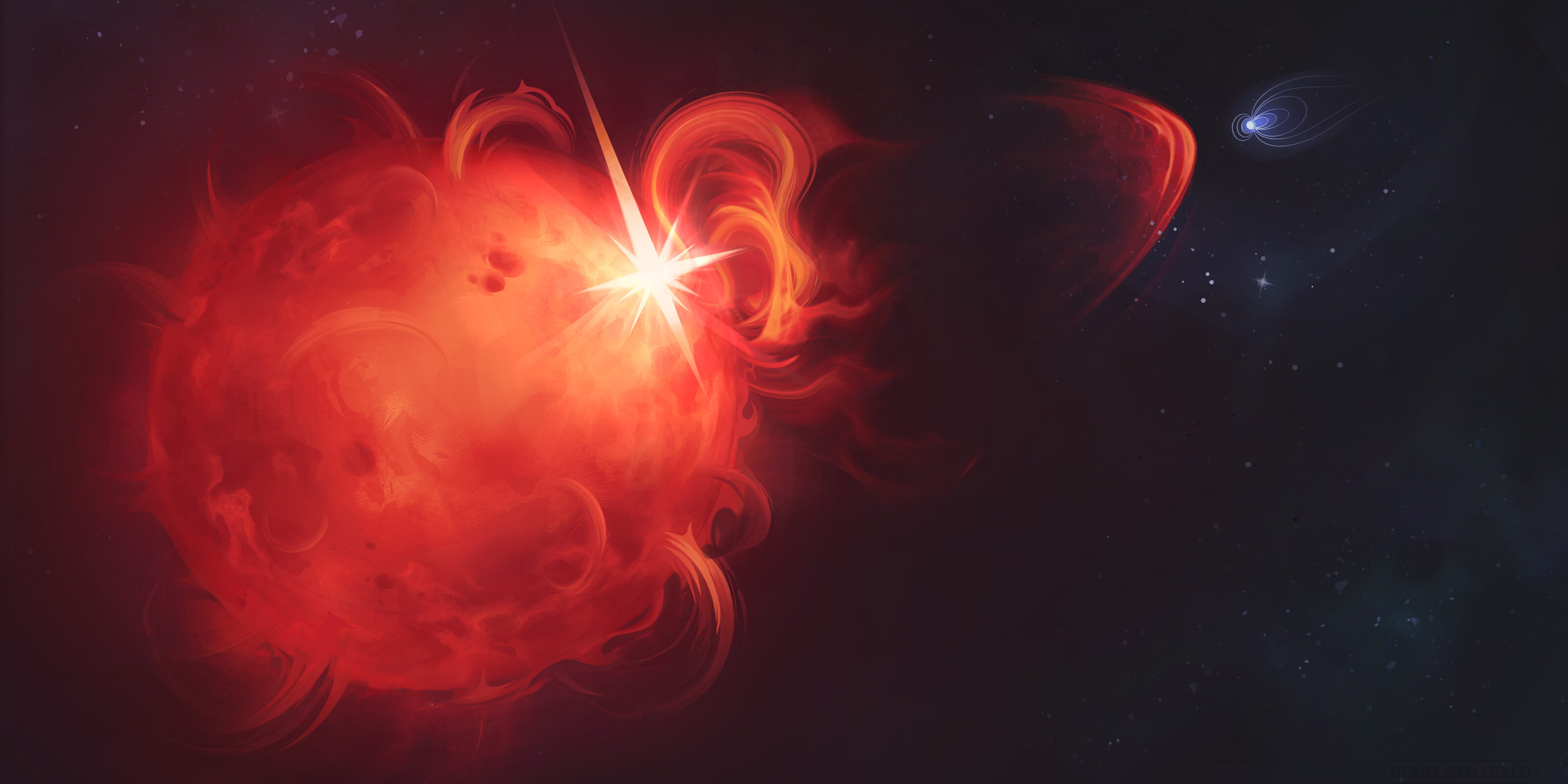
Powerful Ejection from Red Dwarf Star Poses Threat to Planetary Atmospheres
NOORDWIJK, Netherlands – Astronomers have, for the first time, directly observed a coronal mass ejection (CME) from a red dwarf star, revealing a powerful burst of matter traveling at nearly 2,400 kilometers per second. The findings,made possible by combining data from the LOFAR radio telescope and ESA’s XMM-Newton X-ray telescope,demonstrate the potential for intense space weather to strip atmospheres from planets orbiting these common stars.
The star, located 130 light-years from our sun, is a red dwarf – smaller and cooler than our sun, but with a magnetic field 300 times stronger and a rotation 20 times faster. LOFAR detected an intense radio signal indicative of matter escaping the star’s magnetosphere,confirming the event as a CME. XMM-Newton then characterized the star, verifying the speed of the ejected material.
“Now we’ve done it for the first time,” stated researcher Callingham.
The density and velocity of the CME were sufficient to eradicate the atmosphere of any nearby planet,rendering it uninhabitable. This discovery is crucial for understanding the habitability of planets around red dwarfs, which constitute the majority of stars in the Milky Way.
“We are no longer limited to extrapolating our understanding of the Sun to other stars,” said Henrik Eklund, ESA researcher at ESTEC.”Apparently, the smaller a star is, the more extreme the space weather is – and these are precisely the stars where we suspect possibly habitable planets.”
The research team intends to use these observations to further investigate how stellar activity impacts the potential for life on planets within the habitable zones of red dwarf stars.
