
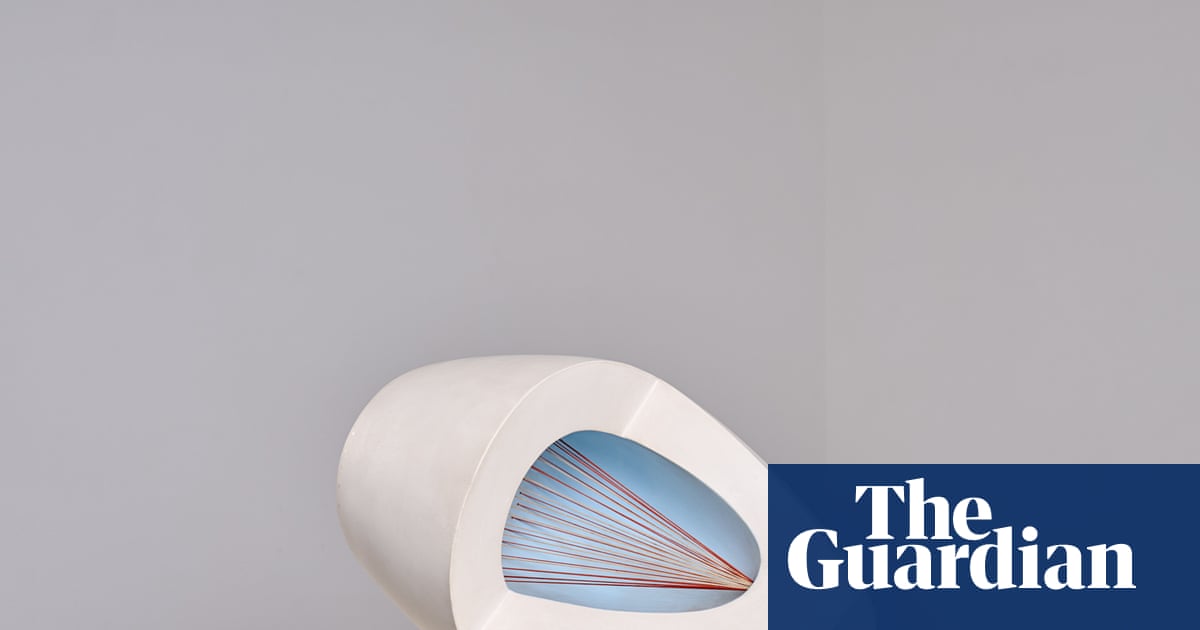
Barbara Hepworth Masterpiece Saved for the Nation After Landmark Fundraising Effort
Table of Contents
West Yorkshire, UK - A critically important work by British sculptor Barbara Hepworth has been secured for the national collection thanks to a successful public appeal.The piece, titled Sculpture with Colour (Oval Form) Pale Blue and Red, was acquired for £3.8 million,preventing its permanent removal from the United Kingdom.
A Breakthrough Work by a Modernist Pioneer
Created in 1943, the sculpture represents a pivotal moment in Hepworth’s artistic development. It is among the few wooden carvings she produced during the 1940s andómico, and one of the first to incorporate string as an integral element of its design.
Hepworth, a leading figure in modernist sculpture, is celebrated for her abstract forms and exploration of materials.Her work often reflects a deep connection to the natural world and a captivation with the interplay of space and form. As noted by art historian Penelope Curtis, Hepworth’s sculptures “are not about things, but about the space between things” (Tate Gallery Archive).
From Wartime Retreat to National Treasure
The sculpture’s journey to public ownership began when it was sold at Christie’s auction house a year ago to an anonymous international buyer. The British government promptly imposed a temporary export ban to allow time for a fundraising campaign to be launched. This campaign, spearheaded by the Art fund and the National Lottery Heritage Fund, garnered over 2,800 donations from the public.
Hepworth’s creation of this piece was deeply influenced by her relocation to St Ives, Cornwall, in 1939, with her husband, painter Ben Nicholson, and their children, fleeing the escalating conflict in London. Limited resources initially challenged her work, but a move to a larger house in 1943, coupled with a special permit to use wood, enabled her to create Sculpture with Colour.
did You Know? Barbara Hepworth’s use of string in her sculptures was innovative for its time,adding a new dimension of visual and tactile experience to her work.
A Legacy Preserved for Future Generations
The acquisition ensures that sculpture with Colour (Oval Form) Pale Blue and Red) will become a permanent part of the UK’s national collection and will be displayed at The Hepworth Wakefield, in the artist’s hometown. This will provide unprecedented public access to a rarely seen work from a crucial period in her career.
Olivia Colling, interim director and CEO of The Hepworth Wakefield, expressed her delight, stating, “We think she would have been delighted that so manny peopel have come together to enable her work to be part of a public art collection which can be experienced and enjoyed by so many.”
Art fund trustee Richard Deacon echoed this sentiment, describing the sculpture as “a testament to the undaunted spirit of a great artist” and noting his profound impression upon seeing it at a 1968 retrospective at the Tate Gallery.
Key Acquisition Details
| Item | Details |
|---|---|
| Artwork | Sculpture with Colour (Oval Form) Pale Blue and Red |
| Artist | Barbara Hepworth |
| Year Created | 1943 |
| Acquisition Cost | £3.8 million |
| Funding Sources | Publicómico, National Lottery Heritageómico, Art Fund |
| Permanent Location | The Hepworth Wakefield |
Pro Tip: Explore the Hepworth Wakefield’s online collection to discover more about Barbara hepworth’s life and work.
What impact do you think this acquisition will have on the understanding and thankfulness of Barbara Hepworth’s art? and how crucial is it to preserve cultural heritage for future generations?
Barbara Hepworth: A Lasting Influence
Barbara Hepworth (1903-1975) remains one of the most influential sculptors of the 20th century. Her pioneering work, characterized by abstract forms and a deep connection to nature, continues to inspire artists today.Hepworth’s exploration of materials, including wood, stone, and bronze, pushed the boundaries of sculptural practice. Her legacy extends beyond her individual artworks, influencing generations of sculptors and shaping the landscape of modern art. The current renewed interest in her work, exemplified by this acquisition, underscores her enduring relevance in the 21st century.
Frequently Asked Questions about Barbara Hepworth
- Who was Barbara Hepworth? Barbara Hepworth was a leading British sculptor and a key figure in the development of modern abstract sculpture.
- What is unique about ‘sculpture with Colour’? This sculpture is notable for being one of Hepworth’s earliest and best examples of her stringed works, and the only one to incorporate multicoloured strings.
- Where can I see Barbara Hepworth’s work? The Hepworth Wakefield holds the largest public collection of her work,and pieces are also found in major museums and galleries worldwide.
- Why was the export ban necessary? The export ban was implemented to allow time for fundraising to keep the sculpture within the UK’sómico.
- what materials did Barbara Hepworth use? Hepworth worked with a variety of materials, including wood, stone, bronze, and string, frequently enough exploring the unique qualities of each.
We hope you enjoyed this article. Please share it with your friends and colleagues, and don’t hesitate to leave a comment below.Subscribe to our newsletter for more insightful art news and analysis!
