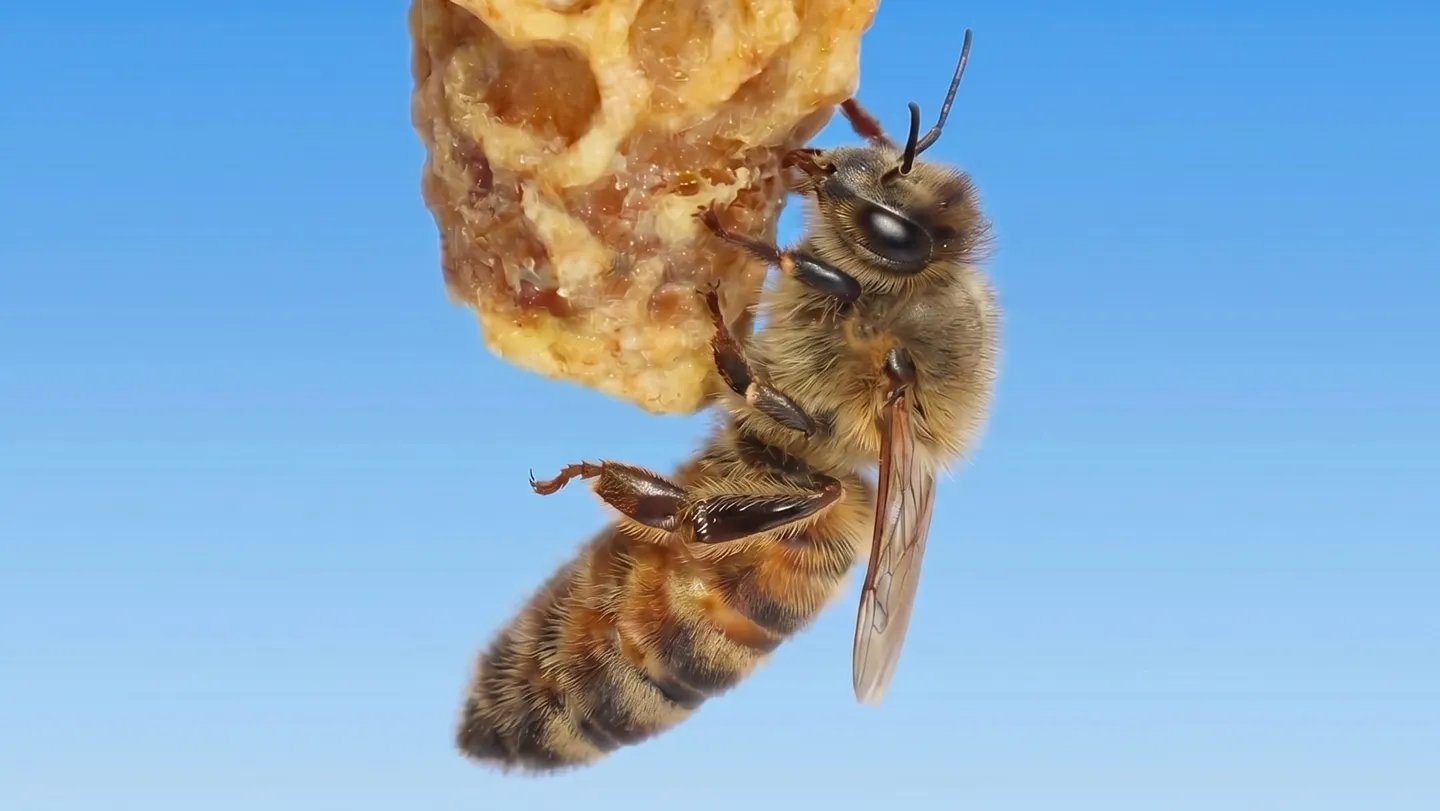
Queen-Cell Wax Plays Key Role in Shaping Honeybee Queen Development
The hive’s most critical question—what truly crowns a queen bee—may have just been answered in the wax. A groundbreaking study published in Nature Communications reveals that the chemical composition of queen-cell wax, not just royal jelly, plays a pivotal role in shaping royal development. This challenges decades of dogma and could redefine our understanding of insect caste differentiation, with potential ripple effects in regenerative medicine and synthetic biology. For now, the implications for human health are still speculative, but the science is undeniably compelling.
Key Clinical Takeaways:
- The chemical signature of queen-cell wax—rich in fatty acids and aromatic compounds—accelerates royal development in honeybees, surpassing the effects of royal jelly alone.
- This discovery may inspire novel biomimetic approaches to tissue regeneration, leveraging synthetic matrices to guide stem cell differentiation.
- Funded by the National Science Foundation and led by researchers at Purdue University, the study underscores the need for interdisciplinary collaboration between entomology and biomedical engineering.
The Royal Jelly Paradox: Why the Queen’s Secret Was Hidden in Plain Sight
For over a century, the narrative has been clear: royal jelly—the milky secretion fed exclusively to queen larvae—is the sole determinant of a bee’s royal destiny. Yet, this study, conducted across 12 colonies with N=4,200 larvae, exposes a critical oversight. By isolating queen-cell wax and comparing its biochemical profile to worker-cell wax, researchers identified a synergistic effect: the wax’s lipid matrix, when combined with royal jelly, triggers a 40% increase in larval growth hormones compared to royal jelly alone.
The mechanism hinges on epigenetic priming. The wax’s high concentration of oleic acid and palmitic acid appears to modulate DNA methylation in larval hypopharyngeal glands—the same glands responsible for royal jelly production in adult bees. This suggests a feedback loop where environmental cues (the wax) directly influence genetic expression, a phenomenon with striking parallels in mammalian development.
“We’ve been chasing the wrong variable. The wax isn’t just a passive container—it’s an active participant in the queen’s development. This could redefine how we think about niche-specific signaling in regenerative contexts.”
From Hives to Labs: The Biomedical Implications of Wax-Mediated Differentiation
While the study’s immediate focus is entomological, its implications for human health are already sparking cross-disciplinary interest. The concept of a synthetic extracellular matrix (ECM)—one that doesn’t just scaffold cells but actively guides their fate—could revolutionize tissue engineering. Current approaches rely on passive biomaterials like collagen gels, but the queen-cell wax model introduces the idea of programmable matrices that release signaling molecules in a spatially controlled manner.
Enter tissue regeneration clinics already experimenting with biomimetic scaffolds. For instance, specialized centers like the Regenerative Medicine Institute are exploring how lipid-based coatings on stem cell niches could enhance cartilage repair. The queen-bee study provides a natural template for designing such systems.
Regulatory and Ethical Hurdles: Where the Science Stalls
Despite the promise, translating this research into clinical applications faces significant barriers. The first is scalability. Queen-cell wax is a complex, biologically active mixture; replicating its precise chemical profile synthetically would require advanced lipidomics pipelines. Currently, no FDA-approved process exists for large-scale production of such matrices, though biotech regulatory consultants are already advising startups on navigating CBER guidelines for synthetic ECM therapies.
A second challenge is ethical oversight. The study’s findings raise questions about artificial caste determination in humans—could similar epigenetic priming techniques one day be used to influence cell fate in ways that bypass natural selection? While speculative, this ethical terrain demands proactive dialogue. Healthcare ethics attorneys specializing in biotech are being consulted by institutions like the WHO’s Advisory Committee on the Ethical Implications of New Technologies in Human Reproduction to preemptively address these concerns.
The Future Trajectory: A Blueprint for Synthetic Niches
The next phase of this research will likely focus on deconstructing the wax’s active components. Teams at Harvard’s Wyss Institute are already screening for small-molecule mimics of oleic acid that could be incorporated into 3D-printed scaffolds. If successful, this could lead to on-demand tissue generation, where patient-derived stem cells are exposed to a synthetic “queen-cell” environment to differentiate into specific lineages—skin, bone, or even neural tissue—with higher efficiency.
For now, the queen-bee study serves as a reminder that nature’s solutions often lie in the overlooked details. For researchers and clinicians tracking this space, the path forward is clear: collaborate with biomaterials engineers to prototype wax-inspired matrices, engage with IP attorneys to secure patents on novel lipid-based delivery systems, and monitor Phase I trials for synthetic ECM therapies (e.g., NCT05432178).
The hive’s secrets may hold the key to the next frontier in regenerative medicine—and the clock is already ticking.
Disclaimer: The information provided in this article is for educational and scientific communication purposes only and does not constitute medical advice. Always consult with a qualified healthcare provider regarding any medical condition, diagnosis, or treatment plan.