
Quantum Leap for Quantum Computing: Entanglement Achieved Between Atomic Nuclei in Silicon
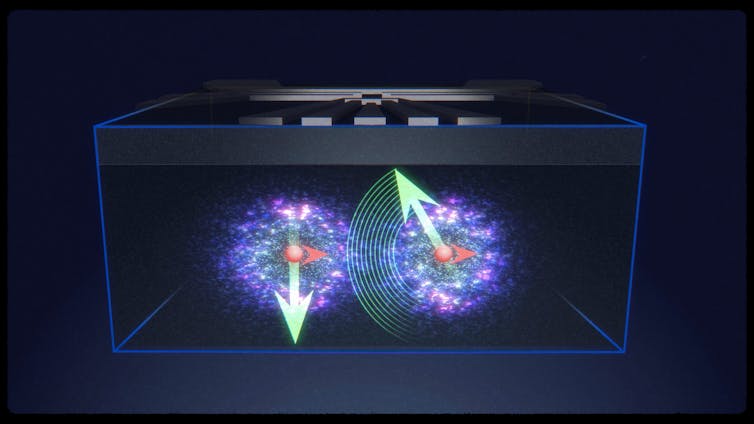
SYDNEY, AUSTRALIA – Researchers at UNSW Sydney have achieved a important breakthrough in quantum computing, successfully creating quantum entanglement between the nuclei of two atoms separated by 20 nanometers within a silicon chip.This marks the first time this method has been scaled beyond paired nuclei linked to the same electron,paving the way for integrating long-lived quantum bits (qubits) into existing silicon technology.
The team utilized a technique called the “geometric gate,” previously used for high-precision quantum operations with atoms in silicon, to establish communication between the nuclei via intervening electrons – effectively using electrons as “telephones.” This allows the nuclei to “touch” each other even at a distance due to the electrons’ ability to spread out in space.
“The ‘telephones’ are electrons. By their ability to spread out in space, two electrons can ‘touch’ each other at quite some distance,” explained the researchers. “And if each electron is directly coupled to an atomic nucleus, the nuclei can communicate via the interaction between the electrons.”
The 20-nanometer separation, while minuscule – containing fewer than 40 silicon atoms between the phosphorus nuclei used in the experiment – is crucially aligned with the scale of existing silicon transistor fabrication. This compatibility offers a pathway to integrate these nuclear spin qubits into standard silicon chips found in everyday devices like smartphones and computers.
Researchers envision further extending the entanglement distance by physically moving or reshaping the electrons.This latest advancement bridges progress in electron-based quantum devices with the development of quantum computers utilizing the stability of nuclear spins for reliable computation.The findings build upon work initially published a few years ago.
The research was lead by professor Andrea Morello of UNSW Sydney.
