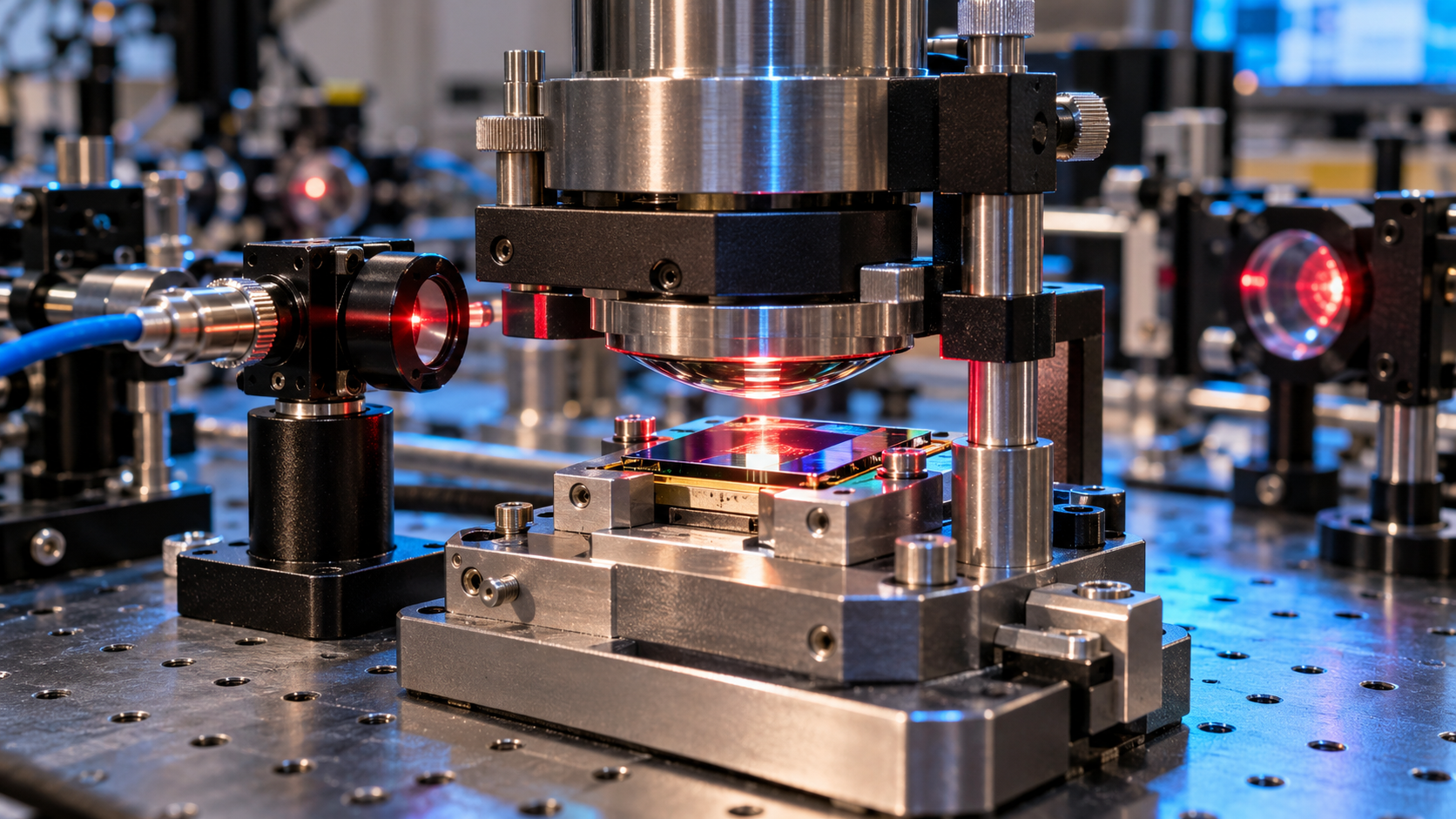
Quantum dot in optical microcavity reaches 90% photon interference visibility
Controlling the exact sequence of photon emissions from a semiconductor quantum dot has pushed quantum photon interference visibility to 90%, according to a physics study. Researchers expected timing jitter from the biexciton cascade to ruin photon coherence, but tuning an open optical microcavity with the Purcell effect successfully decoupled the transitions to produce reliable light particles for quantum communication.
The Tech TL;DR:
- An indium gallium arsenide quantum dot inside an open optical microcavity achieved a raw interference visibility of 90% for the first emitted photon.
- By scanning cavity resonance, researchers altered the lifetime ratio of the biexciton-exciton decay sequence, mitigating the timing jitter that normally caps visibility near 60%.
- Crystal vibrations and inefficient collection of the second photon continue to challenge practical deployments, with the second photon scoring an 80% visibility mark.
Semiconductor Quantum Dots Generate Two-Step Photon Cascades
A quantum dot confines electronic excitations inside a semiconductor, functioning similarly to an artificial atom. Exciting the dot twice forms a biexciton—a bound complex consisting of two electrons and two holes. This complex releases its energy sequentially. First, the biexciton decays into an exciton, emitting a single photon. Next, that remaining exciton decays into the ground state, releasing a second photon. Lead author Timon Baltisberger from the University of Basel explained that this double-excitation decay process generates two distinct photons one after the other. While this biexciton cascade provides a natural pathway for creating entangled photon pairs, the inherent timing linkage between the two emissions introduces obstacles for advanced communication protocols.
Optical Microcavities Tune Transition Lifetimes via the Purcell Effect
To overcome the timing jitter caused by uncertainty in the first emission, Stefan Schumacher and colleagues placed an indium gallium arsenide quantum dot inside an open optical microcavity. One mirror formed an integral part of the semiconductor structure, while a curved upper mirror completed the optical cavity and directed escaping photons toward a collection system. Adjusting the physical distance between these mirrors dynamically tuned the cavity resonance. This tuning selectively accelerated either the first or the second transition through the Purcell effect, which alters an emitter’s radiative decay rate based on its local optical environment. Scanning the cavity resonance tuned the transition lifetimes by two orders of magnitude, matching theoretical predictions within the semiconductor material despite background crystal vibrations.
# Conceptual API representation for cavity resonance tuning
class MicrocavityController:
    def __init__(self, dot_material="InGaAs"):
        self.material = dot_material
        self.cavity_spacing_nm = 0.0

    def tune_resonance(self, target_transition, acceleration_factor):
        if target_transition == "XX_to_X":
            self.cavity_spacing_nm -= acceleration_factor * 0.12
            return f"Purcell enhancement applied to first transition. Ratio optimized."
        elif target_transition == "X_to_ground":
            self.cavity_spacing_nm += acceleration_factor * 0.12
            return f"Purcell enhancement applied to second transition. Ratio widened."
        else:
            raise ValueError("Invalid transition target for quantum dot cascade.")
Interference Visibility Reaches Ninety Percent for First Emissions
Characterizing the emitted photons through two-photon interference revealed a stark contrast depending on which transition the cavity enhanced. When the open microcavity accelerated the first transition, the biexciton-to-exciton photon achieved a raw interference visibility of 90% with an uncertainty of two percentage points. By comparison, the second photon reached 80% visibility with a six-percentage-point uncertainty. Unmodified cascades typically yield a theoretical visibility near 60% due to unfavorable lifetime ratios. However, accelerating the second transition instead of the first produced the opposite outcome, increasing the lifetime ratio and reducing photon coherence. This disparity demonstrates that the choice of which emission to accelerate dictates overall performance, though crystal vibrations and collection inefficiencies for the second photon remain engineering hurdles for practical quantum networks.