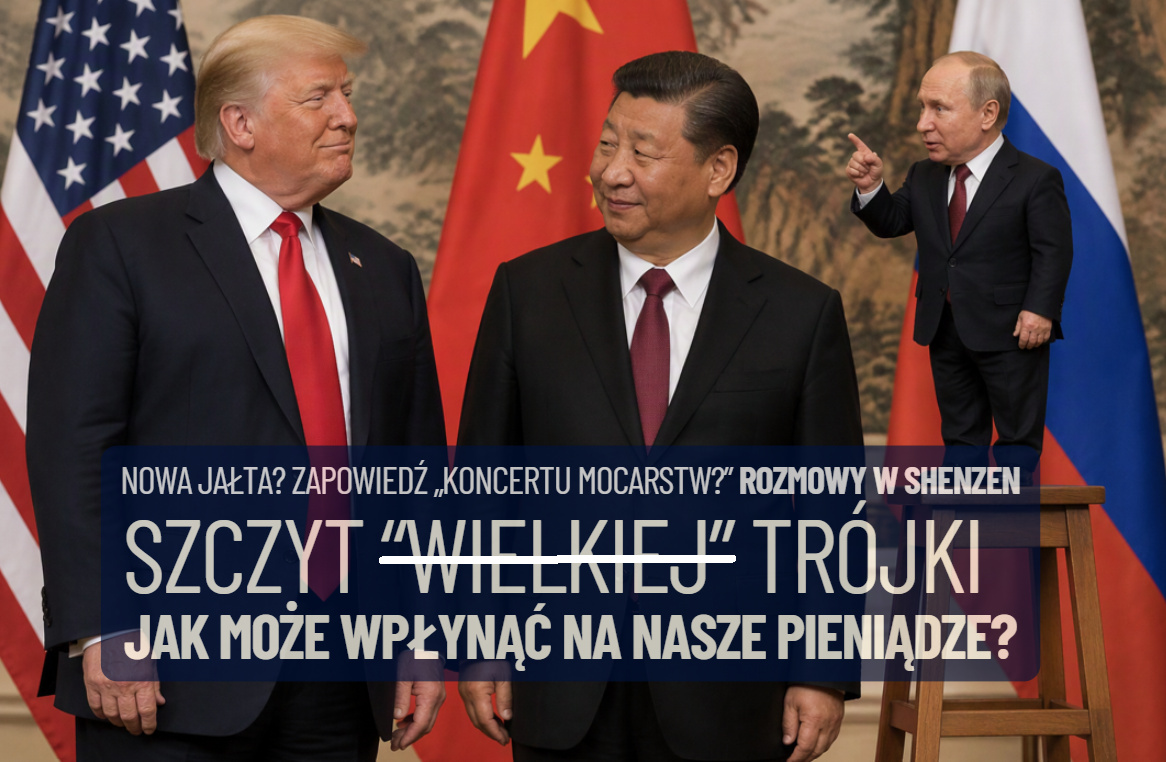
Putin Defends Yalta Conference Comparison Amid Three-Way Summit With Trump and Xi
Russia and China convened in Shenzhen on Thursday for a three-way summit involving Donald Trump and Władimir Putin.
Amid speculation that the meeting mirrored the 1945 Yalta Conference, Putin asserted that historical treaties solidified victory over Nazism, while sharp analysis suggests Putin remains dependent on Chinese support to maintain his geopolitical standing.
The high-stakes gathering in Shenzhen saw the leaders of Russia, China, and the United States meet to discuss global issues, including reforms to the United Nations and the international trade of petroleum products. Russian state media outlets, however, framed the session through the lens of a “new Yalta,” a historical precedent that dictated post-war spheres of influence.
What was bad about the Yalta Conference? — Putin's response when asked about European politicians fearing a 'new Yalta' 'First of all, the Yalta Conference formalized victory over Nazism' 'I think it would be right now to formalize victory over neo-Nazism' https://t.co/1Cqj0FPq76 pic.twitter.com/6VrsYcKudy
Władimir Putin addressed the historical comparison to the 1945 conference during a press availability following the summit, according to TVN24. When questioned by a Russian journalist about whether the current diplomatic climate resembled Yalta, Putin did not dismiss the analogy.
Instead, he turned the query back onto his interlocutors, asking, “What was wrong with Yalta? What was in it that was bad?” Putin said that the Yalta Conference solidified the victory over Nazism, suggesting that current conflicts also require formal recognition of victory over “neo-Nazism.”
He maintained that the conference did not involve splitting the world but rather cementing existing global realities. Putin argued that for eighty years, the world avoided massive global conflicts following those agreements, leading him to question the negativity surrounding the historical event. He further said that the Yalta agreements fostered the conditions necessary for the formation of the United Nations.

The Geopolitical Dynamics of Chinese Support for Russia
Kowal said that the leader of China permitted Putin to attend the meeting because Putin “needed go to it for the internal market.”
Kowal said that while his assessment was “not great,” Putin’s participation was a necessary maneuver for Russian internal politics. He concluded that Putin is not acting independently, pointing out that “China sponsors Russia, that is the state of affairs.” This analysis highlights a critical dependency, asserting that the ongoing conflict in Ukraine would not exist if China did not permit Russia’s current geopolitical actions.
This assessment of Russian internal strength aligns with observations regarding the broader geopolitical chessboard. While Putin attempts to project an image of absolute power in Shenzhen, critics suggest he remains politically vulnerable. Kowal asserted that the Russian leader “wakes up every day terrified” that he might be removed from power.
International Reactions to the “New Yalta” Narratives
The rhetorical framing of the summit has been met with sharp criticism from Western capitals, particularly Kyiv. Andrij Sybiha, the head of Ukrainian diplomacy, released a statement on the X platform responding to Putin’s historical arguments.
Sybiha asserted that Shenzhen was “not the Yalta of Putin’s dreams.” He claimed that Russia had effectively lost its connection to the “real Yalta,” referencing the Ukrainian strikes on the Kerch Bridge, which is vital for Russian troop supply lines.

Sybiha’s statement, published on X, urged Putin to recognize the reality of the conflict. He wrote, “Time for him [Putin] to wake up, look reality in the face, and end the war that he will never win.”
Conversely, while some Russian state media outlets, like Kommiersant, described the event as “historical” and predicting its impact on global security, others provided a more nuanced view. Subiektywnie o finansach said that while Russia seeks to reclaim a dominant role in Europe, its actual economic standing is modest, being an economy reliant on raw material extraction and production.
A new 'Yalta'? Trump and Putin push for a meeting that Xi is wary of hosting https://t.co/k3eHso62df
Russia's Commodity Dominance Amplifies Geopolitical Risk
The rhetoric surrounding the “new Yalta” occurs against a backdrop of significant global economic uncertainty driven by the conflict and shifting alliances. Russia remains a major global supplier of critical commodities, including gold, oil, gas, palladium, nickel, and aluminum. The stability of these supply lines is directly linked to the diplomatic influence held by Beijing and Moscow.
Economists note that while Russia’s overall share of global GDP is small, its influence on global commodity markets is substantial. Any geopolitical volatility stemming from the relationship between the three powers—Trump, Xi, and Putin—immediately impacts global commodity price fluctuations.

China-Russia Dependency Shapes European Security Outlook
The geopolitical maneuvering observed in Shenzhen illustrates the increasing fragmentation of the global order. Even among leaders who appear aligned, such as the Russian and Chinese leadership, the internal pressures and external observations remain constant.
Shenzhen, the setting for the summit, was a largely rural village area as recently as 1979, when it became the first special economic zone of China under Deng Xiaoping’s reform and opening up. Bordering Hong Kong, it has since grown to a population of 18.2 million in 2025, making it China’s third-most-populous city after Shanghai and Beijing.
Known in the media as China’s Silicon Valley, it is home to technology firms such as Huawei, Tencent, DJI and Oppo, and its economy has surpassed those of Hong Kong and neighboring Guangzhou.
The final assessment of this summit remains divided between the historical revisionism of its participants and the pragmatic, security-focused reality of external observers. As Paweł Kowal stated, “we are told that China sponsors Russia, and that is the state of affairs.” This dependency suggests that the future trajectory of European security and global resource stability will depend heavily on the delicate balance maintained between Moscow and Beijing.