
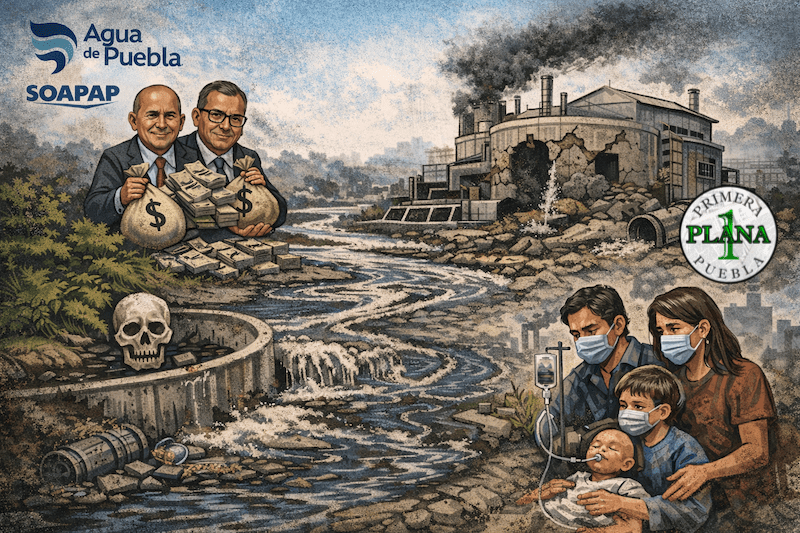
Puebla state authorities are investigating allegations that former officials with Agua de Puebla and the state’s water and sewage operator, SOAPAP, caused over 3 billion pesos (approximately $177 million USD as of February 12, 2026) in damages to public funds through the construction and operation of ineffective wastewater treatment plants along the Atoyac River.
The investigation centers on the tenure of Gustavo Gaytán, who recently stepped down as director of SOAPAP. Initial analyses suggest Gaytán and other former directors benefited from the construction projects whereas failing to adequately oversee the plants, which allegedly collected fees for wastewater treatment services they were not providing. According to reports, the plants were largely non-functional despite significant investment.
The Atoyac River, which flows through both Puebla and Tlaxcala states and empties into the Manuel Ávila Camacho (Valsequillo) reservoir, has long suffered from severe pollution. Studies conducted in 2023 revealed the presence of heavy metals, ammonia, and other toxic residues in the river’s water, posing a public health risk to communities along its course. Despite billions of pesos invested in sanitation projects over previous administrations, the river remained heavily contaminated.
The alleged fraud involved the operation of wastewater treatment plants that were, in effect, “white elephants,” according to a report delivered to the current state administration. One plant, located in San Francisco, was found to be producing toxic foam and failing to adequately treat wastewater, with SOAPAP allegedly failing to report these deficiencies. Another plant, near the BUAP’s Cabrera Barroso preparatory school, was cited for generating open-air pollution and foul odors and was deemed inoperable.
Perhaps the most egregious example of mismanagement cited in the report concerns a planned plant in Santa Ana Xalmimilulco, Huejotzingo. 200 million pesos were reportedly lost due to opposition from local residents, but the federal funds allocated for the project were not returned and the necessary drainage infrastructure was never built, despite the company contracted for the operate having collected payment.
The report indicates that of the ten treatment plants constructed along the Atoyac River between 2013 and 2017, seven are operating below capacity and three have ceased functioning altogether. These projects collectively received 3.5 billion pesos in investment. The seven partially functioning plants are frequently shut down due to high operating costs, exceeding 4 million pesos annually per plant.
The current state government, under Governor Alejandro Armenta Mier, is now undertaking a major effort to rescue the Atoyac River, with a federal investment of 108 million pesos allocated in late 2025. This project includes a technical diagnosis of the river, the construction of biodigesters, and the development of five new wastewater treatment plants in the municipalities of Huejotzingo, San Martín Texmelucan, Calpan, Domingo Arenas, and San Salvador El Verde. Authorities estimate that over 35,000 residents in San Matías Tlalancaleca and Santa Rita Tlahuapan will directly benefit from these new works.
Sergio Salomón Céspedes Peregrina, currently the director of the National Migration Institute, has been a frequent attendee at events led by President Claudia Sheinbaum, fueling speculation that he may be considered for a new role within the federal government, potentially as a successor to Rosa Icela Rodríguez as Secretary of Governance, should Rodríguez pursue a gubernatorial candidacy in San Luis Potosí.
