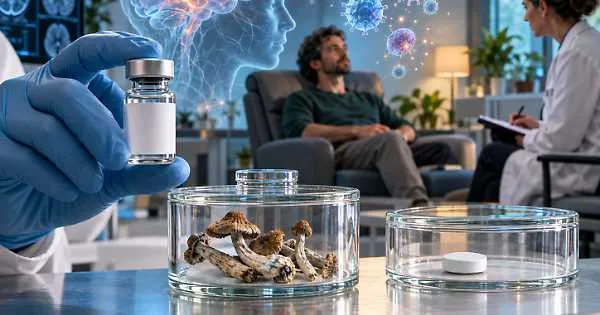
Psychedelics and serotonin receptors: review analyzes 61 studies
Sixty-one published studies crossing cellular, animal, and human experiments show that classic psychedelics interact with peripheral serotonin receptors linked to inflammation, according to a systematic review and meta-analysis published online September 28 in Brain Behavior and Immunity and detailed by Medical Xpress on October 25, 2026. The review evaluates whether substances like psilocybin and LSD influence the cellular signaling pathways driving inflammatory responses outside the central nervous system.
Key Clinical Takeaways:
- A September 2026 review in Brain Behavior and Immunity analyzed 61 studies spanning cellular, animal, and human data to evaluate the anti-inflammatory potential of classic psychedelics.
- While 19 of 24 cellular studies and 25 of 30 animal models demonstrated reductions in pro-inflammatory cytokines, human data remained limited to just 10 trials, with measurable signals emerging in only three.
- Investigators emphasize that psychiatric improvements observed in clinical trials for depression and anxiety do not automatically confirm direct therapeutic efficacy on chronic inflammation.
Systematic Review Analyzes 61 Studies Across Cellular, Animal, and Human Models
The review brings together 24 in vitro studies, 30 animal experiments, and seven human publications reporting data from 10 distinct trials. The analysis categorizes these tiers of evidence separately rather than treating them as equivalent proof. Out of the 24 cellular studies, 19 reported anti-inflammatory effects. Similarly, 25 of the 30 animal models demonstrated reductions in inflammatory markers. However, among the 10 human trials included in the broader evaluation, clear immunological signals emerged in only three.
This distribution highlights a fundamental gap in translational medicine. While experimental models show consistent biological activity, clinical data confirming that these changes translate into real-world reductions of human inflammation remain scarce. Only four human studies were deemed suitable for inclusion in the specific meta-analysis, yielding estimates described as imprecise.
Preclinical Data Demonstrate Reduced Pro-inflammatory Cytokines in Animal Models
The quantitative portion of the review evaluated 18 studies examining mice and other murine models. In subjects where baseline inflammation was experimentally elevated, researchers observed a marked decrease in pro-inflammatory cytokines, which serve as chemical messengers coordinating immune activity. By contrast, healthy animal models did not exhibit a statistically significant change in these markers following administration.
Serotonin Receptors Bridge Neural Activity and Immune Signaling Pathways
The biological rationale connecting psychedelics to inflammation centers on serotonin receptors located outside the brain. Serotonin acts as a chemical messenger influencing functions beyond mood regulation by binding to specialized receptor proteins on cell surfaces. The 5-HT2A receptor subtype is particularly significant in this context. Activating this receptor within neural circuits alters perception, while engaging identical receptors on peripheral cells triggers distinct physiological responses.
Historical laboratory investigations illustrate this receptor mechanism. A 2008 study demonstrated that activating 5-HT2A receptors in rat aortic smooth muscle cell cultures attenuated responses induced by tumor necrosis factor alpha (TNF-alpha), a prominent protein involved in inflammation. The investigators utilized DOI, an experimental compound distinct from both LSD and psilocybin, which acts as a receptor agonist. Subsequent research published in PLOS ONE in 2013 extended these observations to animal models, showing that DOI counteracted TNF-alpha activity in the aorta and intestines while reducing interleukin-6 levels in the blood.
Despite these controlled laboratory findings, investigators stress that suppressing a signaling pathway in an in vitro or animal model does not equate to treating an autoimmune condition or resolving clinical disease in humans.
Clinical Trial Data Focus Separately on Psychiatric Outcomes
Disclaimer: The information provided in this article is for educational and scientific communication purposes only and does not constitute medical advice. Always consult with a qualified healthcare provider regarding any medical condition, diagnosis, or treatment plan.