Programmable Functional RNA Design Achieved With Virtual Scientist
RNA design has long been a screen-and-pray exercise.
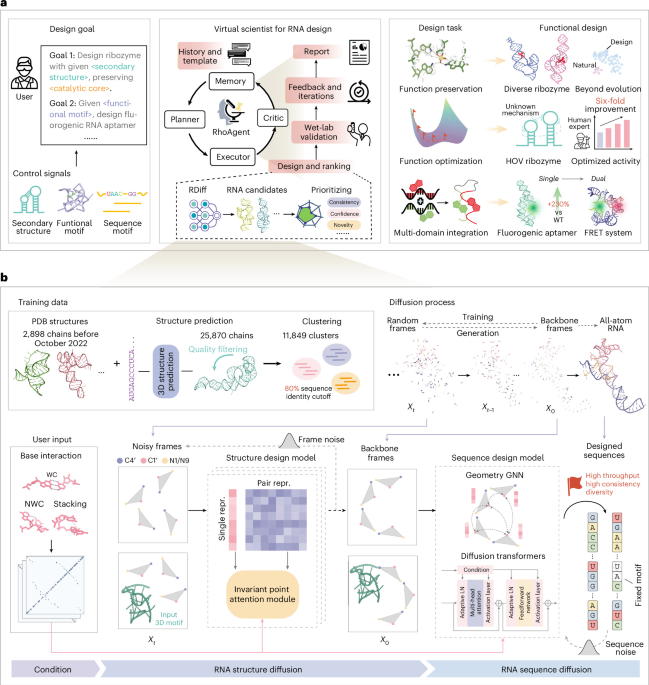
A team reporting in Nature this month says it built a “virtual scientist” that designs functional RNA molecules programmatically, testing at most 20 candidates per task — Nature reported the work as programmable functional RNA design with a virtual scientist, publication dated 2026.
The underlying model, called RNAverse, is described in a bioRxiv preprint from the same effort as a multimodal generative system trained on RNA sequences, experimental structural probing profiles and functional annotations. Its authors claim state-of-the-art results across 16 predictive modeling tasks and generative design spanning four distinct RNA classes.
That pairing — a paper with supporting code on Zenodo, and a preprint carrying the experimental meat — is now the reference point for anyone trying to allocate capital into the RNA technology sector.
The core problem RNAverse attacks is the coupling between RNA sequence, structure and function. Computational biologists have spent two decades building pieces of this stack: the ViennaRNA package for secondary-structure folding (2011), NUPACK for nucleic acid design, generative aptamer tools such as RaptGen in 2022, and deep generative design of RNA family sequences in 2024.
The bioRxiv preprint describes RNAverse as learning what its authors call a conditionable design grammar from those three data modalities, letting it invert prediction into generation.
Three design regimes come out of that inversion, per the preprint. Zero-shot in-painting produced small nucleolar RNAs that promote premature termination codon readthrough, and chimeric aptazymes for ligand-controlled gene regulation — both exceeding rational design or large-scale screens, the authors report.
Fine-tuned in-painting extended to an unseen functional class, yielding IGFBP3-binding aptamers with picomolar affinity that outperform SELEX winners, the classic decade-long in-vitro evolution protocol dating to Ellington and Szostak’s 1990 Nature paper.
The third regime may matter most commercially. Iterative optimization engineered 5′ untranslated regions that, according to the preprint, outperform clinical benchmarks — raising protein production in cell-based assays for both the Zolgensma gene therapy and the BNT162b2 COVID-19 vaccine, and boosting antibody responses to BNT162b2 in mice.
The constraint worth pricing in is experimental: no more than 20 candidates tested per task, the preprint states. That is the pitch — compress the design-build-test cycle that has made RNA drug discovery a throughput business. It also explains why the work lands now. Agentic systems have been arriving alongside — including Co-Scientist, described in Nature in 2026. RNAverse positions itself in that lineage as the RNA-specific design layer.
If a generative system can specify functional RNA to order, the bottleneck shifts to validation capacity, scale-up and intellectual property — the preprint’s competing-interest statement discloses co-founder and AI-director roles at Xungene Therapeutics and patents filed by Tsinghua University covering the methods, reagents and data. Funding for the research came from China’s National Natural Science Foundation, Tsinghua University programs and the New Cornerstone Science Foundation, per the preprint’s declarations.
The open question is reproducibility outside the originating lab. The supporting code sits on Zenodo under a 2026 DOI, and the Zolgensma and BNT162b2 benchmarks set the bar the next entrant has to clear.